Tamil Nadu never narrowed its ration system to the poor when the national food law arrived. Running a universal public distribution system costs the state its own rice, its own money and a network of nearly 37,000 shops.
The numbers
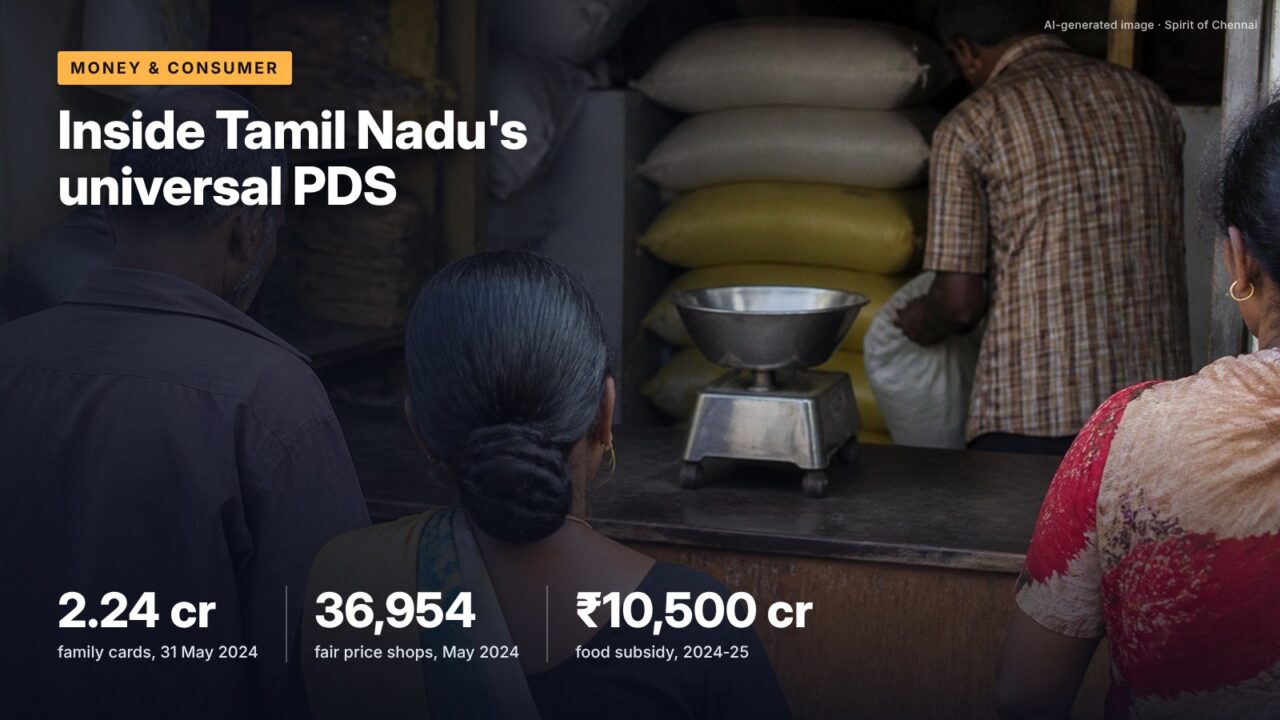
Every family card in Tamil Nadu, rich or poor, can draw rice at the ration shop. The state’s Food and Consumer Protection policy note for 2024-25 counts 2,24,13,920 family cards as on 31 May 2024 and says the state has run a universal public distribution system (PDS) for about 50 years. When the National Food Security Act, 2013 (NFSA) came into force here on 1 November 2016, the state kept its older entitlements, or 5 kg per member, whichever is higher, free of cost.
That choice has a price. The Centre’s NFSA allocation covers only priority households and the poorest Antyodaya families, plus a fixed ‘tide-over’ quantity. Everything else, including rice for about 1.05 crore non-priority cards, the subsidised dal and palm oil, and the cost of keeping the shops open, falls on the state budget.
The five kinds of family card
| Card category | What it means | Cards, 31 May 2024 |
|---|---|---|
| PHH | Priority household under NFSA | 95,81,846 |
| PHH-AAY | Antyodaya Anna Yojana, poorest households | 18,64,099 |
| NPHH | Non-priority household, rice option | 1,05,22,987 |
| NPHH-S | Non-priority, sugar instead of rice | 3,80,280 |
| NPHH-NC | Non-priority, no commodity (identity use only) | 64,708 |
| Total | 2,24,13,920 |
Source: Government of Tamil Nadu, Food and Consumer Protection Department Policy Note 2024-25, Demand No. 13
The split is the heart of the system. Priority and Antyodaya cards together, 1.14 crore, are the NFSA households for which the Centre supplies grain. The 1.05 crore NPHH cards are Tamil Nadu’s own addition. Rice is free for PHH and AAY cards; the policy note describes the NPHH rice allotment of one lakh tonnes a month as fully borne by the state.
Where the rice comes from
The Government of India allocates 2,97,033.30 tonnes of rice a month to Tamil Nadu: 62,477.66 tonnes for AAY, 1,42,476.91 tonnes for priority households and 92,078.73 tonnes of tide-over rice, which the Centre supplies at ₹8.30 a kg. Average monthly offtake from ration shops is about 3.63 lakh tonnes. Dividing one by the other, central allocation covers roughly 82% of what Tamil Nadu’s cardholders actually take; the state finds the rest.
The policy note itself gives two figures for how: a one-lakh-tonne state allotment for NPHH cards, and, in its Civil Supplies Corporation section, purchases of 61,500 tonnes from NCCF under the Open Market Sale Scheme. It does not reconcile them, and readers should treat the exact state-bought quantity as uncertain.
Share of Tamil Nadu’s average monthly ration rice offtake (3.63 lakh tonnes) covered by the Centre’s 2.97 lakh tonne allocation, calculated from the state policy note, 2024-25.
Offtake over five years
| Year | Rice (tonnes) | Sugar (tonnes) | Wheat (tonnes) | Kerosene (kilolitres) |
|---|---|---|---|---|
| 2019 | 38,39,968 | 3,66,699 | 1,60,369 | 1,60,894 |
| 2020 | 39,28,257 | 3,62,783 | 2,23,167 | 1,29,348 |
| 2021 | 37,54,711 | 3,53,204 | 3,52,693 | 1,00,083 |
| 2022 | 35,24,350 | 3,53,394 | 2,52,530 | 63,179 |
Source: Department of Economics and Statistics, Statistical Hand Book of Tamil Nadu 2022-23, Civil Supplies, offtake of essential commodities (calendar years; 2019-21 rice includes AAY and Annapoorna)
Three movements stand out in the state statistical handbook. Rice offtake peaked in the pandemic year of 2020 and has eased since. Wheat, given free in lieu of rice, more than doubled between 2019 and 2021, then fell back. And kerosene collapsed: 63,179 kilolitres in 2022 against 1,60,894 in 2019, a fall of 61% in three years; the handbook does not give reasons.
It’s often said free rice in Tamil Nadu is only for families below the poverty line.
The record shows Non-priority (NPHH) cards also draw rice. The state supplies that grain from its own allotment and pays for it, which is what makes Tamil Nadu’s PDS universal rather than targeted.
What else the subsidy pays for
The ₹10,500 crore food subsidy provision for 2024-25 covers more than rice. Under the special PDS, about 20,000 tonnes of tur dal a month are sold at ₹30 a kg, one kg per card, and about 2 crore litres of palmolein at ₹25 a litre. The difference between purchase cost and these prices is met from the food subsidy; the policy note does not give the purchase cost. Sugar is sold at ₹13.50 a kg to AAY cards and ₹25 to others, with 34,066 tonnes taken off each month against a requirement of 34,104. Wheat is free in lieu of rice, 10 kg a card in Chennai city and district headquarters and 5 kg elsewhere.
For context, the PRS State of State Finances 2025 put Tamil Nadu’s total subsidies at 14% of revenue receipts in 2023-24, and PRS’s 2026-27 budget analysis puts the state’s committed spending on salaries, pensions and interest at 61% of revenue receipts. The CAG’s 2024-25 audit of state finances found interest and subsidies together took about 34% of revenue spending. The food subsidy competes for what is left.
The shop network and Chennai
Cooperative societies run 34,848 of the 36,954 fair price shops; the Civil Supplies Corporation runs 1,505 and women’s self-help groups 440. Of the total, 26,502 are full-time and 10,452 part-time. In Chennai, the handbook counts 1,774 full-time and 12 part-time shops across the North and South civil supplies districts as on 31 March 2023, almost all full-time because of card density.
The system’s integrity checks are digital. The policy note reports 99.42% of the card database seeded with Aadhaar and a biometric authentication success rate of about 98.5% a month, with smart cards read by QR code at the point-of-sale device.
How the card type changes the basket
Card category decides more than rice. Under the 2024-25 policy note, rice-option cards get 500 g of sugar per head a month up to 2 kg, while sugar-option (NPHH-S) cards get 500 g per head plus 3 kg extra, up to 5 kg, in place of rice. Wheat follows the NFSA line: the Centre allocates 8,576.03 tonnes a month for priority and Antyodaya cards only, and the state tops this up with open-market purchases, which the note records in two unreconciled figures, 8,500 tonnes from NCCF and 15,000 tonnes under the Open Market Sale Scheme.
What this means for you
- An NPHH card in Chennai still entitles the family to rice; the card category decides price and quantity, not eligibility to buy.
- If you rarely use the ration shop, the NPHH-NC ‘no commodity’ card exists; 64,708 families had chosen it by May 2024.
- Wheat is free in place of rice, and Chennai cards get the higher 10 kg allowance.
- Biometric failures happen in about 1.5% of monthly transactions; ask the shop about the alternative authentication route rather than leaving without stock.
What to watch
Pending
The next food policy note, which will update card counts, the state’s own rice purchases and the food subsidy provision under the new government.
Pending
Any change in central tide-over allocations or prices, which would shift more of the rice cost onto the state.
Checked against official sources on 23 October 2026. Figures and rules change; confirm on the linked official pages before relying on them.
Sources
- Food and Consumer Protection Department Policy Note 2024-25, Demand No. 13 (Government of Tamil Nadu)
- Statistical Hand Book of Tamil Nadu 2022-23: Civil Supplies (Department of Economics and Statistics, Tamil Nadu)
- State of State Finances 2025 (PRS Legislative Research, 2025)
- Tamil Nadu Budget Analysis 2026-27 (PRS Legislative Research, August 2026)
- State Finances Audit Report, Tamil Nadu, 2024-25: Executive Summary (Comptroller and Auditor General of India, 2026)