Tamil Nadu’s temples own more than a thousand wooden cars. What the HR&CE record shows about their number, the cost of renewing them, and the safety gap exposed in 2022.
The numbers
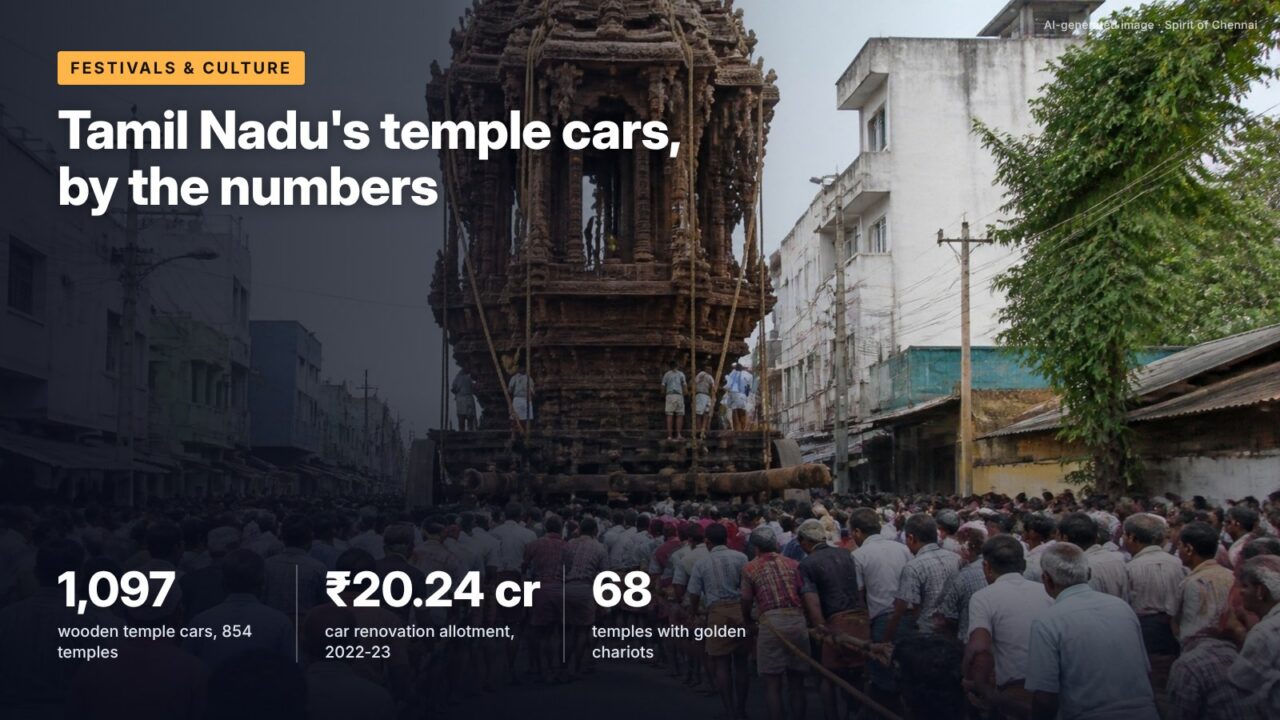
Tamil Nadu’s temples own 1,097 wooden temple cars, the giant chariots pulled through the streets at festival time, spread across 854 temples. That is the count in the Hindu Religious and Charitable Endowments (HR&CE) Department’s 2023-24 and 2024-25 policy notes, up from 989 cars in 809 temples in the 2021-22 note. The notes do not explain the increase of 108 cars in two years, and they do not report that many new cars being built.
Keeping them roadworthy is costly. The department allotted ₹20.24 crore in 2022-23 to renovate 34 wooden cars belonging to 32 temples, and ₹12.89 crore in 2023-24 for 22 cars in 19 temples. That works out to roughly ₹59 lakh a car, and covers about one in twenty of the state’s cars over two years.
What the department owns
| Item | 2021-22 note | 2023-24 note | 2024-25 note |
|---|---|---|---|
| Wooden cars | 989 in 809 temples | 1,097 in 854 temples | 1,097 in 854 temples |
| Temples with golden chariots | 65 | 68 | 68 |
| Temples with silver chariots | 49 | 57 | 55 |
| Wooden car renovation allotment | not stated | ₹20.24 cr, 34 cars (2022-23) | ₹12.89 cr, 22 cars (2023-24) |
Source: HR&CE Department policy notes 2021-22, 2023-24 and 2024-25, Govt of Tamil Nadu
The silver chariot count falls from 57 to 55 between the two latest notes without explanation, a reminder that these inventories are compiled from temple returns and are not audited figures. The largest car on the list is the Aazhi Ther of the Thiyagaraja Swamy temple at Tiruvarur, which every note describes as the biggest temple car in Asia.
How a car is built or rebuilt
A temple car is a wooden structure on a wheeled base, carved to the rules of the Shilpa Sastra, and topped for festivals with a tall cloth and bamboo superstructure. New cars and major renovations go through two layers of approval. A Drawing Committee scrutinises the drawings for new temple cars and rajagopurams; the 2024-25 note cites G.O. (Ms) No. 169 of 16 March 2024 for its role. Inside the department, the HR&CE’s RTI handbook assigns “works related to renovation of temple cars” to the Joint Commissioner (Verification).
Golden and silver chariots
Silver and gold chariots are built differently, by plating a wooden frame. The 2023-24 note gives the detail for two silver chariots then under construction: about 277.5 kg of silver for the Kalikambal Kamadeswarar temple in Chennai, estimated at ₹2.17 crore, and about 301.6 kg for the Mariamman temple at Irukkankudi, estimated at ₹2.29 crore and built by Poompuhar, the state handicrafts corporation. A further ₹7 crore was announced in 2022-23 for silver chariots at Tiruttani and Thirukarukavoor; the 2024-25 note says the Tiruttani chariot is complete and in use. Nine golden chariots were returned to procession after inspection between January 2021 and November 2022.
Average renovation allotment per wooden car in 2022-23, from ₹20.24 crore for 34 cars in the HR&CE policy note 2023-24.
It’s often said every temple car is regularly renovated with government money.
The record shows The policy notes record renovation allotments for 56 wooden cars across 2022-23 and 2023-24, about 5 per cent of the 1,097 cars. The notes do not record state renovation allotments for the other cars in those years.
Safety: the lesson of Kalimedu
The risk in a car festival is not only mechanical. On the night of 27 April 2022, a temple car procession at Kalimedu village near Thanjavur came into contact with live power lines. A Raj Bhavan press release that day recorded 11 deaths and about 15 people injured. The tall superstructure of a decorated car can rise well above the height of street wiring, and the car is pushed and steered by crowds who cannot easily stop it.
The policy notes opened for this article do not describe a written statewide safety protocol for car festivals. What they show is general temple security: 2,064 CCTV cameras in 48 senior-grade temples, watched from a control room at the Commissioner’s office, and sections on fire safety and a temple protection force. In practice car festival safety rests on coordination at district level between the temple executive officer, police, the electricity distributor and the local body: route inspection, trimming or lifting cables, switching off supply along the route, and controlling the crowd at turns. The department’s RTI handbook also shows that permission for extra festival hundials, the donation boxes set up for the crowds, is given by Additional Commissioners.
Why the cars matter to the festival calendar
Cars are concentrated in a small group of temples. The HR&CE Department oversees 46,159 institutions, including 43,631 temples, so the 854 temples with wooden cars are about 2 per cent of them. The department’s income from temple land leases, ₹310.32 crore collected between July 2023 and March 2024 according to the 2024-25 note, is part of what keeps those temples, and their festivals, going.
The car festival is usually the climax of a temple’s annual brahmotsavam, and a car out of service can mean a festival is truncated for years. The department’s wider renewal programme gives the context: 1,775 temples consecrated after thiruppani (renovation) between the government taking charge in 2021 and 12 June 2024, an annual ₹6 crore grant for heritage temple thiruppani, and a ₹100 crore special grant for temples more than 1,000 years old. Car renovation is a small slice of that spending, but it is the part most residents see on the street.
What this means for you
- If a car festival passes your street, expect power cuts along the route and keep vehicles off it from the afternoon.
- Keep children clear of the ropes and the wheels at turns, where crowd control is hardest.
- Concerns about cables or encroachments on a car route can be raised with the temple executive officer and the electricity section office in advance.
- Renovation status of a specific temple car can be sought from the HR&CE Joint Commissioner under the RTI Act.
What to watch
Pending
Completion of the silver chariot at Thirukarukavoor and the 22 wooden car renovations funded in 2023-24, which the 2024-25 note listed as in progress.
Pending
The 2026-27 HR&CE policy note, which should update the car inventory and renovation allotments.
Checked against official sources on 23 October 2026. Figures and rules change; confirm on the linked official pages before relying on them.
Sources
- HR&CE Department Policy Note 2024-25 (Govt of Tamil Nadu)
- HR&CE Department Policy Note 2023-24 (Govt of Tamil Nadu)
- HR&CE Department Policy Note 2021-22 (Govt of Tamil Nadu)
- Handbook under RTI Act, Office of the Commissioner, HR&CE (Govt of Tamil Nadu)
- Governor’s condolence on Kalimedu temple car accident, Press Release No. 46, 27 Apr 2022 (Raj Bhavan, Chennai)