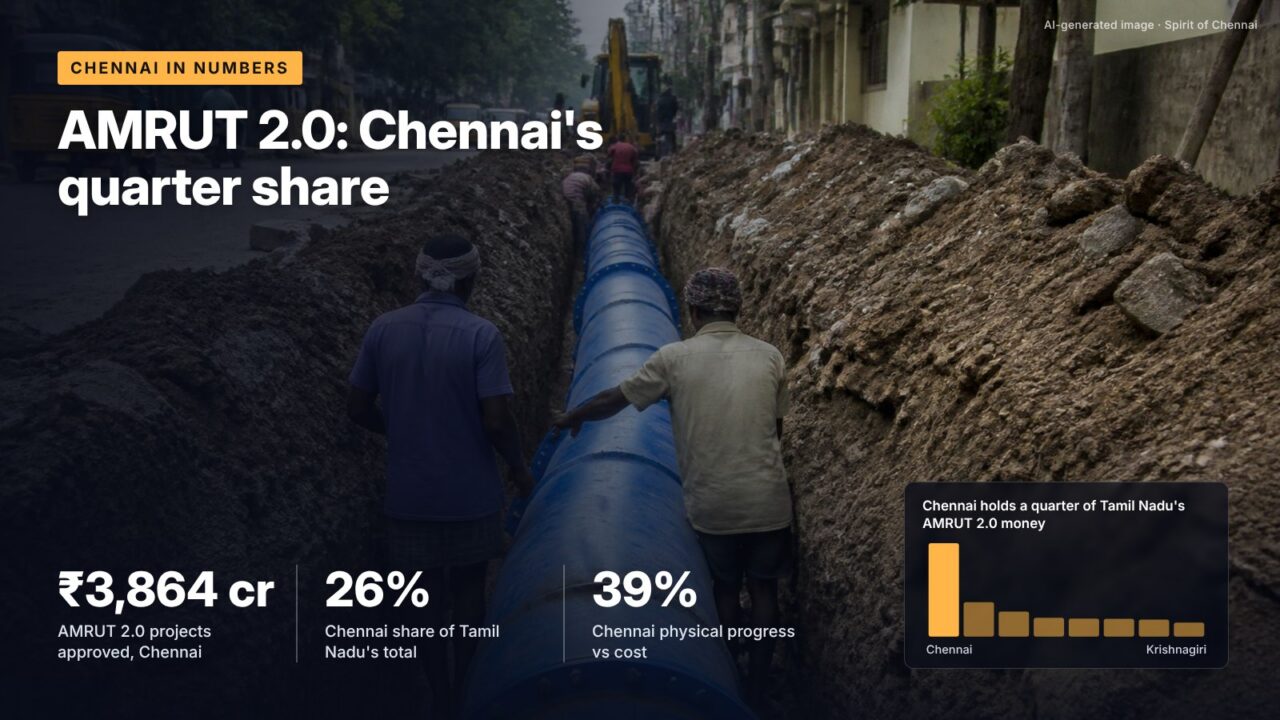
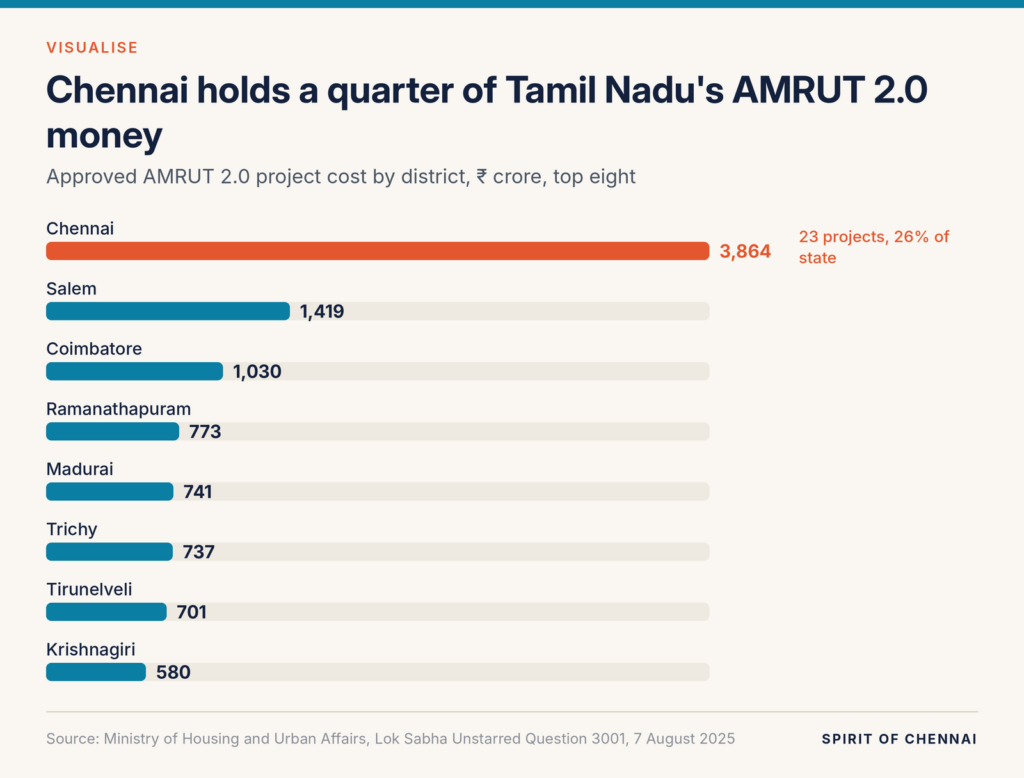
A quarter of the money for AMRUT 2.0 water and sewer projects in Tamil Nadu is earmarked for Chennai. Its 23 projects are large, slow and far behind the state average on physical progress.
The numbers
Chennai district has 23 approved projects worth ₹3,864.01 crore under AMRUT 2.0, the Union government’s urban water and sewerage mission, out of 1,270 projects worth ₹14,687.83 crore in Tamil Nadu, according to a Lok Sabha answer of 7 August 2025. That is 26.3% of the state’s approved project value in a single district.
Progress is slower. Works worth ₹1,505.48 crore had been physically completed in Chennai, 39% of the approved cost, against ₹7,645.06 crore statewide, or 52%. Measured against the cost of projects that have actually started, Chennai was at 47% and the state at 58%.
The reason is mostly scale. The average Chennai project is worth about ₹168 crore, ₹3,864 crore divided by 23. The state average is about ₹11.6 crore. Large sewerage and water projects in a dense city take longer to build than a town’s water tank or park.
What AMRUT 2.0 pays for
The Atal Mission for Rejuvenation and Urban Transformation 2.0 was launched on 1 October 2021 with a total indicative outlay of ₹2,77,000 crore, including central assistance of ₹76,760 crore over five years, according to a February 2025 answer. It covers 666 urban local bodies in Tamil Nadu. Central money is committed to each state, released in instalments and tracked through utilisation certificates.
Tamil Nadu’s numbers in that answer show how far behind the money lags the approvals. Of ₹4,942 crore in committed central assistance, ₹1,614.93 crore, or 33%, had been released, and utilisation certificates had been received for ₹819.45 crore. Nationally, ₹11,785.20 crore of ₹66,750 crore had been released, under 18%. The same answer gives the five-year central figure as ₹76,760 crore in its text and ₹66,750 crore in its annexure without reconciling the two.
Committed central assistance for Tamil Nadu (₹4,942 crore) as a share of approved AMRUT 2.0 project cost (₹14,687.83 crore); the rest falls on the state and local bodies (LS 1518, LS 3001).
District by district
| District | Approved projects | Approved cost, ₹ cr | Grounded cost, ₹ cr | Physical progress, ₹ cr |
|---|---|---|---|---|
| Chennai | 23 | 3,864.01 | 3,199.62 | 1,505.48 |
| Salem | 60 | 1,419.48 | 303.73 | 120.93 |
| Coimbatore | 80 | 1,029.62 | 724.01 | 492.91 |
| Ramanathapuram | 32 | 772.68 | 776.80 | 413.39 |
| Madurai | 27 | 740.87 | 603.48 | 89.83 |
| Trichy | 37 | 736.63 | 828.51 | 392.74 |
| Tirunelveli | 81 | 700.51 | 710.65 | 511.72 |
| Thiruvallur | 34 | 413.99 | 364.27 | 226.88 |
| Kancheepuram | 59 | 146.10 | 157.60 | 101.18 |
| Tamil Nadu (32 districts) | 1,270 | 14,687.83 | 13,082.28 | 7,645.06 |
Source: Ministry of Housing and Urban Affairs, Lok Sabha Unstarred Question 3001, 7 August 2025, annexure as reported by the state on the AMRUT 2.0 portal
Approved cost and grounded cost measure different stages. A project is approved when it is cleared for funding; it is grounded when work begins; physical progress is the value of work actually done on the ground. The gap between the first and the last is where delays show.
The slow and the stalled
Salem is the other outlier: ₹1,419.48 crore approved but only ₹303.73 crore grounded, meaning most of its value had not reached the start of work. Madurai had ₹603.48 crore grounded but only ₹89.83 crore of physical progress. In some districts the grounded cost exceeds the approved cost, which usually reflects revised estimates after tendering.
The annexure uses the older list of 32 districts, so newer districts such as Chengalpattu do not appear separately; their towns are counted under the parent district. Chennai’s neighbours on that list, Thiruvallur and Kancheepuram, have ₹414 crore and ₹146 crore of projects.
What the first AMRUT delivered
The first AMRUT mission is the base Chennai’s new projects build on. A February 2025 answer gives Tamil Nadu’s results with convergence from other schemes: 16,06,924 new household tap connections against a target of 16,15,641, and 25,20,304 new sewer connections against a target of 27,04,442. Tamil Nadu accounted for about 26% of the 95,36,156 new sewer connections reported nationally, well above its share of India’s population. It reported no households under septage management, a separate route some states used for areas without sewers.
For comparison, Chennai’s whole Smart Cities Mission programme was worth ₹1,104 crore by March 2025 (LS 5515), and the city had been released ₹1,058.58 crore under it by November 2023 (LS 834). AMRUT 2.0 is the larger programme for the city by a wide margin.
Tamil Nadu in the national programme
Nationally, 8,887 AMRUT 2.0 projects worth ₹1,89,188 crore, including operation and maintenance, had been approved by 27 January 2025, according to the February 2025 answer. Contracts had been awarded for 5,383 projects worth ₹92,284.01 crore, tenders issued for 820 more worth ₹28,588.19 crore, and works worth ₹27,183.78 crore physically completed, with expenditure of ₹20,834.92 crore. Because the Tamil Nadu district table is from August 2025, the two cannot be divided neatly, but Tamil Nadu’s approved value works out to about 8% of the national figure.
The same answer gives a constituency-level example from the state: in the Karur parliamentary constituency, 99 projects worth ₹826.42 crore had been approved, contracts awarded for all of them, and works worth ₹499.75 crore physically completed, a pace well ahead of Chennai’s. Under the first AMRUT, Tamil Nadu’s 16,06,924 new tap connections were about 11% of the national total of 1,43,65,771.
It’s often said Chennai gets a share of urban mission money roughly in line with its population.
The record shows For AMRUT 2.0, Chennai district’s 23 projects make up 26.3% of the approved project value in Tamil Nadu, while its physical progress is 39% of cost against 52% for the state, per the Lok Sabha answer of 7 August 2025.
What this means for you
- If your street is being dug up for a sewer or water main, the work is likely part of a large AMRUT 2.0 package; Metro Water’s zone office can name the project and contractor.
- Approved cost is not money spent; physical progress is the better guide to how close a project is to finishing.
- Central releases are a third of committed assistance for Tamil Nadu, so the pace of state funding matters as much as Delhi’s.
- New household connections built under AMRUT still need an application and connection charges paid to Metro Water.
What to watch
Pending
The end of AMRUT 2.0’s five-year central assistance period counted from its October 2021 launch, and whether the mission is extended.
Pending
The next state-wise release figures in Parliament, which will show whether Tamil Nadu’s share of central assistance released has risen from 33%.
Checked against official sources on 23 October 2026. Figures and rules change; confirm on the linked official pages before relying on them.
Sources
- Lok Sabha Unstarred Question 3001, Projects covered under AMRUT 2.0 in Tamil Nadu, 07.08.2025 (MoHUA)
- Lok Sabha Unstarred Question 1518, AMRUT scheme in Tamil Nadu, 13.02.2025 (MoHUA)
- Lok Sabha Unstarred Question 1483, Impact of AMRUT on improving urban infrastructure, 13.02.2025 (MoHUA)
- Lok Sabha Unstarred Question 5515, Smart City projects under SCM, 03.04.2025 (MoHUA)
- Lok Sabha Unstarred Question 834, Salient features of Smart Cities Mission, 07.12.2023 (MoHUA)