Chennai’s suburban trains share tracks with express and goods trains, and every extra pair of lines buys timetable space. A look at what has been built, what is still under way, and why a 4.3 km stretch became the network’s bottleneck.
The numbers
The capacity of a suburban network is set less by trains than by tracks. On the Chennai Beach to Tambaram and Chengalpattu corridor, electric multiple unit (EMU) locals share space with long-distance trains unless they have their own pair of lines. Each new third or fourth line separates traffic, allows more frequent locals and stops one late express from delaying a dozen local trains behind it.
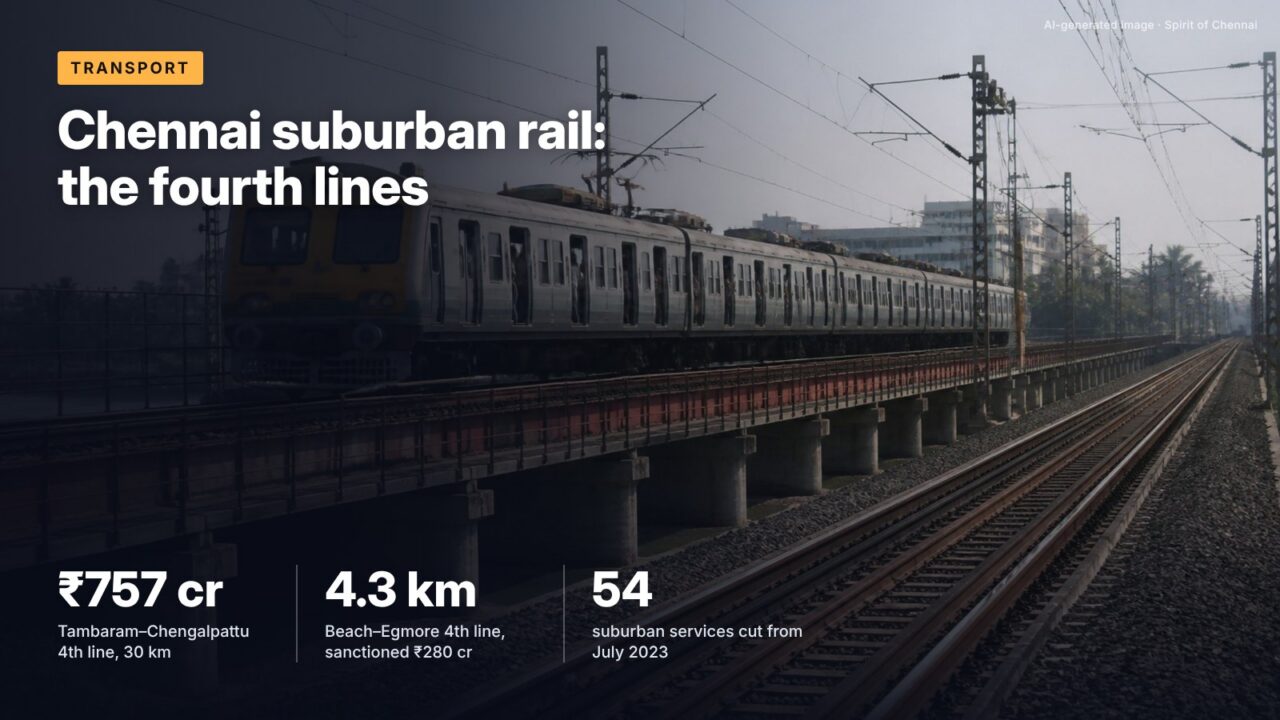
The clearest recent example of the problem is 4.3 km long. The Chennai Beach to Chennai Egmore fourth line, sanctioned at ₹280 crore, was delayed by slow land acquisition, and the delay held up the restoration of suburban services, the Railway Minister told the Lok Sabha on 24 July 2024. The question that prompted the answer referred to 54 suburban services reduced from 14 July 2023 on the Tiruvallur, Velachery and Chengalpattu sections.
The Beach–Egmore bottleneck
The 2024 reply laid out the numbers. The project had an allocation of ₹143.6 crore for 2024-25 and expenditure of ₹167.5 crore up to March 2024. It needed 0.51 hectares of land, of which 0.33 hectares had been acquired, leaving about 0.18 hectares. The reply listed general causes of project delay including state land acquisition, forest clearances, utility shifting and the number of working months lost to weather, and said the state government had been asked to speed up land acquisition.
By March 2026 the government listed “Chennai Beach–Chennai Egmore doubling”, 4 km at ₹272 crore, among completed works in Tamil Nadu, in a Rajya Sabha reply summarised by PIB. The two documents use different labels and slightly different costs; the 2026 list does not use the term fourth line.
What has been built and what is under way
| Work | Length | Cost | Status (March 2026) |
|---|---|---|---|
| Chennai Beach–Korukkupet 3rd line | 5 km | ₹168 crore | Completed |
| Chennai Beach–Attipattu 4th line | 22 km | ₹293 crore | Completed |
| Chennai Beach–Chennai Egmore doubling | 4 km | ₹272 crore | Completed |
| Tiruvallur–Arakkonam 4th line | 27 km | ₹83 crore | Completed |
| Tambaram–Chengalpattu and Chengalpattu–Villupuram 3rd line | 133 km | ₹1,122 crore | Completed |
| Tambaram–Chengalpattu 4th line | 30 km | ₹757 crore | Ongoing |
| Perambur–Ambattur 5th and 6th lines | 6 km | ₹178 crore | Ongoing |
| Attipattu–Gummidipundi 3rd and 4th lines | 23 km | ₹375 crore | Ongoing |
| Arakkonam yard 3rd and 4th lines | 6 km | ₹98 crore | Ongoing |
Source: Press Information Bureau, Rajya Sabha reply on Tamil Nadu railway projects, 13 March 2026
Read together, the list shows where suburban capacity is being added. The northern line toward Gummidipundi is being quadrupled in stages, the western line gets fifth and sixth lines at its busiest inner section near Perambur, and the southern line toward Chengalpattu, already with a third line, is getting a fourth. A dedicated pair for locals on the south corridor would remove the main point of conflict with express trains heading south.
Land acquired against land required for railway projects across Tamil Nadu, per the July 2024 Lok Sabha reply.
The MRTS link to St. Thomas Mount
The elevated MRTS line ends at Velachery, short of the suburban junction at St. Thomas Mount. The extension closes that gap and creates a loop linking the MRTS, the southern suburban line and Metro Corridor 1. In November 2025 Southern Railway asked CSIR-SERC to instrument and load-test the bridge structures, and the section was described as nearing completion and due for commissioning soon, according to a PIB release of 7 November 2025. No commissioning date was given.
Railway budget documents still carry the extension as an itemised work. The Railway Board’s 2025-26 list for the Metropolitan Transport Project, Chennai shows allocations for “Extension of MRTS Phase-II from Velachery to St. Thomas Mount” alongside the original Thirumailai–Velachery MRTS work and the Beach–Tambaram–Chengalpattu project, under several funding codes.
Who blames whom for delays
The two governments describe the same delays differently. The Union government’s 2024 reply put the Beach–Egmore delay down to land acquisition. On 19 August 2024 the then Chief Minister wrote to the Railway Minister protesting cuts between the interim and regular railway budgets for 2024-25: new-line allocations for Tamil Nadu fell from ₹976.1 crore to ₹301.3 crore and doubling from ₹2,214.4 crore to ₹1,928.8 crore, according to the state’s press release. The letter asked for MRTS services to be restored to Beach, the MRTS line to be handed to the state, a faster feasibility study for the Tambaram–Chengalpattu fourth line, AC EMUs, integrated ticketing and peak headways of 5 to 7 minutes.
The Union government’s March 2026 reply put Tamil Nadu’s railway infrastructure and safety outlay at ₹6,626 crore for 2025-26, against an average of ₹879 crore a year in 2009-14. Both statements can be accurate at once: overall spending has risen sharply, while specific heads were cut in one budget and specific projects waited on land.
It’s often said Chennai’s suburban train delays come from a shortage of trains.
The record shows Official records point to tracks and land. The Beach–Egmore line was held up for want of about 0.18 hectares, and yard work at Tambaram in July 2024 forced 55 EMU cancellations for three weeks, per Parliament and PIB Chennai.
The cost of building on a live railway
Every one of these works is built beside running trains. Remodelling Tambaram yard in 2024 required a line and signal block from 23 July to 14 August, with 55 EMU locals fully cancelled and passenger specials run in their place, PIB Chennai announced. Commuters bear such disruptions so that, after completion, more locals can run without conflicting with other trains.
What this means for you
- Service cuts tied to construction are usually announced by Southern Railway a few days ahead; check before travel during yard works.
- The south corridor fourth line (Tambaram–Chengalpattu) is the one to watch for more frequent locals to Guduvanchery and Chengalpattu.
- When the Velachery–St. Thomas Mount link opens, MRTS riders will be able to change to suburban trains and the metro without a road transfer.
- Land acquisition is often the slowest step; small parcels can hold up entire works.
What to watch
Pending
Commissioning of the Velachery–St. Thomas Mount MRTS extension, described as imminent in November 2025.
Ongoing
Tambaram–Chengalpattu fourth line (30 km, ₹757 crore) and the Attipattu–Gummidipundi third and fourth lines.
February each year
Railway budget documents for Chennai works, published by the Railway Board.
Checked against official sources on 23 October 2026. Figures and rules change; confirm on the linked official pages before relying on them.
Sources
- Lok Sabha Unstarred Question No. 324, Ministry of Railways, 24 July 2024
- Indian Railways completes key infrastructure projects in Tamil Nadu, PIB, 13 March 2026
- Changes in suburban EMU services due to Tambaram yard works, PIB Chennai, 17 July 2024
- CSIR-SERC load testing of MRTS bridge structures between Velachery and St. Thomas Mount, PIB, 7 November 2025
- Chief Minister’s letter to Union Railways Minister on 2024-25 allocations, DIPR press release, 19 August 2024
- Metropolitan Transport Project, Chennai: itemised works 2025-26, Railway Board budget documents