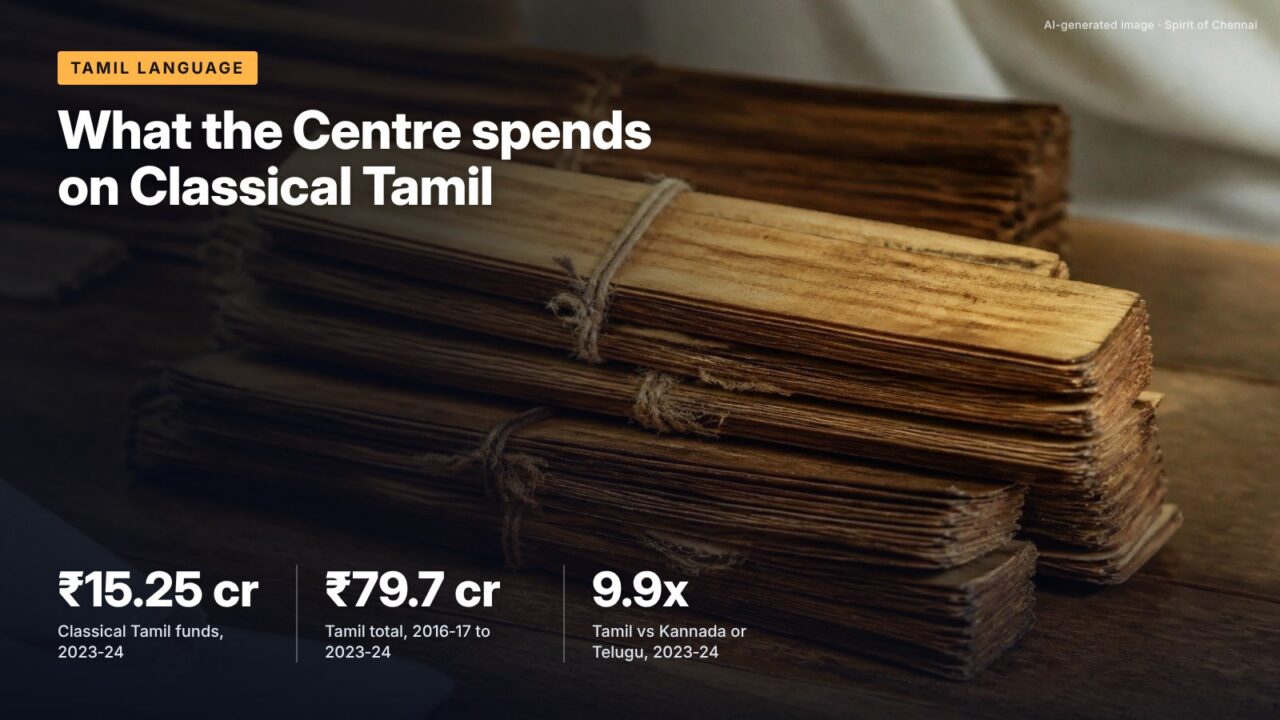
Classical status brings money, but how much, and to whom? Five answers given in Parliament between 2020 and 2024 let us trace the Centre’s spending on each classical language year by year, and they show Tamil well ahead of the other languages on the measured accounts.
The numbers
The Ministry of Education told the Lok Sabha in August 2024 that it provided ₹1,525 lakh (₹15.25 crore) for Classical Tamil in 2023-24, through the Central Institute of Classical Tamil (CICT) in Chennai. Kannada and Telugu received ₹154.50 lakh each, Odia ₹138.50 lakh and Malayalam ₹112.50 lakh, all through centres run by the Central Institute of Indian Languages (CIIL) in Mysuru. Tamil’s allocation was 9.9 times that of Kannada or Telugu (1,525 divided by 154.5).
Sanskrit, the second language to be declared classical, does not appear in these tables at all. Each answer gives the same reason: no separate funds are provided for work on the classical aspect of Sanskrit, which is promoted through three central universities. That makes the published comparison incomplete, and it is the first thing to understand before reading the figures.
The eleven languages and when they joined
Tamil was the first language notified as classical, on 12 October 2004. The Cabinet decision of 3 October 2024 lists the rest: Sanskrit on 25 November 2005, Telugu and Kannada on 31 October 2008, Malayalam on 8 August 2013 and Odia on 1 March 2014. That decision added Marathi, Pali, Prakrit, Assamese and Bengali, taking the total to 11.
The criteria have moved with each round. The first set came in 2004 with a Linguistic Experts Committee under the Sahitya Akademi. In November 2005 they were revised to require 1,500 to 2,000 years of recorded history. On 25 July 2024 the committee revised them again, adding prose and inscriptional evidence. The benefits named in the Cabinet note are national awards, university chairs and centres for the promotion of classical languages.
Year by year, from the Parliament record
No single answer covers the whole period, so the table below joins five of them. Where two answers give different figures for the same year, both are shown.
| ₹ lakh | Tamil (CICT) | Kannada | Telugu | Malayalam | Odia |
|---|---|---|---|---|---|
| 2016-17 | 502 | 91 | 100 | nil | nil |
| 2017-18 | 1,027 | 92 | 100 | nil | nil |
| 2018-19 | 545 | 92 | 99 | nil | nil |
| 2019-20 | 770 | 107 | 107 | nil | nil |
| 2020-21 | 1,200 | 108 / 127.50 | 147 | 8 | 8 |
| 2021-22 | 1,200 | 106.50 | 103.15 | 63.97 | 58.38 |
| 2022-23 | 1,200 | 128.25 / 171.75 | 171.75 | 186.75 | 176.75 |
| 2023-24 | 1,525 | 154.50 | 154.50 | 112.50 | 138.50 |
| 2024-25 | 1,430 | 83.50 | 83.50 | 83.50 | 83.50 |
Source: Ministry of Education replies: Lok Sabha USQ 4677 (March 2020, figures in ₹ crore converted), SQ 371 (27 March 2023), USQ 2288 (5 August 2024), USQ 1124 (2 December 2024)
Three things stand out. Tamil’s line jumped to ₹10.27 crore in 2017-18, fell back to ₹5.45 crore, and settled at ₹12 crore a year from 2020-21 before rising again. Malayalam and Odia got nothing until 2020-21 because their centres, though approved, had not been set up, the March 2020 answer says. And the 2024-25 row, given in December 2024, shows the same ₹83.50 lakh for every non-Tamil language, which suggests an allocation rather than final spending.
Total for Classical Tamil from 2016-17 to 2023-24, adding the yearly figures in the 2020, 2023 and 2024 answers.
Why the figures do not always agree
Kannada’s 2020-21 figure is ₹108 lakh in the March 2023 answer and ₹127.50 lakh in the August 2024 one. Its 2022-23 figure is ₹128.25 lakh in August 2024 and ₹171.75 lakh in December 2024. The December answer also describes its table as funds provided by the CIIL while including Tamil, which the CICT handles. Allocations, releases and expenditure are different stages, and the answers do not say which they report. Anyone using these numbers should cite the answer and the date.
The Sanskrit question
The comparison most often made in Tamil Nadu is with Sanskrit. The record here is limited. Every answer from 2020 to 2024 says no separate funds are given for the classical aspect of Sanskrit; instead, funds go to three central universities for teaching and research. The October 2024 Cabinet note says those universities were established by an Act of Parliament in 2020. Their budgets are not counted as classical-language spending, so the Parliament tables cannot settle how Sanskrit and Tamil compare in total central support.
It’s often said the Centre’s classical-language money goes overwhelmingly to Sanskrit, leaving Tamil with little.
The record shows In the classical-language accounts given to Parliament, Tamil received the largest share every year from 2016-17 to 2024-25. Sanskrit is funded through three central universities, which the ministry does not count as classical-language funds, so the two are not reported on the same basis (Lok Sabha, August 2024).
Money per speaker
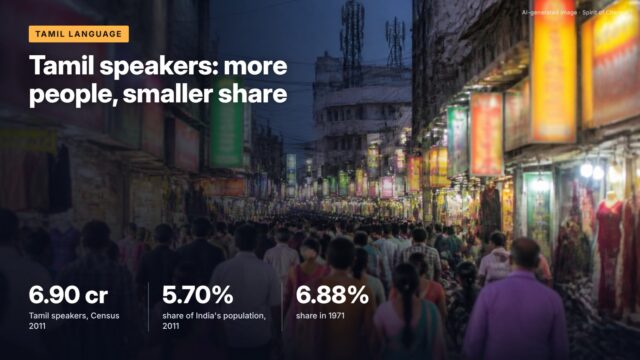
Another way to read the numbers is against the number of speakers. Census 2011’s language paper counts 6.90 crore Tamil speakers, 4.37 crore Kannada speakers and 8.11 crore Telugu speakers. On the 2023-24 figures, the Centre spent about ₹2.21 per Tamil speaker (₹15.25 crore divided by 6.90 crore), about 35 paise per Kannada speaker and about 19 paise per Telugu speaker. These are small sums set against the size of the language communities; state governments and universities carry much of the everyday work of language development.
What the money buys
The Cabinet note describes the CICT’s work as translation of ancient Tamil texts, research and courses. The CIIL centres for Kannada, Telugu, Malayalam and Odia are smaller units within a Mysuru institute, which helps explain the gap. A free-standing institute carries fixed costs that a centre inside another body does not.
What this means for you
- When you see a claim about classical-language funding, check which Parliament answer it uses and whether the figure is an allocation or spending.
- Tamil’s central funding runs through the CICT in Chennai, so its annual reports and the ministry’s answers are the primary records.
- Comparisons with Sanskrit need the budgets of the three central Sanskrit universities, which are reported separately from classical-language funds.
- The five languages added in October 2024 will compete for the same pool once their centres are set up.
What to watch
Pending
Funding lines for Marathi, Pali, Prakrit, Assamese and Bengali, declared classical on 3 October 2024; they will appear in future Parliament answers once centres are established.
Pending
Final 2024-25 figures: the December 2024 answer gave a uniform ₹83.50 lakh for four languages and ₹14.30 crore for Tamil, which may change in later replies.
Checked against official sources on 23 October 2026. Figures and rules change; confirm on the linked official pages before relying on them.
Sources
- Lok Sabha USQ 4677, Money spent on promotion of classical language, Ministry of HRD, March 2020
- Lok Sabha SQ 371, Classical status to Indian languages, Ministry of Education, 27 March 2023
- Lok Sabha USQ 2288, Funds for classical languages, Ministry of Education, 5 August 2024
- Lok Sabha USQ 1124, Promotion of Kannada as classical language, Ministry of Education, 2 December 2024
- Cabinet approves conferring status of classical language to Marathi, Pali, Prakrit, Assamese and Bengali, PMIndia, 3 October 2024
- Census of India 2011, Language: India, States and Union Territories (Paper 1 of 2018), Office of the Registrar General