Tamil Nadu has deposited more than ₹22 crore since 1977 placing Tamil inside other people’s universities, from Varanasi to Cambridge, Massachusetts. Its Tamil Development policy note lists each deposit, and the list shows how the strategy has shifted from Indian campuses to the diaspora.
The numbers
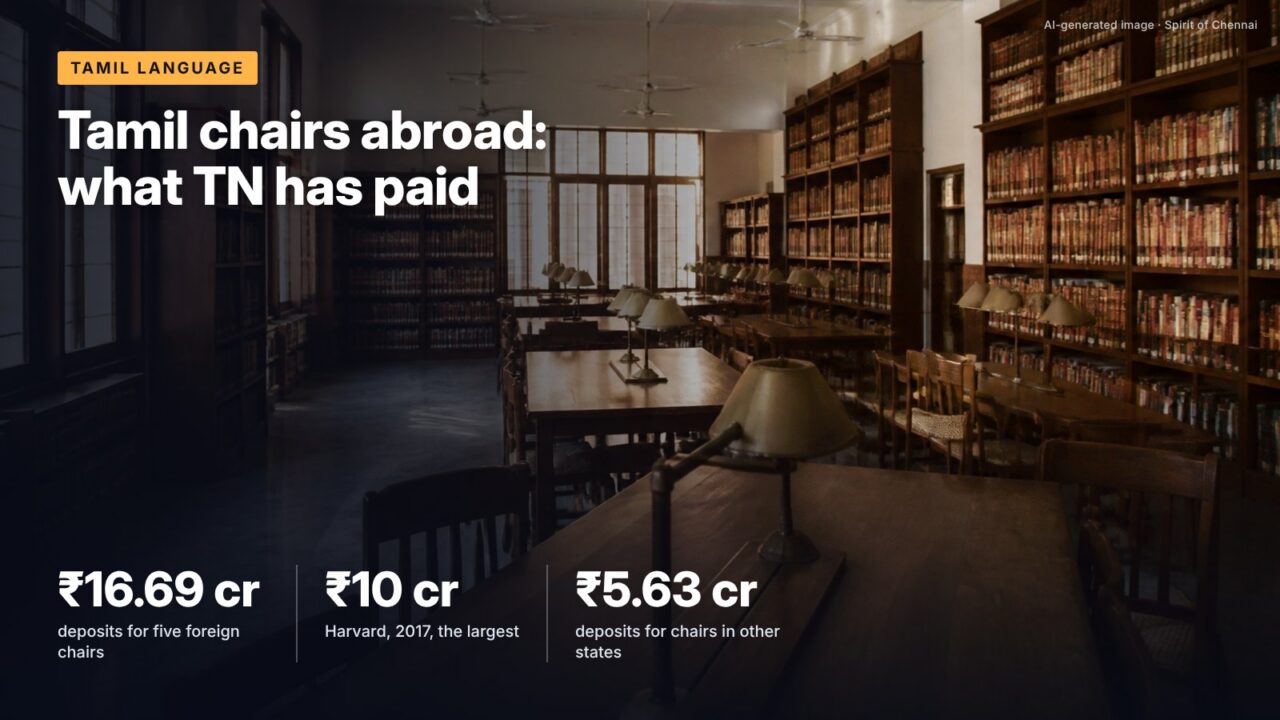
The Tamil Development Department’s policy note for 2024-25 records deposits totalling ₹16,69,41,750 for Tamil research chairs at five institutions abroad: the Mahatma Gandhi Institute in Mauritius, Harvard University, the University of Houston, the University of Toronto and the University of Cologne. A further ₹5,63,00,000 has gone to chairs at Banaras Hindu University, Utkal University of Culture in Odisha and Jawaharlal Nehru University in Delhi. Together that is ₹22.32 crore (16.69 plus 5.63).
The note describes the payments as deposits, not grants. A chair is usually funded by an endowment: the university invests the capital and uses the income to pay a professor and run a programme. The size of the deposit therefore decides how secure a chair is, and whether the state’s money is the core of the endowment or one contribution among many.
The foreign chairs, one by one
| Institution | Country | Year | Deposit (₹) |
|---|---|---|---|
| Mahatma Gandhi Institute | Mauritius | 2010 | 1,00,00,000 |
| Harvard University | USA | 2017 | 10,00,00,000 |
| University of Houston | USA | 2019 | 1,00,00,000 |
| University of Houston | USA | 2022 | 2,44,41,750 |
| University of Toronto | Canada | 2021 | 1,00,00,000 |
| University of Cologne | Germany | 2021 | 1,25,00,000 |
| Total | 16,69,41,750 |
Source: Tamil Development Department, Government of Tamil Nadu, Policy Note 2024-25, section 1.9
Harvard’s ₹10 crore in 2017 accounts for 60 per cent of the foreign total (10 divided by 16.69). Houston is the only university to have received two deposits, in 2019 and 2022, the second for an exact sum of ₹2,44,41,750 that the note does not explain. Four of the five foreign institutions received their deposits after 2016. Apart from the Mauritius institute, all are research universities in North America and Europe, where a chair brings scholarly standing as well as teaching.
Share of Tamil Nadu’s foreign chair deposits that went to Harvard in 2017, according to the Tamil Development policy note.
How a diaspora chair is really built
The Toronto case shows the usual pattern. On 26 June 2018 the University of Toronto announced that Tamil Chair Inc. and the Canadian Tamil Congress had pledged $3 million to endow a full-time chair in Tamil studies at its Scarborough campus, noting that the Greater Toronto Area has the largest Tamil community outside Asia. By May 2020 the campus reported that $1.3 million had been raised. Tamil Nadu’s deposit of ₹1 crore followed in 2021.
In other words, the community led and the state joined. The same is likely at other campuses, though the policy note does not say what share of each endowment the state supplied, and the universities’ own totals are not in the official record used here.
It’s often said Tamil chairs abroad are set up and paid for by the Tamil Nadu government.
The record shows At Toronto the chair began with a $3 million community pledge in 2018; the state’s ₹1 crore deposit came three years later, according to the 2024-25 policy note. The state is a contributor, not always the founder.
The Indian chairs, an older policy
| Institution | Year | Deposit (₹) |
|---|---|---|
| Banaras Hindu University, Varanasi | 1977 | 3,00,000 |
| Utkal University of Culture, Odisha | 1999 | 10,00,000 |
| Jawaharlal Nehru University, New Delhi | 2003 | 50,00,000 |
| Jawaharlal Nehru University, New Delhi | 2022 | 5,00,00,000 |
Source: Tamil Development Department, Government of Tamil Nadu, Policy Note 2024-25, section 1.9
Inside India the state started early and small. BHU’s ₹3 lakh in 1977 is the oldest entry; JNU’s ₹5 crore top-up in 2022 is the largest. The note also records a Tamil language lab inaugurated at BHU on 10 June 2023, and donations of 1,471 books to Visva-Bharati in West Bengal and 1,015 books to the Trivandrum Tamil Sangam in Kerala.
The official record is thinner on results than on money. The policy note lists the year and amount of each deposit, but not who holds each chair, how many students it teaches or what it has published. For a programme that now spans three continents, those are the natural questions for the Assembly and for the universities, and the answers would let readers judge which model of support works best: one large deposit, as at Harvard, or repeated smaller ones, as at Houston and JNU.
Set against the Centre’s spending
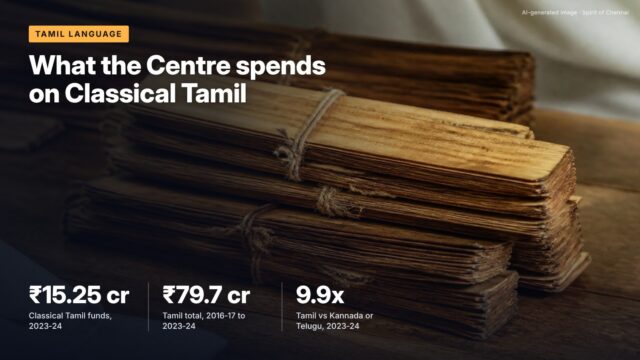
For scale: the Centre gave the Central Institute of Classical Tamil ₹15.25 crore in 2023-24 alone, the Ministry of Education told the Lok Sabha in August 2024. Tamil Nadu’s foreign chair deposits over 12 years add up to roughly one year of that institute’s central funding. Chairs are a small, visible part of language policy; the larger effort is at home.
The Centre also counts university chairs among the benefits of classical status, alongside national awards and promotion centres, according to its October 2024 Cabinet note. Tamil Nadu’s own chairs sit outside that scheme.
Teaching, not only research
Chairs fund research. Teaching the diaspora is a separate task, and within Tamil Nadu it sits with bodies such as the Department of Tamil Studies in Foreign Countries at Tamil University, Thanjavur, which lists research on overseas Tamils, training for learners in and outside India, and textbooks among its aims, with MA, MPhil and PhD programmes. The department’s page does not publish student numbers or countries served.
The policy note also lists the Tamil Thai award, ₹5 lakh and a shield for organisations that set up Tamil associations in Tamil Nadu, other states and abroad, which had been given to 11 organisations by 2022.
What this means for you
- If you are part of a diaspora campaign for a chair, the Tamil Development Department is the state body that has made deposits; the policy note lists past ones.
- Ask any university how much of its Tamil endowment is from government and how much from donors; the answer shows how secure the post is.
- Students abroad can look to universities on this list for Tamil courses, but research chairs do not always teach beginners.
- The policy note is tabled each year, so new deposits appear there first.
What to watch
Pending
Any new chair deposits, which the Tamil Development Department reports in its annual policy note to the Assembly.
Pending
Toronto’s progress towards its $3 million target, last reported by the university at $1.3 million in May 2020.
Checked against official sources on 23 October 2026. Figures and rules change; confirm on the linked official pages before relying on them.
Sources
- Policy Note 2024-25, Tamil Development Department, Government of Tamil Nadu
- Group pledges $3 million to U of T for chair in Tamil studies, University of Toronto, 26 June 2018
- How two leaders are preserving the Tamil language for future generations, University of Toronto Scarborough, 18 May 2020
- Department of Tamil Studies in Foreign Countries, Tamil University, Thanjavur
- Lok Sabha USQ 2288, Funds for classical languages, Ministry of Education, 5 August 2024
- Cabinet approves conferring status of classical language to five languages, PMIndia, 3 October 2024