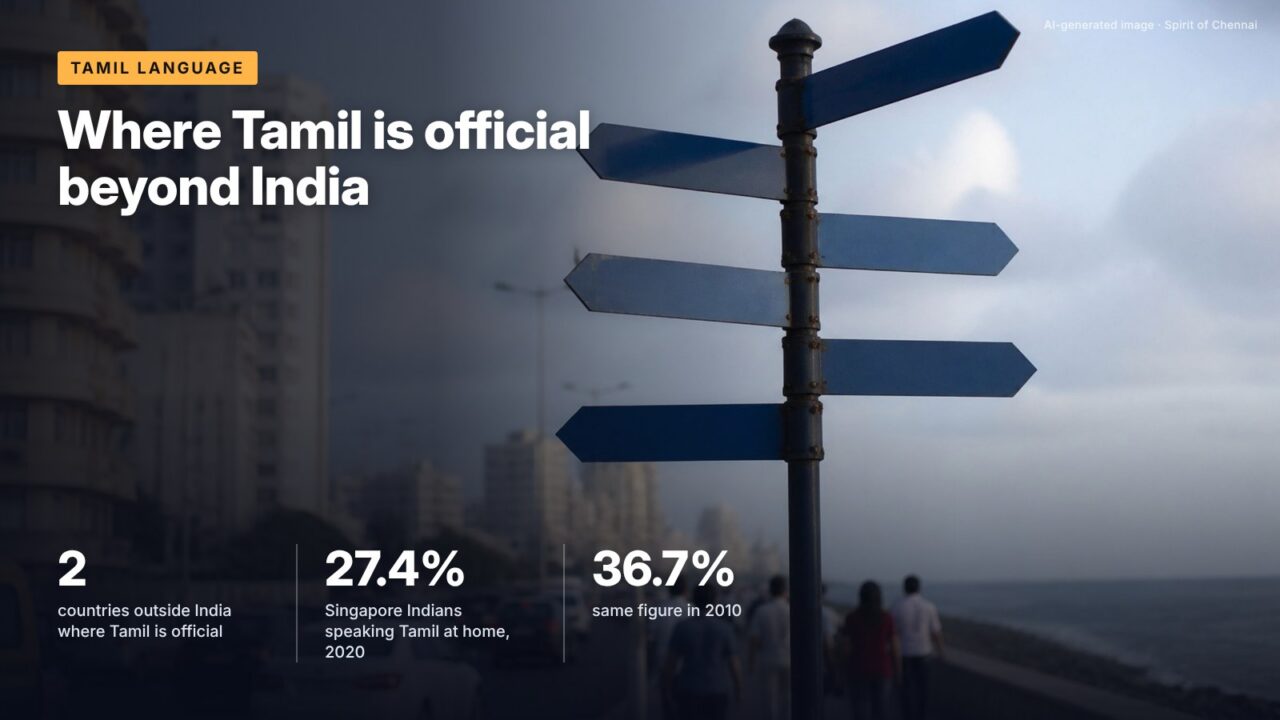
Tamil is an official language in two countries outside India, Sri Lanka and Singapore, with constitutional guarantees stronger in some ways than those in Tamil Nadu. Singapore’s latest census shows what official status can and cannot do.
The numbers
Sri Lanka’s Constitution makes Sinhala the official language in Article 18, then adds that Tamil shall also be an official language and English the link language. Article 19 names both Sinhala and Tamil as national languages. In Singapore, Tamil is one of the four official languages under Article 153A of the Constitution, alongside Malay, Mandarin and English.
Yet the most recent official numbers from Singapore point the other way. Its 2020 census found that 27.4 per cent of Indian residents spoke Tamil most often at home, down from 36.7 per cent in 2010, while English rose from 41.6 to 59.2 per cent. Official status protects a language in public life; it does not decide what families speak at dinner.
Sri Lanka: Tamil in the courts and the provinces
Sri Lanka’s language chapter, Articles 18 to 25A, is detailed. The footnotes in the official text show that Tamil’s status as an official language was inserted by the Thirteenth Amendment, and that the Sixteenth Amendment rewrote Articles 20 to 24 and added Article 25A, which makes the language chapter prevail over inconsistent laws.
Article 20 lets members of Parliament, provincial councils and local bodies work in either national language. Article 21 gives every person the right to be educated in either. Article 22 makes Sinhala and Tamil languages of administration throughout the country, with Tamil the language of administration in the Northern and Eastern Provinces. Article 24 makes both languages of the courts, with the state bound to provide interpretation.
Two details show how carefully the chapter balances the languages. Article 21 says that where one national language is the medium of a state-funded university course, the other must also be offered, subject to exceptions. Article 22 lets the President direct that both languages be used for administration in areas with a linguistic minority population, even outside the North and East. Parties in court may take part in either language, and the state must provide interpretation where it is needed. These are rights a citizen can point to in a dispute with a public office, which is what distinguishes constitutional status from a policy commitment.
| Right | Sri Lanka (Constitution) | Tamil Nadu (Indian law) |
|---|---|---|
| Official status | Official and national language, Arts 18-19 | Official language of the state under the 1956 Act |
| Courts | Language of courts throughout, Art 24 | Subordinate courts; High Court still in English |
| Administration | Throughout, and primary in North and East, Art 22 | State government business |
| Education | Right to be educated in either national language, Art 21 | Compulsory subject in schools under the 2006 Act |
Source: Constitution of the Democratic Socialist Republic of Sri Lanka, Chapter IV (Parliament of Sri Lanka); Tamil Nadu position summarised from state laws
On paper, Tamil’s position in Sri Lanka’s higher courts is stronger than in Madras High Court, where English remains the language of proceedings. How fully the Sri Lankan provisions are carried out is a separate question that the constitutional text cannot answer.
Singapore: official, multilingual, shifting
Singapore’s Indians were 9.0 per cent of residents in 2020, down slightly from 9.2 per cent in 2010, out of a resident population that grew from 3.77 million to 4.04 million. Among all residents aged five and over, the share speaking Tamil most often at home fell from 3.3 to 2.5 per cent.
The census also shows how literacy works in a bilingual school system. In 2020, 41.8 per cent of literate Indian residents were literate in English and Tamil only. Singapore’s schools teach in English with a second, “mother tongue” language as a subject, and the home-language figures show which of the two is gaining in daily life.
| Singapore residents | 2010 | 2020 |
|---|---|---|
| Total residents | 3.77 million | 4.04 million |
| Indians as share of residents | 9.2% | 9.0% |
| Tamil at home, all residents | 3.3% | 2.5% |
| Tamil at home, Indians | 36.7% | 27.4% |
| English at home, Indians | 41.6% | 59.2% |
Source: Department of Statistics Singapore, Census of Population 2020, Statistical Release 1: Key findings
Drop in the share of Singapore Indians using Tamil most at home, 2010 to 2020, from the 2020 census.
It’s often said official status keeps a language strong.
The record shows Tamil is official in Singapore, yet the share of Indian residents using it most at home fell from 36.7 to 27.4 per cent in ten years, the 2020 census reports. Home use depends on schooling, work and migration as much as on law.
Elsewhere in the diaspora
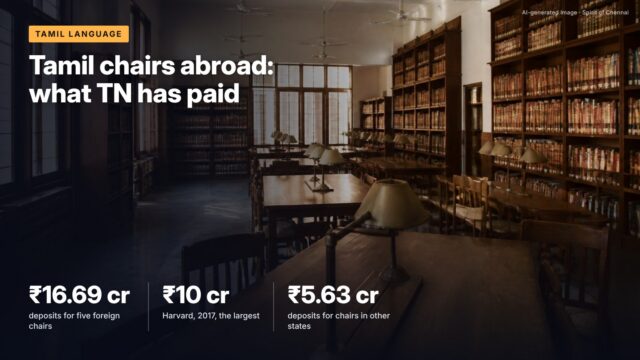
Outside these two countries, Tamil has institutional rather than constitutional footholds. Tamil Nadu’s Tamil Development policy note records a ₹1 crore deposit in 2010 for a Tamil chair at the Mahatma Gandhi Institute in Mauritius, and deposits for chairs in the United States, Canada and Germany. The University of Toronto has described the Greater Toronto Area as home to the largest Tamil community outside Asia.
The base at home
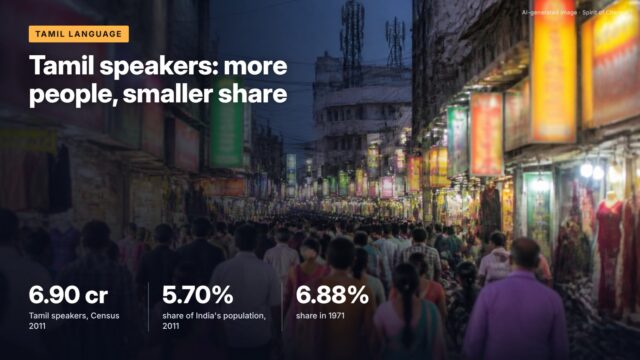
Inside India, Tamil is the mother tongue of 88.37 per cent of Tamil Nadu’s people and 88.22 per cent of Puducherry’s, according to the Census 2011 language paper. Those two jurisdictions remain the language’s base, and the natural source of teachers and teaching material for communities abroad.
What the comparison shows
The three settings show three models. Sri Lanka writes Tamil into its constitution with rights in courts, schools and administration, tied to regions. Singapore makes Tamil one of four official languages in a state where English is the working language. Tamil Nadu makes Tamil the language of government and requires it in schools, while English holds the higher courts. Each gives Tamil legal standing; none, on its own, settles whether the next generation speaks it at home.
What this means for you
- Families moving to Singapore can expect Tamil as a school subject, not a medium of instruction.
- In Sri Lanka, citizens have a constitutional right to use Tamil in courts and to be educated in it.
- For diaspora learning, Tamil Nadu’s universities and the chairs it funds abroad are the main official links.
- Official census figures, not community estimates, are the reliable measure of home-language shift.
What to watch
Pending
Singapore’s next census, which will show whether the fall in home use of Tamil among Indians continued after 2020.
Pending
Any new constitutional or official-language legislation in Sri Lanka affecting Articles 18 to 25A.
Checked against official sources on 23 October 2026. Figures and rules change; confirm on the linked official pages before relying on them.
Sources
- Constitution of the Democratic Socialist Republic of Sri Lanka, Chapter IV: Language, Parliament of Sri Lanka
- Constitution of the Republic of Singapore, Article 153A, Singapore Statutes Online, Attorney-General’s Chambers
- Census of Population 2020, Statistical Release 1: Key findings, Department of Statistics, Singapore
- Census of India 2011, Language (Paper 1 of 2018), Office of the Registrar General
- Policy Note 2024-25, Tamil Development Department, Government of Tamil Nadu
- Group pledges $3 million to U of T for chair in Tamil studies, University of Toronto, 26 June 2018