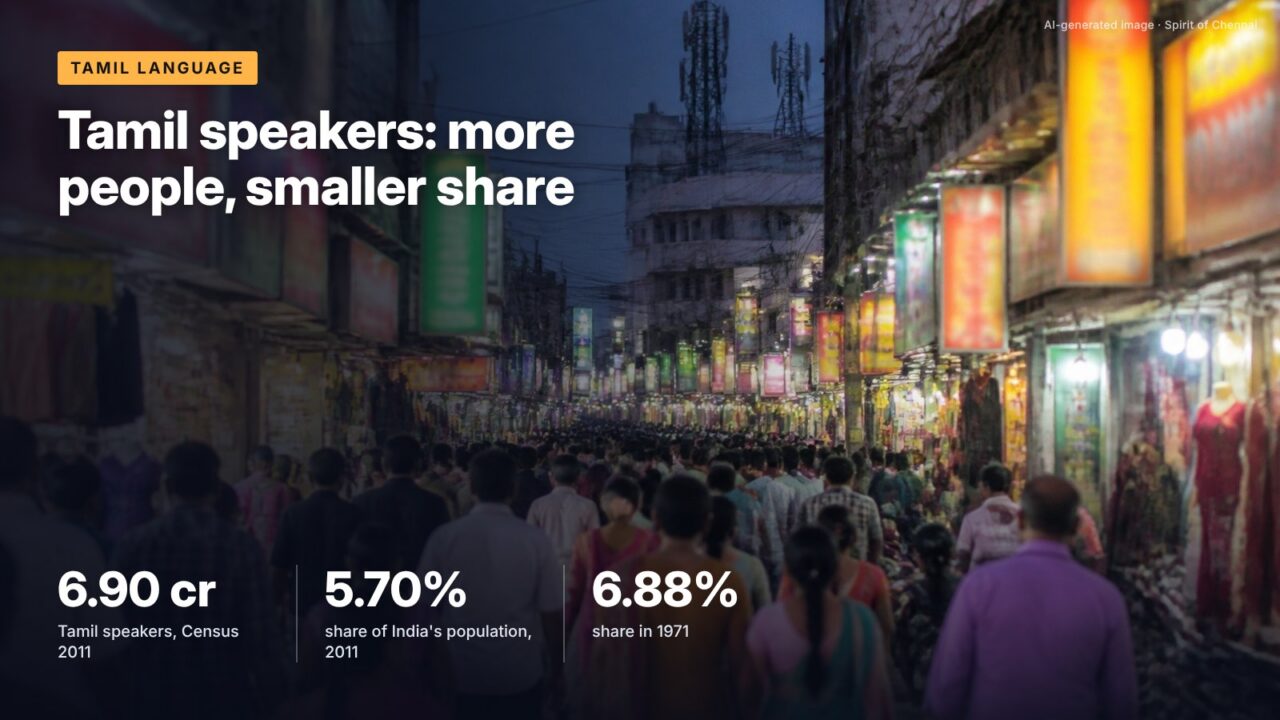
Census 2011 counted 6.90 crore Tamil speakers in India, more than in any earlier census. Yet Tamil’s share of the national population has fallen at every count since 1971. The official language tables explain both trends, and contain one surprising gap.
The numbers
The Registrar General’s language paper for Census 2011, released on 25 June 2018, counts 6,90,26,881 Tamil speakers, 5.70 per cent of the population. Tamil ranks fifth among the 22 scheduled languages, after Hindi, Bengali, Marathi and Telugu. In 1971 the census counted 3,76,90,106 Tamil speakers, 6.88 per cent of the country. The number grew by 3.13 crore over 40 years; the share fell by 1.18 percentage points.
Both trends are real, and they are not in conflict. A language can grow in absolute terms and still shrink as a share if other languages grow faster. Reading the series carefully also requires knowing how the census counts a “speaker” and what happened in 1981.
How the census counts a Tamil speaker
The census asks each person for their mother tongue, then groups the answers. In 2011 it received 19,569 raw mother-tongue returns, rationalised them into 1,369 mother tongues, and grouped those under 121 languages, 22 scheduled and 99 not. Under “Tamil” sit 6,88,88,839 people who wrote Tamil itself and 1,38,042 who returned other mother tongues the census classes under Tamil (the difference between 6,90,26,881 and 6,88,88,839).
So the figure measures the language people name as their mother tongue, not everyone who can speak Tamil. Second-language speakers, such as many Telugu, Kannada or Urdu-speaking residents of Tamil Nadu, are counted elsewhere. In 2011, 270 mother tongues had 10,000 or more speakers each, which gives a sense of how much grouping lies behind the 22 scheduled-language totals.
The series, census by census
| Census | Tamil speakers | Share of India | Hindi share | Malayalam share |
|---|---|---|---|---|
| 1971 | 3,76,90,106 | 6.88% | 36.99% | 4.00% |
| 1981 | not available | not available | 38.74% | 3.86% |
| 1991 | 5,30,06,368 | 6.32% | 39.29% | 3.62% |
| 2001 | 6,07,93,814 | 5.91% | 41.03% | 3.21% |
| 2011 | 6,90,26,881 | 5.70% | 43.63% | 2.88% |
Source: Office of the Registrar General, Census of India 2011, Language (Paper 1 of 2018), Statement 5. 1981 excludes Assam; 1991 excludes Jammu and Kashmir
The 1981 gap is the surprise. The census statement marks the Tamil figure for that year as unavailable and records that Tamil Nadu’s census records were lost in floods. Anyone quoting a 1981 Tamil figure is quoting an estimate, not the published series.
Among the other large scheduled languages in 2011, Bengali had 9.72 crore speakers (8.03 per cent), Marathi 8.30 crore (6.86 per cent) and Telugu 8.11 crore (6.70 per cent), all ahead of Tamil. Kannada had 4.37 crore (3.61 per cent) and Malayalam 3.48 crore (2.88 per cent). Every one of the southern languages lost share between 1971 and 2011, and Telugu lost more than Tamil, falling from 8.16 to 6.70 per cent. The pattern is regional rather than specific to Tamil, which supports reading it as a matter of population growth rather than language loss.
The census year with no published Tamil figure; the Registrar General’s statement says Tamil Nadu’s records were lost in floods.
Why the share falls
Tamil speakers grew 14.69 per cent between 1991 and 2001 and 13.54 per cent between 2001 and 2011. The country grew faster. The same table lets us work out India’s population: 6,90,26,881 is 5.70 per cent of about 121.1 crore in 2011, and 6,07,93,814 is 5.91 per cent of about 102.9 crore in 2001, a rise of roughly 17.7 per cent. Tamil grew about four points slower than India over that decade.
Because about 88 per cent of Tamil Nadu’s residents return Tamil as their mother tongue (8,837 per 10,000 in 2011), the language’s national share largely follows the state’s population growth relative to the country. Hindi’s share rose from 36.99 to 43.63 per cent over the same 40 years, mainly reflecting faster population growth in the states where it is the main mother tongue. Malayalam’s share fell faster than Tamil’s, from 4.00 to 2.88 per cent; Kannada’s more slowly, from 3.96 to 3.61 per cent.
It’s often said the number of Tamil speakers is falling.
The record shows The number has risen at every census for which figures exist, from 3.77 crore in 1971 to 6.90 crore in 2011. Only the share of India’s population has fallen, according to the Census 2011 language paper.
Where Tamil speakers live
The census statement gives speakers per 10,000 people in each state. In 2011 Tamil was the mother tongue of 8,837 per 10,000 in Tamil Nadu and 8,822 per 10,000 in Puducherry. Outside those two, Karnataka had 345 per 10,000 (3.45 per cent), Kerala 150, undivided Andhra Pradesh 84 and Maharashtra 45. These shares are small, but Karnataka’s and Maharashtra’s large populations make them substantial communities in absolute terms.
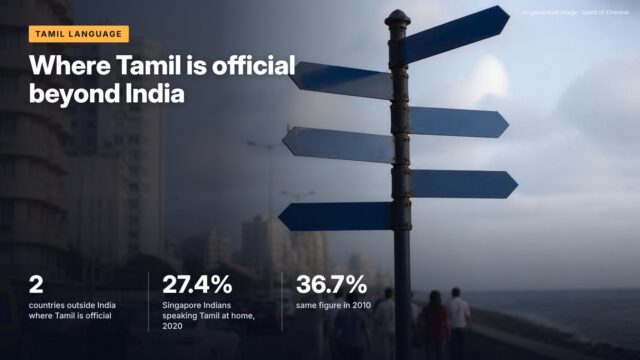
Abroad the census does not reach, but other official counts show the same pressure on the language. Singapore’s 2020 census found that the share of Indian residents speaking Tamil most often at home fell from 36.7 per cent in 2010 to 27.4 per cent in 2020.
What the numbers mean for policy
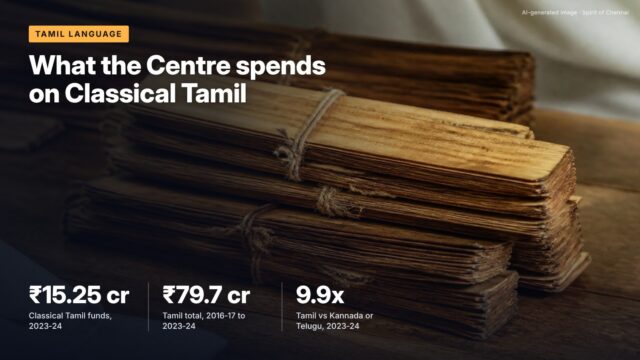
Share matters in a federal system. Central schemes are often weighed against the size of the communities they serve. On the 2023-24 figures given to Parliament, the Centre’s classical-language funding for Tamil came to about ₹2.21 per speaker (₹15.25 crore divided by 6.90 crore), as the August 2024 Lok Sabha answer and the census together show. Tamil was the first language declared classical, on 12 October 2004, according to the Cabinet’s 2024 note, and classical status rests on antiquity, not speaker numbers.
The language paper took seven years to appear after the 2011 enumeration. The next census will extend the series and show whether the post-1991 slowdown in Tamil Nadu’s growth relative to India has continued.
What this means for you
- Quote Tamil speakers as 6.90 crore (Census 2011) and give the year; it is the latest official count.
- Do not quote a 1981 Tamil figure as official; the census marks it unavailable.
- A falling share is mostly about relative population growth, not people abandoning the language.
- For second-language Tamil speakers, the census mother-tongue tables are the wrong measure; look for its bilingualism tables instead.
What to watch
Pending
Language tables from the next census, which will add a sixth point to the series; the 2011 tables took until June 2018 to be published.
Pending
Whether the next count fills the 1981 gap in any revised historical series.
Checked against official sources on 23 October 2026. Figures and rules change; confirm on the linked official pages before relying on them.
Sources
- Census of India 2011, Language: India, States and Union Territories (Paper 1 of 2018), Office of the Registrar General and Census Commissioner
- Language (Paper 1 of 2018), Census of India 2011, catalogue entry, Office of the Registrar General
- Census of Population 2020, Statistical Release 1: Key findings, Department of Statistics, Singapore
- Lok Sabha USQ 2288, Funds for classical languages, Ministry of Education, 5 August 2024
- Cabinet approves conferring status of classical language to five languages, PMIndia, 3 October 2024