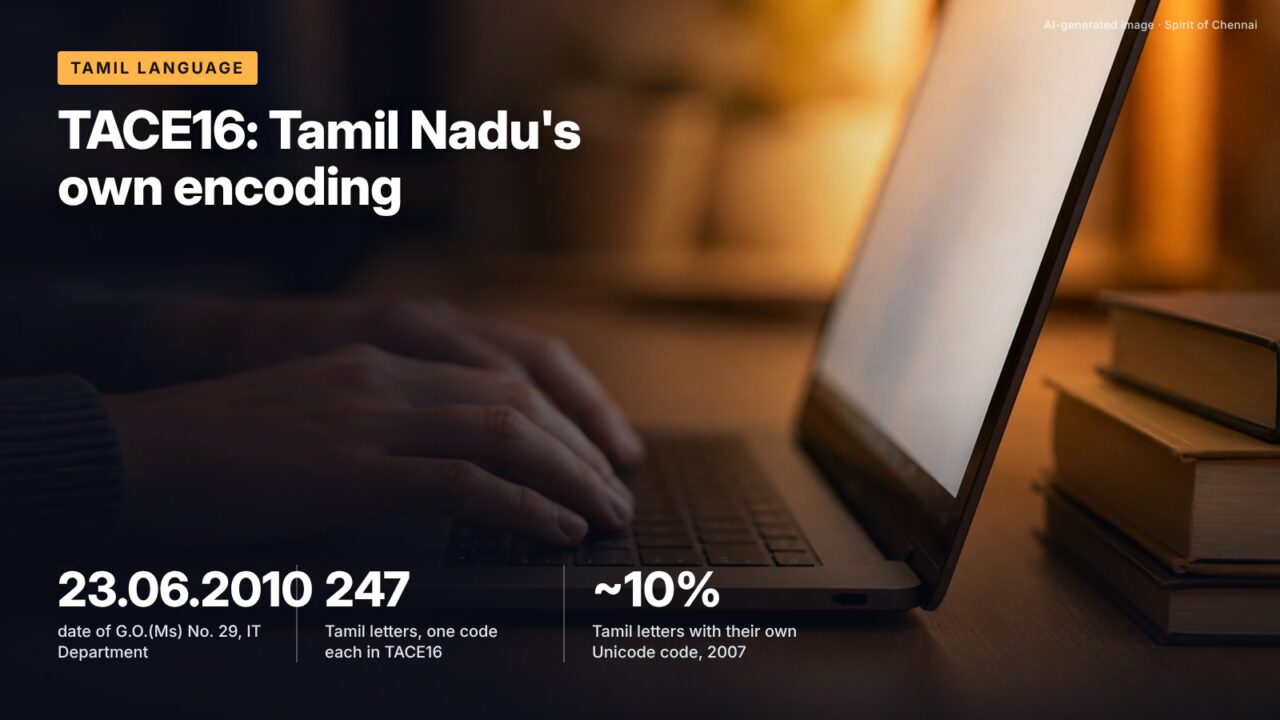
Almost every Tamil message on a phone is stored in Unicode, but Tamil Nadu has had its own official encoding since 2010. The story of TACE16 is a rare case of a state government arguing with a global standards body over how a script should be stored.
The numbers
On 23 June 2010 the Information Technology Department issued G.O.(Ms) No. 29, signed by Principal Secretary P.W.C. Davidar, prescribing standards for 16-bit coding of Tamil script. It accepted that Unicode was becoming the current 16-bit encoding for worldwide data interchange, set out rules for using it, and placed the state’s own Tamil All Character Encoding, TACE16, in Unicode’s Private Use Area, a range reserved for characters a standard does not define. It also updated the Tamil sort order for both schemes.
A state press release issued during the World Classical Tamil Conference of 2010 explained the aim: move government computing from 8-bit to 16-bit encoding and give every department and citizen licence-free fonts and keyboard drivers for both Unicode and TACE16, on all operating systems. A five-member technical committee chaired by Dr P.R. Nakkeeran, then Director of the Tamil Virtual Academy, was set up to run it.
How Unicode stores Tamil
Unicode treats Tamil like other Indian scripts. It gives separate codes to vowels, consonants and vowel signs, and builds most syllables by combining a consonant with a sign. The G.O. cites code points from U+0B82 to U+0BFA in the main Tamil block. A font and a rendering engine then draw the right shape.
Tamil Nadu’s objection was that this does not match how Tamil readers think of letters. A May 2007 presentation to the Unicode Technical Committee by Dr M. Ponnavaikko for the state government and Mani M. Manivannan of the TACE-16 task force counted 247 Tamil letters, 325 with Grantha letters, and 347 code points with numerals and special signs. It said only about 10 per cent of Tamil letters had their own code, while the combined vowel-consonant letters (uyirmei) make up roughly 64 to 70 per cent of running text.
| Writing மணிவண்ணன் | Unicode | TACE16 |
|---|---|---|
| Letters a reader counts | 6 | 6 |
| Codes stored | 9 | 6 |
| Bytes in UTF-16 or 16-bit form | 18 | 12 |
| Bytes in UTF-8 | 27 | not applicable |
| Sorting | needs collation rules | by code value |
Source: Government of Tamil Nadu and TACE-16 task force presentation to the Unicode Technical Committee, L2/07-175, May 2007; byte counts calculated at 2 bytes per 16-bit code and 3 bytes per Tamil character in UTF-8
The byte counts follow from the code counts: nine Unicode codes at two bytes each in UTF-16 is 18 bytes, and at three bytes each in UTF-8, the form used on most of the web, 27 bytes. Six TACE16 codes at two bytes each is 12. The presentation’s case also covered sorting, searching and counting letters, which it said were simpler when each letter has one code.
Unicode codes needed for a name a primary school child counts as six letters, in the example from the state’s 2007 presentation.
What the Unicode side said
The argument was heard in Chennai. A draft report of Unicode’s South Asia subcommittee, from its meeting on 23 and 24 January 2008, records the state’s request for a Unicode block for TACE16 and the task force’s finding that Unicode did not match users’ perception of characters.
The report also records the counter-argument. Unicode’s stability principles mean characters can never be removed, and its rules against duplicate encoding would block adding a second way of writing the same text unless the existing model was shown to be unable to represent Tamil. Placing TACE16 in the Basic Multilingual Plane would have meant moving a reserved range, U+0800 to U+08FF. Participants asked for the task force’s measurements to be made reproducible, with data and pseudo-code, and task force members disputed the subcommittee’s points on efficiency.
It’s often said Unicode cannot write Tamil correctly.
The record shows Unicode can represent all Tamil text through consonant and vowel-sign sequences, and Tamil Nadu’s own G.O. 29 of 2010 accepts it as the current standard for data interchange. The dispute was about efficiency and how letters are counted, not about whether Tamil can be written.
The outcome
TACE16 never entered Unicode’s main Tamil block. The 2010 G.O. was the compromise: Unicode for interchange, TACE16 available inside the Private Use Area for applications that want one code per letter, and both covered by state-funded fonts and keyboard drivers. The press release described a first phase of fonts and drivers and a second phase of conversion tools between encodings.
Tamil has since gained space in Unicode in another direction. The Tamil Supplement block, U+11FC0 to U+11FFF, holds about 51 characters for historic fractions, grain measures such as the nel and uzhakku, units for land, weight and money, clerical and agricultural signs, and an end-of-text mark. These are the symbols found in old revenue records and palm-leaf accounts, and they matter for anyone digitising them.
What the G.O. tells departments to do
The order is more than a statement of preference. Its appendices set out working rules: Tamil is treated as relatively simple to process because vowels, consonants and syllables can be handled as whole units, and for natural language processing those units may be mapped to Private Use Area codes. The conjunct and separated forms of the Grantha letter kssa are to be sorted separately. Rule 13 says the government will recommend the rules in Appendix A to the Unicode Technical Committee for adoption into the standard, so the order doubles as the state’s formal position on how Unicode should handle Tamil. Departments buying software are expected to follow it, which is why the state paid for its own fonts and drivers rather than leaving each office to buy them.
Why it still matters
For ordinary users, Unicode won: phones, browsers and social media all store Tamil that way. TACE16 matters for specialised work where letter-level processing counts: dictionaries, spell-checkers, language teaching software and text analysis. The 2010 order still frames government practice, because it sets the standards departments are meant to follow and the fonts they are meant to use.
What this means for you
- Use Unicode for anything you share, publish or send; it is what the G.O. calls the current standard for interchange.
- If software miscounts Tamil letters or sorts names oddly, the cause is often the combining-sign model, not a bug in your text.
- Projects that digitise old accounts or inscriptions should check the Tamil Supplement block for fractions and measures before inventing symbols.
- TACE16 text sits in the Private Use Area, so it needs conversion before it can be read on ordinary devices.
What to watch
Pending
Any further Unicode additions for Tamil: proposals are filed as numbered documents with the Unicode Technical Committee and appear in new chart versions.
Pending
Updates to the state’s licence-free fonts and conversion tools, which the 2010 plan assigned to a second phase.
Checked against official sources on 23 October 2026. Figures and rules change; confirm on the linked official pages before relying on them.
Sources
- G.O.(Ms) No. 29, Information Technology (B-1) Department, 23 June 2010: Standards prescribed for 16-bit coding of Tamil script, Government of Tamil Nadu (Unicode document L2/10-318)
- Press release on Tamil fonts and keyboard drivers for 16-bit encodings, Government of Tamil Nadu, 2010
- TACE-16 proposal presentation by the Government of Tamil Nadu to the Unicode Technical Committee, L2/07-175, May 2007
- Draft report of the South Asia Subcommittee, Chennai meeting of 23-24 January 2008, Unicode Consortium, L2/08-085
- Tamil Supplement code chart, U+11FC0 to U+11FFF, Unicode 18.0, Unicode Consortium