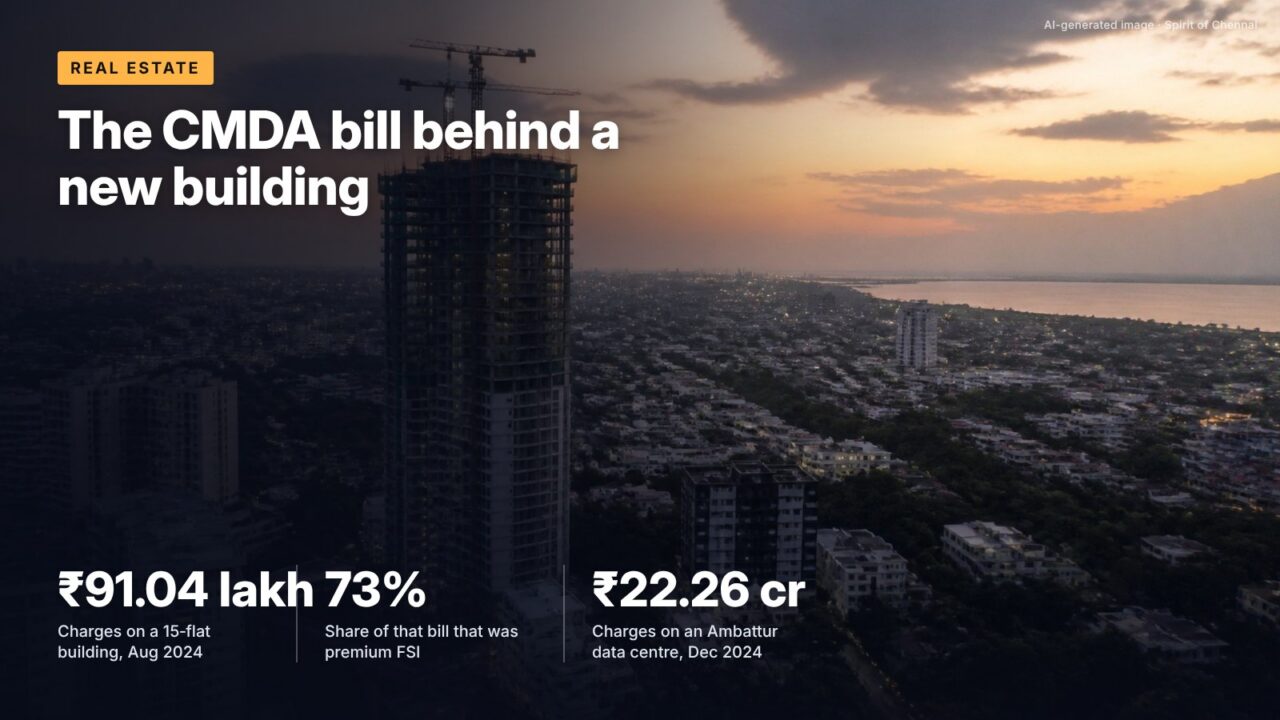
A CMDA planning permission letter is also a bill. Two real 2024 approvals, one for a 15-flat building in K.K. Nagar and one for a data centre in Ambattur, show which charges a project pays, how premium FSI dominates the cost of building more, and why the metro discount matters.
The numbers
When CMDA approved a stilt-plus-five-floor building with 15 flats in New Bangaru Colony, K.K. Nagar West, on 28 August 2024, the permission letter recorded ₹91.04 lakh in fees, charges and deposits. Of that, ₹66.35 lakh, nearly three-quarters, was the premium FSI charge: the price of building more floor area than the rules normally allow. Spread across the flats, that one item came to about ₹4.42 lakh a unit.
Every planning permission in the Chennai Metropolitan Area lists its charges in the same way, and the letters are public on CMDA’s website. Read together with the building rules, they show what a developer pays before a brick is laid, and which parts of that bill come back.
The rules behind the bill
Building in Tamil Nadu is governed by the Tamil Nadu Combined Development and Building Rules, 2019, framed under G.O.Ms.No.18 of 4 February 2019. Floor space index (FSI) is the total covered floor area, minus exempted spaces such as stilt parking, divided by the plot area. A building above 18.30 m is a high-rise and goes through a separate route; CMDA was given high-rise approval powers under G.O.Ms.No.65 of 21 April 2022. The rules ask the authority to issue written permission within 45 days of receiving a complete application.
Premium FSI is extra floor area sold on top of the normal limit. CMDA’s premium FSI guidelines date to G.O.Ms.No.163 of 9 September 2009. A 2018 order, G.O.(Ms) No.148, set the extra area allowed as a share of normal FSI by road width: 50% on roads of 18 m and above, 40% on 12 m to 18 m roads and 30% on 9 m to 12 m roads, and barred premium FSI in Coastal Regulation Zone and other ecologically sensitive areas. The proceeds go into an account for infrastructure in the area.
Two bills, side by side
| Charge | 15 flats, Virugambakkam (₹) | Data centre, Ambattur (₹) |
|---|---|---|
| Scrutiny fees | 10,559 | 1,30,457 |
| Development charge, land and building | 4,18,000 | 9,68,000 |
| Regularisation charge, land | 1,38,000 | – |
| Open space reservation (OSR) charge | – | 3,80,70,000 |
| Infrastructure and amenities (I&A) charge | 7,54,000 | 2,51,15,000 |
| Premium FSI charge | 66,35,000 | 5,12,22,000 |
| Shelter charge | – | 2,55,97,000 |
| CMWSSB infrastructure development charge | 6,65,000 | 92,80,000 |
| Security and caution deposits, display board | 4,83,000 | 7,22,55,000 |
| Flag day | 500 | 500 |
| Total | 91,04,059 | 22,26,37,957 |
Source: CMDA planning permission letters PP/NHRB/C/0395/2024 (28 Aug 2024) and PP/HRB/N/0523/2024 (30 Dec 2024); totals are my sums
The Ambattur project, a basement-plus-ten-floor data centre on CTH Road in the SIDCO estate approved on 30 December 2024, paid ₹22.26 crore. There the premium FSI charge of ₹5.12 crore was 23% of the bill. The bigger share, about 32%, was deposits: ₹1.32 crore of security deposit and ₹5.91 crore of caution deposit. The building rules describe the security deposit as refundable on completion, so part of the Ambattur figure is money the developer expects to recover.
Premium FSI charge per flat on the 15-unit K.K. Nagar building, from the CMDA permission letter (₹66.35 lakh divided by 15).
What each charge pays for
Scrutiny fees cover processing, and development charges are levied on the land and building area. The I&A charge funds trunk infrastructure that the project will use; the CMWSSB charge does the same for water and sewer networks in sewered areas. The OSR charge is paid in lieu of reserving part of a large site as open space. The shelter charge is an affordable-housing levy: under Rule 34(1), developments whose FSI area exceeds 4,000 sq m pay 1% of the guideline value of the excess area, or provide 10% of FSI as housing for lower-income groups.
The shelter charge is explicitly tied to the guideline value of the land, so the April 2023 restoration of guideline values to 2012 levels feeds into it. The size of premium FSI in the K.K. Nagar bill explains why the price of extra floor area is the lever the government has chosen to pull near rail lines.
The rail corridor discount
Rule 30(5) of the 2019 rules lets the government sell premium FSI at concessional rates for transit-oriented development, and charges 50% of the normal premium rate within 500 m of a Metro Rail corridor. On 14 January 2024 G.O.Ms.No.15 extended the same 50% rate to properties within 500 m of the centre line of the MRTS and three suburban rail lines, listed in a new Annexure XXIV.
| Corridor added in January 2024 | Length | Stations |
|---|---|---|
| MRTS, Chennai Beach to Velachery | 19.715 km | 17 |
| MRTS extension, Velachery to St. Thomas Mount | 5 km | 3 |
| Suburban, Chennai Beach to Vandalur | 34.6 km | 20 |
| Suburban, Chennai Beach to Minjur | 26.2 km | 15 |
| Suburban, Chennai Central to Thiruninravur | 29.4 km | 17 |
Source: G.O.Ms.No.15, Housing and Urban Development, 14 January 2024, Annexure XXIV
The K.K. Nagar letter describes its building as availing premium FSI with the TOD benefit, so its ₹66.35 lakh was already the discounted figure. Without the corridor rate, on the rules as written, the same extra floor area would have cost about twice as much.
It’s often said a CMDA planning permission means a building can go up straight away.
The record shows Both 2024 letters say the permission is not final: construction can start only after a building permit from the local body, and CMDA’s Enforcement Cell must be told at commencement, plinth level and last storey.
Conditions that come with the money
The letters attach conditions that buyers can check later. Rainwater harvesting shown on the plan is mandatory, and leaving it out is treated as a deviation. The Ambattur permission reserves a third of the terrace for solar and requires CCTV along the road. The K.K. Nagar letter tells the promoter to register with TNRERA before advertising or selling. Both are valid for eight years and both are subject to a pending writ petition, W.P.(MD) No. 8948 of 2019.
What this means for you
- Look up your building’s planning permission letter on CMDA’s site; it lists the floors, charges and conditions the developer accepted.
- If a flat is sold as being in a premium FSI building, the extra floors are legal only if the premium charge appears on the letter.
- Near a metro, MRTS or suburban line, check whether a project used the 50% corridor rate; it is one reason denser buildings are coming up along these routes.
- Ask your builder for the completion certificate and confirm the rainwater harvesting and solar conditions were met before handover.
What to watch
Pending
Any further premium FSI concession for new Metro Phase 2 corridors, which would need an amendment similar to January 2024’s Annexure XXIV.
Pending
The outcome of W.P.(MD) No. 8948 of 2019, to which CMDA permissions are made subject.
Checked against official sources on 23 October 2026. Figures and rules change; confirm on the linked official pages before relying on them.
Sources
- Planning permission, CMDA/PP/NHRB/C/0395/2024, Virugambakkam, CMDA, 28 August 2024
- Planning permission, CMDA/PP/HRB/N/0523/2024, Ambattur, CMDA, 30 December 2024
- G.O.Ms.No.15, Housing and Urban Development, 14 January 2024: premium FSI concession on MRTS and suburban rail corridors, TN Government Gazette
- Tamil Nadu Combined Development and Building Rules, 2019 (copy published by Coimbatore City Municipal Corporation)
- G.O.(Ms) No.148, Housing and Urban Development, 26 October 2018: variations to Development Control Regulations
- Government Orders list, Chennai Metropolitan Development Authority
- Government Orders, Directorate of Town and Country Planning, Tamil Nadu