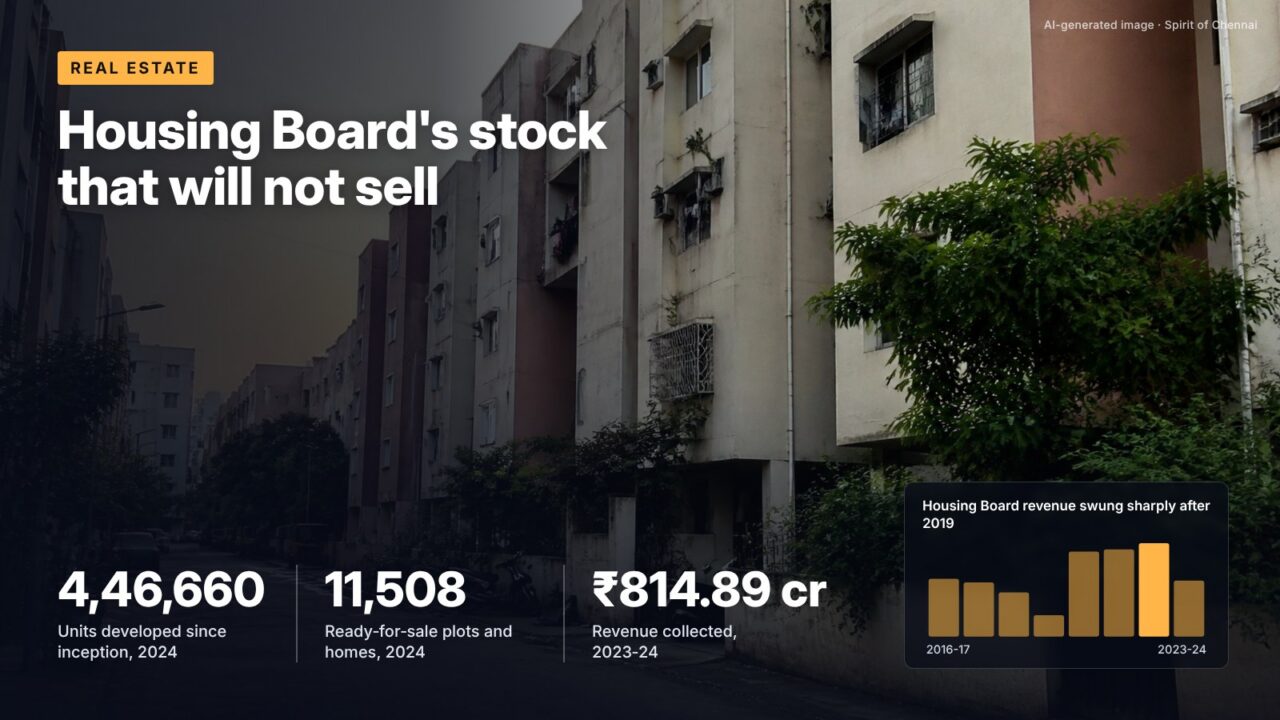
The Tamil Nadu Housing Board has built more than 4.4 lakh plots and homes since 1961. Its own policy notes show a harder recent story: revenue that swings with one-off drives, and a ready-to-sell stock that has not gone away.
The numbers
The Tamil Nadu Housing Board (TNHB) collected ₹814.89 crore in 2023-24, down from ₹1,362.13 crore the year before, according to the Housing and Urban Development policy note for 2024-25. Over the same period its stock of completed plots and homes waiting for buyers rose from 8,540 to 11,508. A board set up to house Tamil Nadu’s middle and lower-income families is sitting on thousands of units it cannot sell.
That is not new. Read across three policy notes and an old audit, the Board’s numbers describe an agency that builds well enough but struggles with pricing, location and paperwork, and leans on special drives to clear the backlog.
What the Board has built
TNHB was set up in 1961 under the Tamil Nadu State Housing Board Act, succeeding the City Improvement Trust of 1947, the 2022-23 policy note records. By 2024 it had developed 4,46,660 units: plots, houses and flats. The note splits them as 1,33,964 for economically weaker sections (EWS), 1,03,960 low income (LIG), 84,859 middle income (MIG) and 60,679 high income (HIG). Those four add up to about 3.83 lakh; the notes do not classify the remainder.
| Category | Units, 2022 note | Units, 2024 note | Added |
|---|---|---|---|
| EWS | 1,32,940 | 1,33,964 | 1,024 |
| LIG | 1,03,658 | 1,03,960 | 302 |
| MIG | 83,720 | 84,859 | 1,139 |
| HIG | 59,187 | 60,679 | 1,492 |
| All units | 4,39,698 | 4,46,660 | 6,962 |
Source: Housing and Urban Development Department, Policy Notes 2022-23 and 2024-25, TNHB sections
The two snapshots, roughly two years apart, show the Board adding about 7,000 units, with more of the increase at the upper end than the lower. Between the 2022 and 2024 notes, HIG units grew by 1,492 against 1,024 for EWS. Low-income housing in the state increasingly runs through the Urban Habitat Development Board and the Union’s Pradhan Mantri Awas Yojana, rather than TNHB.
Revenue that rises and falls with drives
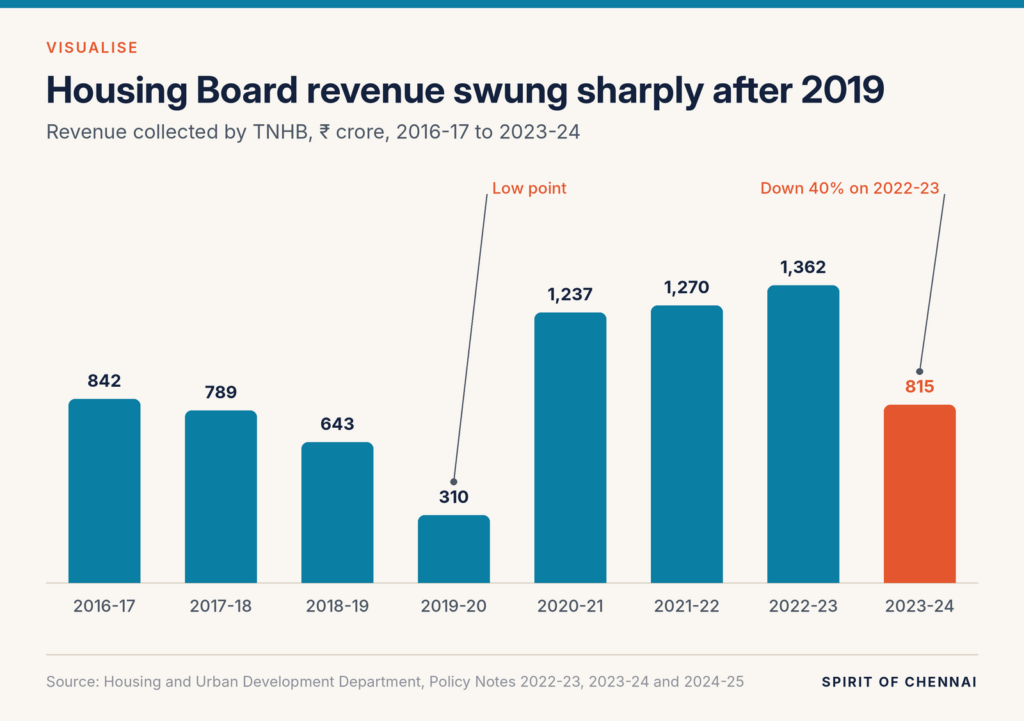
Revenue fell from ₹841.84 crore in 2016-17 to ₹309.55 crore in 2019-20, then jumped above ₹1,200 crore for three years before dropping back to ₹814.89 crore in 2023-24. The notes link the high years to clearing old dues and sale deeds. Between May 2021 and March 2023 the Board issued 11,137 sale deeds and sold 4,806 plots, 1,351 flats and 85 houses; an interest waiver order worth ₹53 crore helped allottees who had missed instalments get their deeds, with 524 beneficiaries and ₹4.16 crore waived by March 2023. Once that backlog thinned, collections fell.
Share of the Board’s 2,94,650 sold dwelling units that had sale deeds issued by 2022, according to the 2022-23 policy note: 2,71,046 deeds.
The stock that will not sell
| Policy note | Plots | Homes | Total ready for sale |
|---|---|---|---|
| 2022-23 | 5,373 | 6,599 | 11,972 (incl. 2,814 ongoing) |
| 2023-24 | 4,834 | 3,706 | 8,540 (completed schemes) |
| 2024-25 | 7,482 | 4,026 | 11,508 |
Source: Housing and Urban Development Department, Policy Notes 2022-23, 2023-24 and 2024-25
The three counts are not defined identically: the 2022 figure includes units under construction and the 2023 figure covers completed schemes only. Even so, the 2024 stock of 7,482 plots is the largest plot backlog in the three notes. The 2023-24 note lists a rationalised interest structure and IT systems as its measures to lift sales.
The pattern is old. In its report for the year ended March 2003, the Comptroller and Auditor General found ₹96.43 crore blocked in 18,755 unsold plots across 17 schemes completed between 1996 and 2002, and blamed poor planning, missing infrastructure and a defective pricing policy. Two decades on, the plot backlog has shrunk but not disappeared.
It’s often said the Housing Board mainly builds subsidised homes for the poor.
The record shows EWS units are about 30% of what the Board has built. Its current pipeline is dominated by self-financing flats, rental quarters for government staff and commercial projects, while most low-income housing now runs through TNUHDB and PMAY.
What the Board builds now
The self-financing scheme, running since 2004, collects the full price in stages before completion. In 2023-24 it had 23 projects with 3,487 units worth ₹1,231.44 crore; the largest were 1,000 units at Sholinganallur (₹218.05 crore) and 570 at Nerkundram (₹323.60 crore). By 2024-25 the note cites 2,385 units at ₹886 crore. The Tamil Nadu Government Rental Housing Scheme, for government employees, had 2,609 flats under construction at eight locations for ₹541.96 crore, including 1,387 at Todhunter Nagar, Saidapet.
Commercial work is growing too: a ₹236.76 crore office complex at Peter’s Colony, plans for a Marina Business Centre on 25.16 acres in Foreshore Estate, and a ₹1,280 crore mixed complex at Tirumazhisai pocket 3 proposed on a PPP basis. The 2024-25 note sets a revenue target of ₹1,650 crore, roughly double the year before.
Rental flats and redevelopment
A less visible part of the Board’s work is housing for government staff. The Tamil Nadu Government Rental Housing Scheme had built 32,044 rental flats by 2022, with 3,113 more under construction at nine locations for ₹626.80 crore, according to the 2022-23 note. A year later the pipeline was 2,609 flats at eight locations costing ₹541.96 crore. The largest is the redevelopment of Todhunter Nagar in Saidapet, where 504 flats in three blocks had been finished and 1,387 more in nine blocks were being built.
Redevelopment is likely to grow. The 2023-24 note says old residential buildings on 14 Board sites will be rebuilt in phases, and the 2024-25 note counts 60 government rental quarter sites identified for reconstruction, 43 on government land and 17 on Board land. Rebuilding on land it already owns spares the Board the location problem that has dogged its suburban plots.
The low-income side is under separate scrutiny. CAG’s Report No. 2 of 2023, a performance audit on housing for the urban poor, was tabled in the Assembly on 11 October 2023.
What this means for you
- If you bought from TNHB and still have no sale deed, ask the division office about pending dues and any current waiver or settlement scheme before interest grows.
- Unsold TNHB plots and flats are listed for sale; check the location’s road, water and transport links, which the auditor flagged as reasons for past unsold stock.
- Self-financing projects take your money in stages before completion, so confirm the project’s TNRERA registration and timeline.
- Compare TNHB prices with the local guideline value; Board pricing was one reason for unsold stock in the past.
What to watch
2025-26
Whether the Board approaches its ₹1,650 crore revenue target set for 2024-25, which the next policy note should report.
Pending
Progress on the Tirumazhisai pocket 3 PPP complex and the Marina Business Centre, both at the planning stage in the 2023-24 note.
Checked against official sources on 23 October 2026. Figures and rules change; confirm on the linked official pages before relying on them.
Sources
- Policy Note 2024-25, Housing and Urban Development Department, Government of Tamil Nadu
- Policy Note 2023-24, Housing and Urban Development Department, Government of Tamil Nadu
- Policy Note 2022-23, Housing and Urban Development Department, Government of Tamil Nadu
- Report of the Comptroller and Auditor General of India for the year ended 31 March 2003 (Civil), Government of Tamil Nadu
- CAG Report No. 2 of 2023, Performance Audit on Housing for Urban Poor, Government of Tamil Nadu