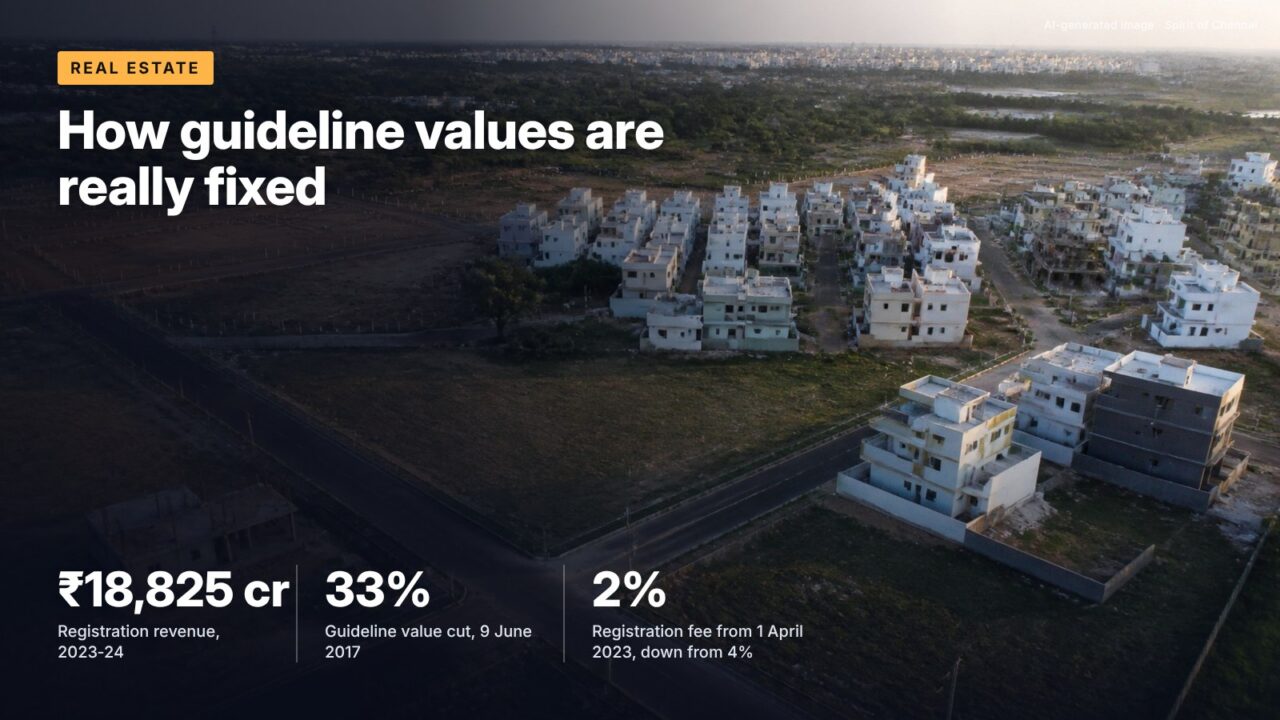
In Tamil Nadu the guideline value, the minimum value at which land can be registered, is set by a statutory committee rather than by buyers and sellers. Here is how that committee works, what the 2017 cut and the 2023 restoration did to the numbers, and what happens when a registrar thinks a deed is undervalued.
The numbers
Registration revenue in Tamil Nadu rose from ₹10,643 crore in 2020-21 to ₹18,825 crore in 2023-24, according to the Registration Department policy note for 2024-25. Over the same four years the number of documents registered grew far more slowly, and in 2023-24 it fell. The gap between the two lines is largely a story about guideline values: the per-street and per-survey-number minimums on which stamp duty is calculated.
Those values are not a market survey. They are fixed by a committee under the Indian Stamp Act, cut or restored by resolution, and enforced at the sub-registrar’s counter. Anyone buying, gifting or settling property in Chennai pays duty on them, so it helps to know who sets them and how a dispute over value is settled.
Who sets the guideline value
The legal basis is Section 47AA, which Tamil Nadu inserted into the Indian Stamp Act, 1899. It creates a Valuation Committee headed by the Inspector General of Registration, with sub-committees headed by District Collectors. The procedure sits in the Tamil Nadu Stamp (Constitution of Valuation Committee for Estimation, Publication and Revision of Market Value Guidelines of Properties) Rules, 2010, whose Rules 3 to 5 cover how the values are prepared.
The district sub-committees prepare the values and the state committee publishes and revises them; the public checks them by street or survey number on the department’s portal. The machinery behind it is large: the department works through 11 registration zones, 56 registration districts and 582 sub-registrar offices, with 11 offices of District Revenue Officers or Special Deputy Collectors (Stamps) that hear valuation disputes, the policy note says.
The 2012 base, the 2017 cut and the 2023 restoration
The current values trace back to guidelines prepared by the sub-committees and brought in from 1 April 2012. On 9 June 2017 the Valuation Committee reduced them across the board by 33%. From 1 April 2023 a fresh committee resolution restored them to the 1 April 2012 level, and the government cut the registration fee on sale, exchange, gift and settlement between non-family members from 4% to 2% at the same time. On 16 August 2023 the Central Valuation Committee also fixed a statewide minimum value for house sites and agricultural land.
A worked illustration shows why the pairing mattered. Take a street valued at ₹3,000 a square foot in 2012 and a 1,000 sq ft plot. After the 2017 cut the value became ₹2,010 (₹3,000 less 33%), and at 7% stamp duty plus the old 4% fee the buyer paid about ₹2.21 lakh. After April 2023 the value returned to ₹3,000, and at 7% duty plus the new 2% fee the bill became ₹2.70 lakh. The fee cut softened the restoration but did not cancel it.
| Year | Documents registered | Change | Revenue (₹ crore) | Change |
|---|---|---|---|---|
| 2020-21 | 26,95,650 | +4.17% | 10,643.08 | −3.49% |
| 2021-22 | 29,98,048 | +11.22% | 13,913.65 | +30.73% |
| 2022-23 | 34,41,248 | +14.78% | 17,296.84 | +24.32% |
| 2023-24 | 33,22,857 | −3.44% | 18,825.32 | +8.84% |
Source: Commercial Taxes and Registration Department, Policy Note 2024-25 (Stamps and Registration), revenue table
What the revenue series says
Divide revenue by documents and the average yield per document rises every year: about ₹39,500 in 2020-21, ₹46,400 in 2021-22, ₹50,300 in 2022-23 and ₹56,700 in 2023-24. The last step is the telling one. In 2023-24, the first year of restored values, documents fell by 3.44% while revenue still grew by 8.84%. Higher values per deed, not more deeds, carried the year.
The yield figure is a blunt average. It mixes sale deeds with low-value instruments and cannot separate the effect of guideline values from rising prices or a shift toward costlier properties. But it is consistent with what the committee’s decisions would predict.
Share of the local body surcharge on transfers that the state passes to councils; in 2023-24, up to December 2023, ₹3,224.14 crore of ₹3,323.86 crore collected went to local bodies, says the Registration policy note.
Where part of the duty goes
Part of what a buyer pays is a surcharge on transfers that belongs to local bodies. The department keeps 3% as a collection charge and passes 97% on. This is why municipal budgets track the property market. Tambaram Corporation’s 2025-26 budget expects ₹50 crore under “duty on transfer of property”, against ₹5.25 crore in the old Tambaram Municipality budget for 2019-20, though the corporation now covers a larger area. A guideline revision therefore moves council revenue as well as state revenue.
Flats moved to a composite value in December 2023
Until late 2023 a new flat was typically bought through two instruments: a sale deed for the undivided share of land, carrying 7% duty on the land’s value, and a construction agreement for the building, carrying 1%. From 1 December 2023 the first sale of a flat in a multi-storey building is registered on a single composite value, covering land share and building together, the policy note says. A summary of G.O.(Ms) No.131 of 1 December 2023 by JSA, a law firm gives the combined levy as 6% below ₹50 lakh, 7% from ₹50 lakh to ₹3 crore and 9% above ₹3 crore, each including the 2% registration fee. The concession applies only to first sales; resales stay on the general rates.
For buildings the department uses value thresholds for site inspection. No inspection is needed where a building has an approved plan, or where the stated value is below ₹1 lakh in villages or ₹2 lakh in municipalities and corporations. Registering officers can inspect buildings valued below ₹50 lakh; Assistant Executive Engineers handle those of ₹50 lakh and above.
When the registrar disputes your value: Section 47A
If the registering officer believes the value declared in a deed is below market value, the document is referred under Section 47A to the District Revenue Officer (Stamps) or a Special Deputy Collector (Stamps). The party can appeal to the Inspector General of Registration under Section 47A(5) and then to the High Court under Section 47A(10). Unpaid deficit duty carries interest of 1% a month, and the Inspector General can reopen orders on his own under Section 47A(6).
| Section 47A cases, 2023-24 | Number |
|---|---|
| Pending at start of year | 1,653 |
| Referred during the year | 3,093 |
| Final orders passed | 3,763 |
| Cases where deficit was collected | 3,232 |
| Amount collected | ₹69.37 crore |
Source: Commercial Taxes and Registration Department, Policy Note 2024-25, Section 47A statement
On those figures, 983 cases were still open at the end of the year (1,653 plus 3,093, less 3,763). That is a small number against 33 lakh documents, which suggests most deeds are simply registered at or above the guideline value.
It’s often said the guideline value is the government’s estimate of what a property will sell for.
The record shows It is a statutory minimum used to compute duty. A deed can carry a higher price; it is a declared value below the market value that can trigger a Section 47A reference.
The department is also rebuilding its software. STAR 3.0, a five-year project sanctioned at ₹323.45 crore under G.O.(Ms) No.73 of 12 July 2023, was at the consultant and bid-evaluation stage when the policy note was written. The current system already supports online token booking, online payment, e-stamping in every sub-registrar office and blockchain-enabled digitised documents from 1 May 2023. Values can be checked on the TNREGINET portal.
What this means for you
- Check the guideline value for the exact street or survey number on TNREGINET before you agree a price, since duty is charged on whichever is higher.
- If you are buying a new flat, ask the builder whether the sale will be registered on the composite value, and which slab it falls in.
- If a deed is referred under Section 47A, you have an appeal to the Inspector General and then the High Court; interest on any deficit runs at 1% a month, so do not let it sit.
- Budget for the full levy: stamp duty and the 2% registration fee, not the fee alone.
What to watch
Pending
STAR 3.0, the ₹323.45 crore registration software overhaul sanctioned in July 2023, moving from bid evaluation to rollout.
Pending
Any further Valuation Committee revision of street or survey-number values; the department publishes changes through TNREGINET.
Checked against official sources on 23 October 2026. Figures and rules change; confirm on the linked official pages before relying on them.
Sources
- Policy Note 2024-25, Stamps and Registration, Commercial Taxes and Registration Department, Government of Tamil Nadu
- TNREGINET guideline value and registration portal, Registration Department, Tamil Nadu
- Revision of stamp duty on first sale of flats (summary of G.O.(Ms) No.131, 1 December 2023), JSA Advocates and Solicitors
- Tambaram City Municipal Corporation, Budget 2025-26
- Tambaram Municipality, General Budget 2019-20