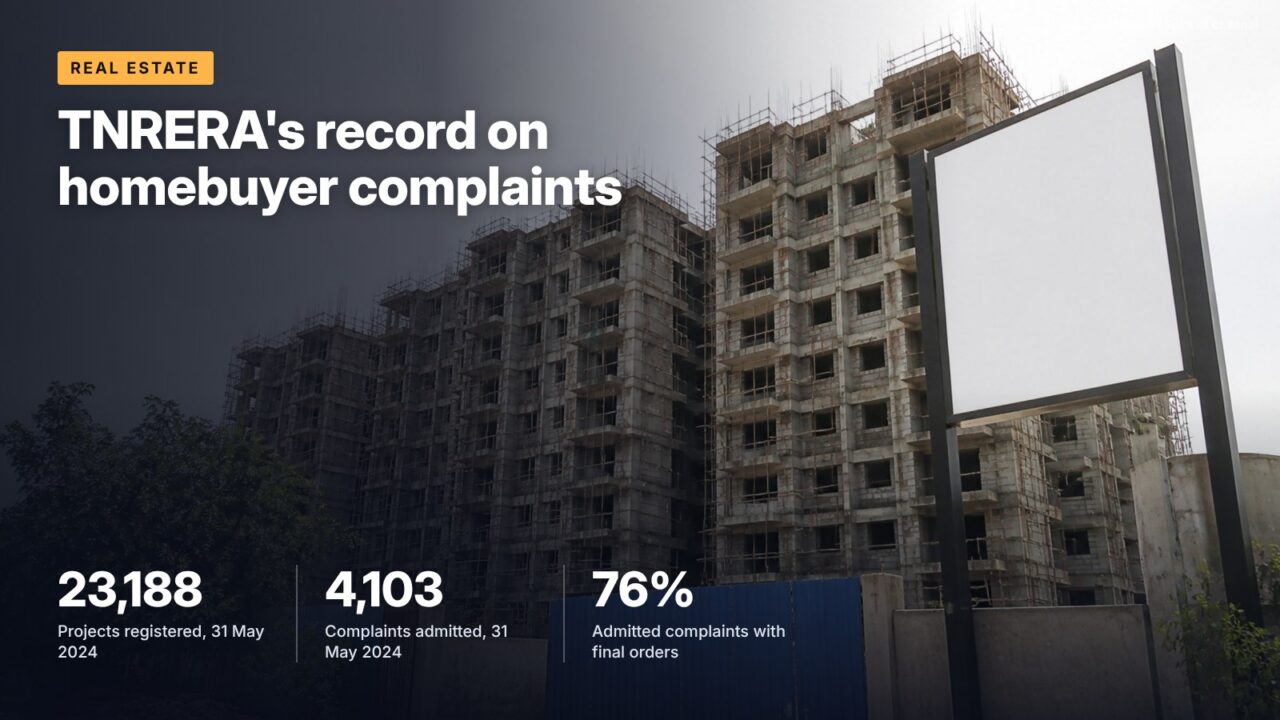
Tamil Nadu’s real estate regulator has registered more than 23,000 projects and passed final orders in about three of every four homebuyer complaints it has admitted. The numbers, the law it applies and the gaps that remain.
The numbers
By 31 May 2024 the Tamil Nadu Real Estate Regulatory Authority (TNRERA) had admitted 4,103 complaints against promoters and passed final orders in 3,130, leaving 973 under hearing, according to the Housing and Urban Development policy note for 2024-25. Fourteen months earlier the figures were 3,644 admitted, 2,742 decided and 902 pending. The regulator is deciding cases at roughly the rate they arrive, which keeps the backlog flat rather than shrinking it.
Most of those complaints concern two things the law treats as the promoter’s core obligations: handing over on the promised date and refunding buyers who withdraw. Understanding what TNRERA can and cannot order is the difference between a useful complaint and a wasted year.
How the regulator was set up
The Real Estate (Regulation and Development) Act, 2016 is a central law; each state frames rules and sets up an authority. Tamil Nadu notified its rules under G.O.Ms.No.112 of 22 June 2017, and issued orders the same day creating the authority, a selection committee and a Real Estate Regulatory Fund, according to CMDA’s list of government orders. TNRERA sits at Gandhi Irwin Bridge Road, Egmore. Appeals from its orders go to the Tamil Nadu Real Estate Appellate Tribunal (TNREAT). The Union housing ministry’s April 2024 tracker lists both as permanent bodies in Tamil Nadu, with an adjudicating officer appointed.
What the Act lets a buyer claim
Section 18(1) of the Act is the clause most buyers rely on. If a promoter fails to complete or hand over by the agreed date, a buyer who withdraws gets a refund with interest at the prescribed rate plus compensation; a buyer who stays is paid interest for every month of delay until possession. Tamil Nadu’s Rule 18 fixes that rate at the State Bank of India’s highest marginal cost of lending rate plus two percentage points, and the same rate applies when a buyer defaults. Rule 19 gives the promoter 90 days to pay a refund once it is due.
Complaints are filed under Section 31, by an individual buyer or by an association of allottees. Section 29(4) asks the authority to dispose of applications within 60 days or record why it could not. Interest, penalty or compensation left unpaid can be recovered as arrears of land revenue under Section 40(1), which brings in the district revenue machinery. Section 4(2)(l)(D) requires 70% of buyers’ money to be kept in a separate project account and withdrawn only in step with certified progress.
| Indicator | 31 March 2023 | 31 May 2024 |
|---|---|---|
| Projects registered | 15,411 | 23,188 |
| Agents registered | 2,843 | 3,109 |
| Complaints admitted | 3,644 | 4,103 |
| Final orders | 2,742 | 3,130 |
| Complaints pending | 902 | 973 |
| TNREAT appeals admitted | 402 | 487 |
| TNREAT appeals disposed | 358 | 474 |
Source: Housing and Urban Development Department, Policy Notes 2023-24 and 2024-25, TNRERA sections
Why registrations jumped after 2021
The 2023-24 policy note records 10,558 project registrations in 2022 alone, against fewer than 1,000 in each earlier year. Between March 2023 and May 2024 another 7,777 projects were added. The note does not break the count down by type, so it is not possible to say from official data how many are apartment projects and how many are plotted layouts. Section 3(2)(a) of the Act exempts projects on land of 500 sq m or less, or with eight apartments or fewer, so a large share of small Chennai buildings sit outside the regulator altogether.
Apartments or fewer in a project, or land of 500 sq m or less, and the RERA Act does not require registration, unless the state lowers the threshold.
How Tamil Nadu compares
| State | Projects registered | Agents registered | Cases disposed |
|---|---|---|---|
| Maharashtra | 45,245 | 47,273 | 16,843 |
| Tamil Nadu | 21,505 | 3,040 | 3,055 |
| Gujarat | 12,972 | 2,667 | 5,702 |
| Telangana | 8,227 | 3,335 | 1,070 |
| Karnataka | 6,582 | 3,763 | 4,035 |
| Uttar Pradesh | 3,581 | 6,714 | 45,221 |
| All India | 1,24,739 | 87,212 | 1,21,966 |
Source: Ministry of Housing and Urban Affairs, RERA Implementation Progress Report as on 08-04-2024
On the Union ministry’s April 2024 tracker, Tamil Nadu had the second-largest number of registered projects in India, about 17% of the national total, but only about 2.5% of cases disposed nationally. Uttar Pradesh, with a sixth of Tamil Nadu’s project count, had disposed of nearly 15 times as many cases. The figures do not say why. Possible explanations include how many disputes reach each regulator, how complaints are counted, and the share of plotted layouts, which generate fewer possession disputes than apartments. They should not be read as a ranking of regulators.
What happens on appeal
A party unhappy with a TNRERA order has 60 days to appeal to TNREAT under Section 44(2). A promoter cannot be heard unless it first deposits at least 30% of the penalty, or the full amount due to the buyer with interest and compensation, under Section 43(5). Tamil Nadu’s Rule 29 sets an appeal fee of ₹1,000 by demand draft, in Form L. The tribunal had disposed of 474 of 487 appeals by May 2024, so the appellate stage is not where Tamil Nadu cases stall.
It’s often said RERA protects every flat buyer in Chennai.
The record shows Only registered projects are covered. Projects of eight apartments or fewer, or on 500 sq m or less, are exempt, and Tamil Nadu’s rules also exclude some projects that had already applied for a completion certificate.
That last point matters for older buildings. Rule 2(h) treats as ongoing only projects without a completion certificate, and leaves out Chennai Metropolitan Area projects where a completion certificate application had been filed with CMDA with an architect’s certificate that structural work was done. Buyers in such buildings must look to consumer commissions or civil courts.
What this means for you
- Before paying a booking amount, confirm the project’s TNRERA registration and note the declared completion date; it is the date against which delay interest runs.
- If a handover is late, decide early whether you want a refund or delay interest; Section 18 gives you the choice, at SBI’s highest MCLR plus 2%.
- Group complaints through an allottees’ association where many buyers in one project are affected; the Act allows it.
- Keep payment receipts tied to the project’s bank account; the 70% escrow rule is your evidence if funds were diverted.
- If an order in your favour is ignored, ask for recovery as arrears of land revenue under Section 40(1).
What to watch
Pending
Publication of the 2025-26 TNRERA figures in the next housing policy note, which will show whether pending complaints have fallen below the 973 of May 2024.
Pending
Any Tamil Nadu move to lower the eight-apartment or 500 sq m registration threshold, which the Act permits the state to do.
Checked against official sources on 23 October 2026. Figures and rules change; confirm on the linked official pages before relying on them.
Sources
- Policy Note 2024-25, Housing and Urban Development Department, Government of Tamil Nadu (TNRERA section)
- Policy Note 2023-24, Housing and Urban Development Department, Government of Tamil Nadu
- RERA Implementation Progress Report as on 08-04-2024, Ministry of Housing and Urban Affairs
- Real Estate (Regulation and Development) Act, 2016, Legislative Department, Government of India
- Tamil Nadu Real Estate (Regulation and Development) Rules, 2017, Government of Tamil Nadu
- Tamil Nadu Real Estate Regulatory Authority, official website
- Government Orders list, Chennai Metropolitan Development Authority