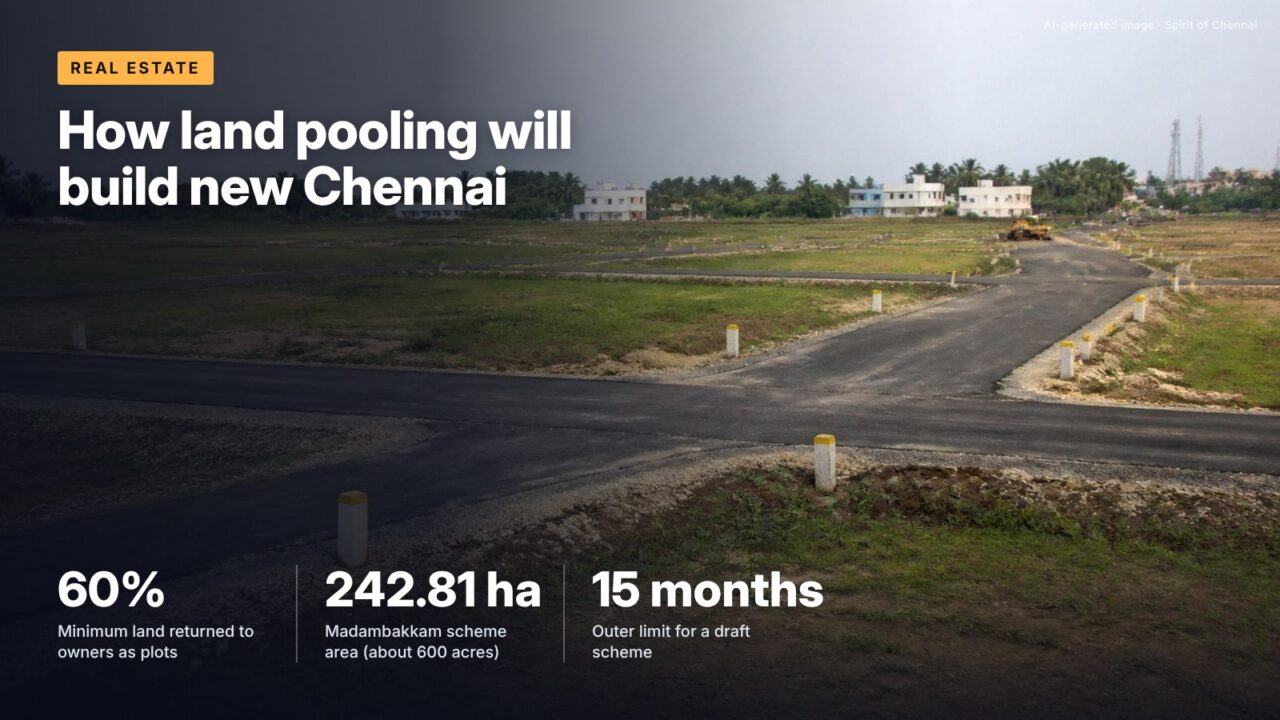
Tamil Nadu now has a working law that lets planners assemble land for new neighbourhoods without acquiring it: owners pool their plots and get at least 60% back as serviced plots. Here is how the 2023 law and 2024 rules work, and where the first Chennai scheme, at Madambakkam, has got to.
The numbers
Under Chapter IV-A of the Tamil Nadu Town and Country Planning Act, as rewritten in 2023, a planning authority can draw a line around farmland on the city’s edge, pool every plot inside it, lay roads and services, and hand at least 60% of the area back to the original owners as reconstituted plots. The rest, up to 40%, goes to roads, parks, social infrastructure and plots the authority sells to pay for the works, according to the amending Bill introduced on 19 April 2023.
The first scheme in the Chennai region is at Madambakkam in Chengalpattu district, about 242.81 hectares. A government order of 13 December 2024 gave CMDA six more months from 14 December 2024 to publish its draft. How it fares will show whether land pooling can supply the serviced land that the enlarged metropolitan area needs.
Why the state rewrote the law
Land pooling first entered the Act through a 2018 amendment that was never brought into force. The 2023 Bill’s statement of objects says those provisions were found ineffective and needed revamping to win wider participation from landowners. The rewritten Act was commenced under G.O.Ms.No.62 of 22 June 2023, and the Tamil Nadu Land Pooling Area Development Scheme Rules, 2024 followed under G.O.Ms.No.16 of 14 January 2024, according to the CMDA and Town and Country Planning order lists.
The context is scale. The housing department’s 2024-25 policy note records that the Chennai Metropolitan Area was expanded in 2022 from 1,189 sq km to 5,904 sq km, through G.O.Ms.No.184 of 21 October 2022, which added contiguous areas of Kancheepuram, Thiruvallur, Chengalpattu and Ranipet districts. Acquiring land at that scale for roads and services is slow and costly; pooling is the alternative the state has chosen to test.
How a scheme moves, step by step
| Stage | Section | Time limit |
|---|---|---|
| Declaration of intention, with government approval | 39-A | Starts the clock |
| Designated officer appointed | 39-D | Within 1 month |
| Draft scheme published | 39-I | 9 months, extendable by 6; lapses after 15 |
| Objections to draft | 39-K | 60 days |
| Government decision on draft | 39-L | 3 months |
| Preliminary scheme | 39-N, 39-O | 9 months, then 2 months for approval |
| Final scheme | 39-Q, 39-S | 9 months, then 2 months for approval |
| Appeal to Director or authority | 39-R | 1 month |
| Revision in High Court | 39-V | 60 days, extendable by 30 |
Source: Tamil Nadu Town and Country Planning (Third Amendment) Amendment Bill, 2023, Chapter IV-A, as summarised from L.A. Bill No. 14 of 2023
A scheme can start in three ways. The planning authority can declare one with prior government approval; the government can direct an authority to prepare one; or owners holding 70% of the land in an area can bring one forward, as can a government department or public sector body. After the declaration, any development in the area needs permission, and unauthorised work can be stopped and reversed.
If owners of more than half the land object to a draft scheme, the government must withdraw it, under Section 39-L(4) of the 2023 amendment.
What owners get, and what they pay
Section 39-H fixes the shares. At least 60% of the area returns to owners as reconstituted plots, or they receive compensation under the final scheme. Roads, parks, social infrastructure and sale plots together take up to 40%. Within that, up to 10% can be used for housing for economically weaker sections and people displaced by the scheme. Money from sale plots must go to infrastructure and compensation.
Owners are not simply handed free plots. The final scheme levies a betterment contribution on each plot, proportionate to the estimated rise in its value, with religious and charitable plots exempt. Sums due are a first charge on the final plot and can be recovered as arrears of land revenue. In return, the owner’s plot is smaller but sits on a laid-out road with services, which in a fast-growing fringe can be worth more than the larger raw parcel.
The protections, and their limits
The 50% objection threshold is the main safeguard: a scheme that a majority of landowners by area reject cannot proceed. But the threshold is measured on land, not people, so a few large holders count for more than many small ones. Once the approved draft is published, land needed for the scheme vests in the authority after two months without affecting ownership; at the preliminary stage it vests absolutely unless the scheme says otherwise, and the authority can evict and remove structures. After the preliminary scheme is approved, it can no longer be withdrawn.
It’s often said land pooling is just land acquisition under another name.
The record shows Under Chapter IV-A owners keep at least 60% of the area as reconstituted plots and can force withdrawal of a draft if owners of more than half the land object. Acquisition carries no such return or veto.
Where Madambakkam stands
The CMDA land pooling page lists one scheme, Madambakkam, with its declaration of intention published in the Chengalpattu District Gazette. Under Section 39-I a draft must follow within nine months of the declaration, extendable by six. The December 2024 order used that proviso to extend the deadline by six months from 14 December 2024 for the draft scheme covering about 242.81 hectares (600 acres). Section 39-I also says a declaration lapses if no draft appears within fifteen months in all. CMDA’s page, as checked for this article, still lists only the declaration stage, so whether a draft has been published is not clear from it.
There are older models nearby. The Tamil Nadu Housing Board’s Tirumazhisai satellite town covers 311.05 acres on the Chennai–Bengaluru highway, with Phase I of 123 acres developed at ₹245.70 crore, according to the 2022-23 housing policy note. That was built on land the Board owned. Madambakkam is the first test of building a neighbourhood on land the authority does not.
What this means for you
- If you own land near Madambakkam, read the declaration in the Chengalpattu District Gazette and track the draft; objections are due within 60 days of its publication.
- After a declaration, development in the area needs the authority’s permission; do not buy or build there on the assumption it does not.
- Expect a betterment contribution on your returned plot; ask how it will be estimated before the final scheme.
- A scheme can be withdrawn if owners of more than 50% of the land object to the draft, so coordinated objections matter.
What to watch
Pending
Publication of the Madambakkam draft scheme, or confirmation of its status, on CMDA’s land pooling page.
Pending
Any further schemes in the expanded Chennai Metropolitan Area under the 2024 rules.
Checked against official sources on 23 October 2026. Figures and rules change; confirm on the linked official pages before relying on them.
Sources
- Tamil Nadu Town and Country Planning (Third Amendment) Amendment Bill, 2023 (L.A. Bill No. 14 of 2023), via PRS Legislative Research
- G.O.Ms.No.242, Housing and Urban Development, 13 December 2024: Madambakkam LPADS time extension, TN Government Gazette No. 405
- Land Pooling Area Development Scheme page, Chennai Metropolitan Development Authority
- Government Orders, Directorate of Town and Country Planning, Tamil Nadu
- Government Orders list, Chennai Metropolitan Development Authority
- Policy Note 2024-25, Housing and Urban Development Department, Government of Tamil Nadu
- Policy Note 2022-23, Housing and Urban Development Department, Government of Tamil Nadu