Tamil Nadu has audited hundreds of public buildings for disability access and won central money to fix some of them. The policy notes show how far that has gone since the Rights of Persons with Disabilities Act took effect, and what remains on paper.
The numbers
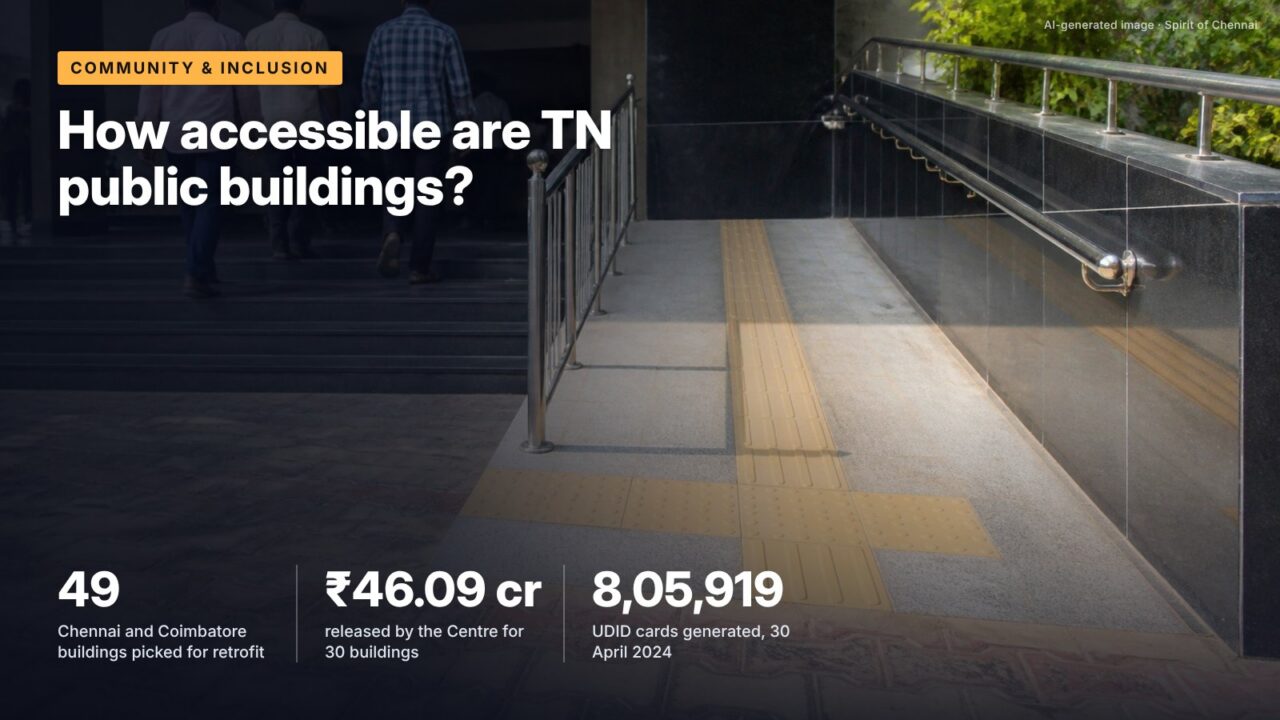
Under the Accessible India Campaign, the Union government’s programme to make public buildings usable by disabled people, Tamil Nadu selected 49 buildings in Chennai and Coimbatore for barrier-free works. The Centre has released ₹4,608.95 lakh (about ₹46.09 crore) for 30 of them, and civil work is under way, the Welfare of Differently Abled Persons Department’s 2024-25 policy note says. Separately, the department has paid for access audits of 74 buildings in Chennai and 176 in ten cities.
Those numbers are modest against the size of the job. Tamil Nadu has thousands of government offices, schools, hospitals and bus stands. The useful question is not whether the state has a programme, but how the law converts audits into ramps, lifts and usable toilets, and how quickly.
What the law requires
The Rights of Persons with Disabilities Act, 2016, in force from 19 April 2017, recognises 21 categories of disability and makes accessibility of public buildings, transport and services a legal duty rather than a welfare favour. Tamil Nadu framed its own rules under section 101 in 2018. The state has constituted a State Advisory Board under section 66 and district committees under section 72, designated special courts under section 84 and named Special Public Prosecutors under section 85, according to the policy note. It has also notified an Equal Opportunity Policy, which every government establishment must follow, and reserves 5% of higher education seats for disabled students.
The administrative base is older than the Act. The state set up a separate Directorate for the Rehabilitation of the Disabled in 1992, issued a state disability policy in 1994 and upgraded the office to a State Commissioner in 1999 under the earlier 1995 Act, the Commissionerate’s history page records.
From audit to retrofit, 2021 and 2024
| Measure | Policy Note 2021-22 | Policy Note 2024-25 |
|---|---|---|
| Access audits, Chennai buildings | 72 | 74 (₹12.45 lakh) |
| Access audits, statewide | 176 | 176 in 10 cities (₹44.84 lakh) |
| Accessible India Campaign, buildings | Stage 1: 16 done (₹22.08 cr); Stage 2: 14 sanctioned (₹28.56 cr) | 49 selected; ₹46.09 cr released for 30 |
| Department budget | ₹813.63 cr (2021-22) | ₹1,389.16 cr (2024-25) |
| UDID cards | more than 3.18 lakh | 8,05,919 (30 April 2024) |
| Maintenance allowance | ₹1,500 a month, 1,96,144 people | ₹2,000 a month, 2,35,906 people (2023-24) |
Source: Welfare of Differently Abled Persons Department, Policy Notes 2021-22 and 2024-25
Read together, the two notes show slow progress on buildings and fast progress on identity and cash support. The first stage of the campaign, 16 buildings at ₹22.08 crore, was complete by 2021, with the Centre having released half the cost. The second, 14 buildings for ₹28.56 crore, was “to commence shortly” then; the 2024 note reports a single figure of 30 funded buildings with civil works ongoing, which suggests the second stage was still not finished three years later. The 2021-22 note also recorded sanction for audits of 200 tourist places and 790 revenue and block offices, which the 2024 note does not report as completed.
Growth in UDID cards between the two policy notes, from more than 3.18 lakh to 8,05,919, the national disability card now used as proof of eligibility (Policy Note 2024-25).
It’s often said a building that has been “access audited” is now accessible.
The record shows An audit only lists what must change. The 2024-25 note reports audits of 176 buildings but retrofit funding for 30, with civil works still ongoing (WDAP Policy Note 2024-25).
Buses and travel
Transport is where the Act’s promise meets daily life. The 2021 note recorded an audio announcement system in 75 Chennai buses, useful for blind passengers, and cited the national bus body code but no fleet-wide figures on low-floor or ramp-equipped buses. Disabled passengers travel free in government buses with a pass, and with an escort in town buses; visually impaired people may travel up to 100 km in mofussil buses without conditions. In 2023-24, 35,294 people used free travel, and the 75% concession covered 13.80 lakh trips at a cost of ₹69.56 crore.
Jobs and the 4% rule
Section 34 of the Act reserves 4% of posts in government establishments for people with benchmark disabilities, meaning 40% or more. The 2021 note said 559 posts in groups A and B, and all group C and D posts, had been identified as suitable, that 1,645 disabled people had been appointed against the reservation, and that a special recruitment drive had been ordered for backlog vacancies, without giving the backlog size. By 2024 the state had set up an expert committee to identify suitable posts and a high level committee on reservation in promotion. Neither note publishes the number of reserved posts actually filled across departments, which is the figure that would show compliance.
Where the money goes
The department’s budget roughly doubled from ₹667.08 crore in 2020-21 to ₹1,389.16 crore in 2024-25. Most of it is cash support: social security, meaning the maintenance allowance and free travel, takes 57.96%. The six-year Rights Project, begun in 2022 with World Bank support and a total budget of ₹1,773.87 crore, takes 19.83% and funds the audits and service centres. Disabled people also draw pensions through the Revenue Department, which reported 4,39,178 beneficiaries of its state disability pension and 62,109 of the national disability pension in March 2024 (Revenue Policy Note 2024-25).
The pension rules show how much the support has moved. In 2021 the Revenue Department’s state disability pension was ₹1,000 a month for anyone aged 18 or over with 40% disability and no regular job, according to its 2021-22 policy note; it is now ₹1,500. Neither department publishes how many disabled people receive both a pension and the maintenance allowance, or how many receive neither.
What this means for you
- If a government office in Chennai is not accessible, write to the District Differently Abled Welfare Officer and cite the RPwD Act; accessibility is a legal duty, not a request.
- Get a UDID card. It is now the main proof for allowances, travel concessions and job reservation.
- For job applications, check whether the post is listed as identified for your disability category; only identified posts carry the 4% reservation.
- Complaints about denial of rights go to the State Commissioner for Persons with Disabilities, and serious cases can go to the designated special court.
What to watch
Pending
Completion of civil works in the 30 buildings funded under the Accessible India Campaign, and funding for the remaining selected buildings.
2028
The six-year Rights Project, begun in 2022, reaches the end of its planned term; watch for its results on access audits and retrofits.
Checked against official sources on 23 October 2026. Figures and rules change; confirm on the linked official pages before relying on them.
Sources
- Welfare of Differently Abled Persons Department Policy Note 2024-25 (Government of Tamil Nadu)
- Welfare of Differently Abled Persons Department Policy Note 2021-22 (Government of Tamil Nadu)
- Commissionerate for the Welfare of the Differently Abled: About us (Government of Tamil Nadu)
- Revenue and Disaster Management Department Policy Note 2024-25: social security pensions (Government of Tamil Nadu)
- Revenue and Disaster Management Department Policy Note 2021-22 (Government of Tamil Nadu)