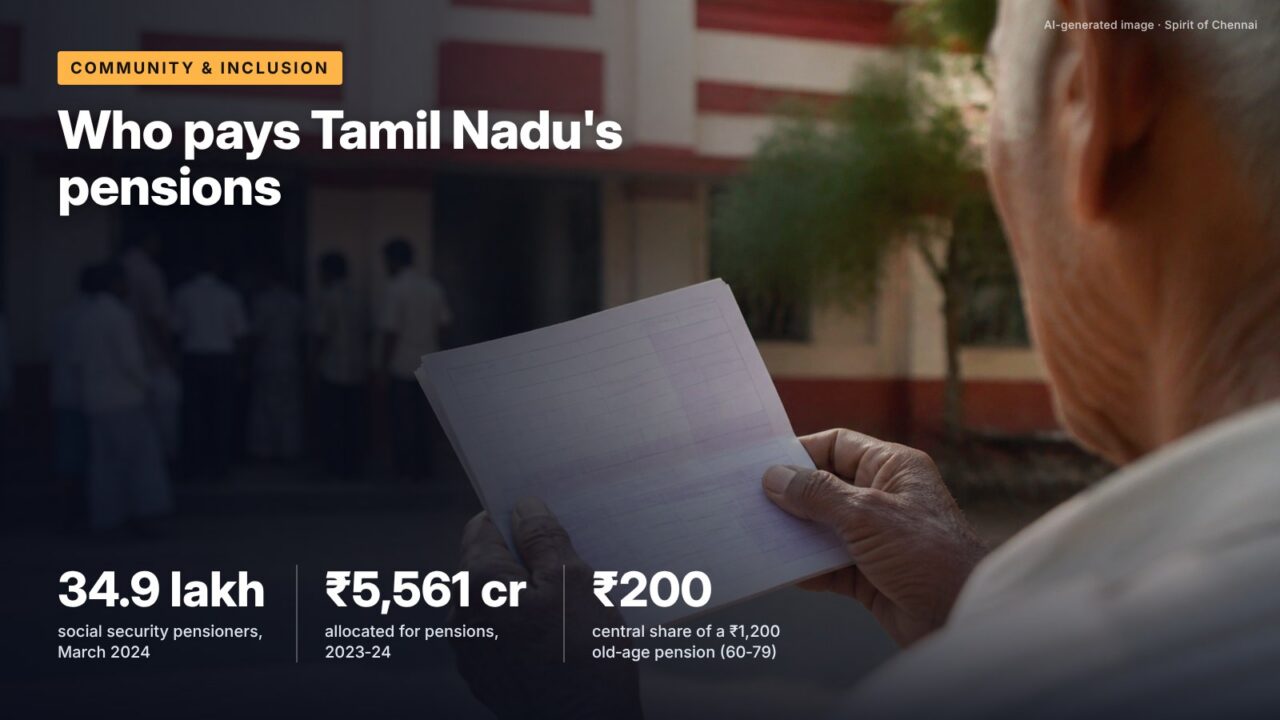
Nearly 35 lakh people in Tamil Nadu draw a monthly state pension. The schemes carry central names, but the state pays most of the money, and the rolls have barely grown in three years.
The numbers
Tamil Nadu paid social security pensions to 34,90,969 people in March 2024 under nine schemes, and allocated ₹5,561.31 crore for them in 2023-24, according to the Revenue and Disaster Management Department’s 2024-25 policy note. Most pensioners receive ₹1,200 a month; disability pensions are ₹1,500.
Two features of these numbers are easy to miss. The first is how little comes from the Centre: for an old-age pensioner aged 60 to 79, the Union government pays ₹200 of the ₹1,200, and the state pays ₹1,000. The second is how slowly the rolls have grown. In August 2021 the count was 34,12,916, so in about two and a half years the number of pensioners rose by roughly 78,000, or 2.3%, while the monthly amount rose by a fifth.
Who gets what
| Scheme | Beneficiaries, Mar 2024 | Centre (₹/month) | State (₹/month) | Total (₹/month) |
|---|---|---|---|---|
| National old-age pension (IGNOAPS), 60-79 | 14,18,073 (all ages) | 200 | 1,000 | 1,200 |
| National old-age pension (IGNOAPS), 80+ | included above | 500 | 700 | 1,200 |
| Destitute widow pension (state) | 6,67,036 | nil | 1,200 | 1,200 |
| National widow pension (IGNWPS) | 5,08,042 | 300 | 900 | 1,200 |
| Differently abled pension (state) | 4,39,178 | nil | 1,500 | 1,500 |
| Uzhavar Pathukappu old-age pension (state) | 2,48,262 | nil | 1,200 | 1,200 |
| Destitute or deserted wives (state) | 1,18,407 | nil | 1,200 | 1,200 |
| National disability pension (IGNDPS) | 62,109 | 300 | 1,200 | 1,500 |
| Unmarried women aged 50+ (state) | 25,542 | nil | 1,200 | 1,200 |
| Sri Lankan refugee pensions (state) | 4,320 | nil | 1,200 or 1,500 | 1,200 or 1,500 |
| Total | 34,90,969 |
Source: Revenue and Disaster Management Department, Policy Note 2024-25, beneficiary table and Table 2.3
The national schemes, named after Indira Gandhi and run under the Centre’s National Social Assistance Programme, cover about 20 lakh people. The other 15 lakh are on schemes the state funds alone, such as the destitute widow pension, the pension for deserted wives and the pension for unmarried women over 50. Even within the national schemes the state carries most of the cost, so the “central” label says more about eligibility rules than about who pays.
Approximate allocation per pensioner per year in 2023-24: ₹5,561.31 crore divided by 34.9 lakh beneficiaries (Policy Note 2024-25).
That figure is a little above twelve payments of ₹1,200 (₹14,400), partly because disability pensions are ₹1,500 and partly because the allocation is a budget line, not an audited spending total; the March 2024 headcount and the year’s allocation are not perfectly matched in time.
How the rules decide coverage
Eligibility is narrow by design. The national old-age pension requires a person to be 60 or over, destitute and below the poverty line; the national widow pension starts at 40 and the national disability pension requires 80% disability. The state schemes add their own tests: an asset limit of ₹1 lakh for the destitute widow, deserted wife, unmarried women and landless labourer pensions, ignored if the applicant lives in a free government house; and for the state disability pension, 40% disability and no regular job, or private income of no more than ₹3 lakh a year. The deserted wives pension requires separation for at least five years or a court certificate.
These rules explain the slow growth. The headcount is set less by how many old or widowed people there are than by how many pass a destitution test that has not been loosened. The policy notes publish no figure for rejected or pending applications, so it is not possible to tell from official data how many people apply and are turned away.
Three years of change
| Measure | Policy Note 2021-22 | Policy Note 2024-25 |
|---|---|---|
| Total pensioners | 34,12,916 (25 August 2021) | 34,90,969 (March 2024) |
| Standard monthly pension | ₹1,000 | ₹1,200 (from August 2023) |
| Disability pension | ₹1,000 | ₹1,500 (from 1 January 2023) |
| Annual allocation | ₹4,807.56 cr (2021-22) | ₹5,561.31 cr (2023-24) |
| Centre’s share, old-age 60-79 | ₹200 | ₹200 |
Source: Revenue and Disaster Management Department, Policy Notes 2021-22 and 2024-25
It’s often said old-age pensions are a central scheme paid for by New Delhi.
The record shows For most old-age pensioners the Centre pays ₹200 of ₹1,200 a month, and a large group of pensions are funded entirely by the state (Table 2.3, Policy Note 2024-25).
One name causes confusion. The Uzhavar Pathukappu pension above, paid to 2,48,262 landless agricultural labourers, is only one part of the Chief Minister’s Uzhavar Pathukappu Thittam, a wider welfare scheme for farm workers with 2,83,28,270 registered members and dependants as on 31 March 2024. That wider scheme paid ₹184.18 crore to 1,38,494 beneficiaries in 2023-24 for purposes other than the monthly pension, so the two sets of figures should not be added together.
Disability support runs on two tracks
Disabled people can be paid from two different departments. The Revenue Department’s pensions above cover about 5 lakh people. Separately, the Welfare of Differently Abled Persons Department pays a maintenance allowance of ₹2,000 a month, which reached 2,35,906 people in 2023-24 at a cost of ₹567.49 crore. The two are separate schemes with separate rules, which confuses applicants; the department that handles the application decides which one applies. Health support for older pensioners runs through yet another department: the Health Department’s doorstep screening and medicine scheme, Makkalai Thedi Maruthuvam, reported 1.72 crore beneficiaries in its 2024-25 policy note.
How payment and applications work
Applications for all social security pensions can be made online through the Commissionerate of Revenue Administration’s portal. Revenue officials verify the claim and the Special Tahsildar for social security schemes sanctions it, and the prescribed time limit is 30 days. Under G.O.(Ms) No.572 of 30 November 2023, pensions are being paid by direct benefit transfer to bank accounts on a pilot basis in Ariyalur and Perambalur, with extension to other districts being pursued.
What this means for you
- Apply online and keep the acknowledgement; if there is no decision in 30 days, follow up with the Special Tahsildar (Social Security Scheme) at your taluk office.
- Check which scheme fits: a widow under 40, for example, is eligible only for the state destitute widow pension, not the national one.
- Disabled applicants should ask about both the Revenue pension and the disability department’s ₹2,000 maintenance allowance.
- Keep your bank account active and linked; direct transfer is being extended beyond the pilot districts.
What to watch
Pending
Extension of direct benefit transfer of pensions beyond Ariyalur and Perambalur, under G.O.(Ms) No.572 of 2023.
Pending
The 2026-27 Revenue policy note, the first under the new government, for any change to pension amounts or eligibility.
Checked against official sources on 23 October 2026. Figures and rules change; confirm on the linked official pages before relying on them.
Sources
- Revenue and Disaster Management Department Policy Note 2024-25: social security pension schemes (Government of Tamil Nadu)
- Revenue and Disaster Management Department Policy Note 2021-22 (Government of Tamil Nadu)
- Online application for Social Security Scheme pensions (Commissionerate of Revenue Administration, Tamil Nadu)
- Welfare of Differently Abled Persons Department Policy Note 2024-25: maintenance allowance (Government of Tamil Nadu)
- Health and Family Welfare Department Policy Note 2024-25 (Government of Tamil Nadu)