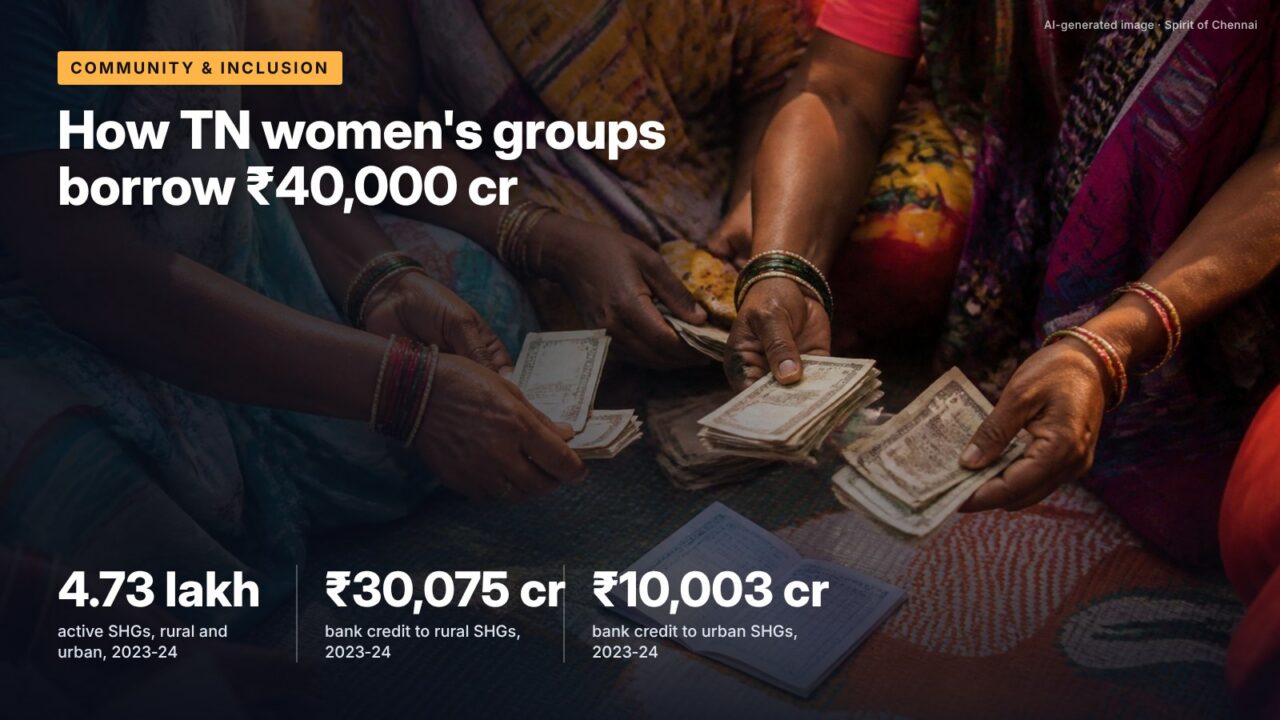
Banks lent Tamil Nadu’s rural women’s self-help groups ₹30,075 crore in 2023-24, five times the target set a decade earlier. The policy notes show how the credit machine works, and what they leave out.
The numbers
In 2023-24, banks gave ₹30,074.76 crore to 4,79,350 rural self-help groups in Tamil Nadu against a target of ₹30,000 crore, and ₹10,003.42 crore to 1,78,805 urban groups, according to the Tamil Nadu Corporation for Development of Women’s 2024-25 policy note. Together that is just over ₹40,000 crore of credit to women’s groups in a single year.
Ten years earlier the ambition was much smaller. A Rural Development Department letter of August 2014 set a target of ₹6,000 crore in bank loans to SHGs and their federations for 2014-15, following a Chief Minister’s announcement in the Assembly. The rural achievement in 2023-24 was five times that target, although the 2014 target also covered loans to federations, so the comparison is approximate.
How the system is built
A self-help group is 12 to 20 women, aged 18 to 60, from the same neighbourhood, who save together and lend to each other before borrowing from a bank, the Kancheepuram district’s scheme page explains. Groups in a village panchayat form a Panchayat Level Federation (PLF), and PLFs form Block Level Federations; all 388 block federations are now registered. The rural programme, the Tamil Nadu State Rural Livelihoods Mission, has run since 2012-13 with Centre and state funding in a 60:40 ratio. Urban groups come under a separate urban livelihoods mission. The movement itself is older: the state’s Mahalir Thittam began in 1997, and Chennai was the last district brought in, in 2000.
Public money enters at three points. A new group gets a revolving fund, ₹15,000 for a rural group and ₹10,000 for an urban one. Federations can lend to groups from a Community Investment Fund, up to ₹1.50 lakh per group at a maximum of 9%. And the state subsidises interest on bank loans: rural loans up to ₹3 lakh are charged 7%, and loans of ₹3 lakh to ₹5 lakh the lower of the bank’s one-year MCLR or 10%.
Credit linkage, year by year
| Year | Target (₹ cr) | Achieved (₹ cr) | Groups credit-linked |
|---|---|---|---|
| 2014-15 | 6,000 (SHGs and PLFs) | not stated | not stated |
| 2021-22 | 20,000 | 21,392.52 | not stated |
| 2022-23 | 25,000 | 25,022.19 (later 25,642.01) | 4,39,349 |
| 2023-24 | 30,000 | 30,074.76 | 4,79,350 |
Source: Rural Development Department letter (D) No. 383 of 27 August 2014; TNCDW Policy Notes 2023-24 and 2024-25 (rural SHG bank linkage)
Two details deserve attention. The 2022-23 achievement is given as ₹25,022.19 crore in one note and ₹25,642.01 crore in the next, a revision of about ₹620 crore that the notes do not explain; the later figure is presumably final. And the average loan per rural group rose from ₹5.68 lakh in 2022-23 to ₹6.27 lakh in 2023-24, so growth now comes as much from bigger loans as from more groups. Divided among 12 to 20 members, ₹6.27 lakh is roughly ₹31,000 to ₹52,000 per woman.
New rural SHGs formed between 2014-15 and 2022-23 under the rural livelihoods mission, peaking at 42,724 in 2016-17 (Policy Note 2023-24).
The urban side is smaller but not minor. The urban mission has formed 1,16,904 groups since 2014, besides 12,817 older groups, and cumulative urban bank linkage stood at ₹33,467 crore in the 2023-24 note. Urban groups that repay on time get an additional 3% interest subsidy on top of the subsidy that brings the rate down to 7%, so a prompt urban borrower can pay well below the bank’s headline rate.
Formation has slowed, lending has not
The 2023-24 note counts new rural groups each year: 11,328 in 2014-15, a peak of 42,724 in 2016-17, then between about 8,800 and 29,000 a year, and 13,508 in 2023-24 according to the later note. Active groups were 4.48 lakh in the 2023-24 note and 4.73 lakh in the 2024-25 note. In other words, the base of groups is now growing slowly. The 4,79,350 rural groups reported as credit-linked in 2023-24 is larger than the count of active rural groups in the earlier note (3.18 lakh), which suggests the linkage figure counts loans, including repeat loans, rather than distinct groups; the notes do not say. The 2023-24 note identified 31.87 lakh eligible households still to be mobilised into groups, which marks the remaining room for growth.
Repayment and the risk side
The notes say little about bad loans. The 2023-24 note reported 3,414 recovery camps held in 2022-23 that recovered ₹18.38 crore of non-performing loans, and the 2024-25 note sets a target of under 5% of loans overdue by more than 30 days for model block federations. Neither publishes a statewide non-performing asset ratio for SHG loans, the number that would tell a reader whether ₹40,000 crore a year is sustainable.
It’s often said SHG loans are government grants that women do not have to repay.
The record shows They are bank loans. The state’s interest subsidy lowers the rate to 7% on smaller loans, and recovery camps chase overdue accounts (Policy Note 2024-25).
What the money is used for
The livelihood side is smaller but growing. The World Bank-supported Vazhndhu Kaattuvom 2.0 project, budgeted at ₹910.37 crore and covering 3,994 village panchayats in 120 blocks, funds producer and enterprise groups and community skill schools; Chennai is not covered. The MaThi brand sells SHG products through 134 kiosks and exhibitions, which recorded ₹3.65 crore in sales in 2022-23. For Chennai’s women, the urban mission works among others in Corporation resettlement tenements, though the notes give no Chennai-specific credit figures. In 2014, Chennai’s district target of ₹352 crore was the second highest in the state. Many SHG members also draw pensions under the social security schemes, which are separate from group credit.
What this means for you
- In Chennai, women’s groups are organised under the urban livelihoods mission rather than the rural one; ask the Mahalir Thittam office for Chennai how to join or form a group.
- Keep the group’s savings, meetings and records regular for at least three to six months; banks and federations look at this before the first loan.
- Ask your bank about the interest subsidy. Prompt repayment keeps the effective rate at 7% on loans up to ₹3 lakh.
- Borrow for an activity that produces income; the loan has to be repaid from the group’s monthly collections.
What to watch
Pending
The 2024-25 credit linkage achievement in the next TNCDW policy note, and whether the ₹30,000 crore rural level was exceeded.
Pending
Any statewide figure on overdue SHG loans, which neither recent note publishes.
Checked against official sources on 23 October 2026. Figures and rules change; confirm on the linked official pages before relying on them.
Sources
- Rural Development (TNCDW / Mahalir Thittam) Policy Note 2024-25 (Government of Tamil Nadu)
- Rural Development (TNCDW / Mahalir Thittam) Policy Note 2023-24 (Government of Tamil Nadu)
- Letter (D) No. 383, Rural Development and Panchayat Raj Department, 27.08.2014: ₹6,000 crore SHG credit (Government of Tamil Nadu)
- Tamil Nadu State Rural Livelihood Mission, Kancheepuram district (District administration, Government of Tamil Nadu)
- Revenue and Disaster Management Department Policy Note 2024-25 (Government of Tamil Nadu)