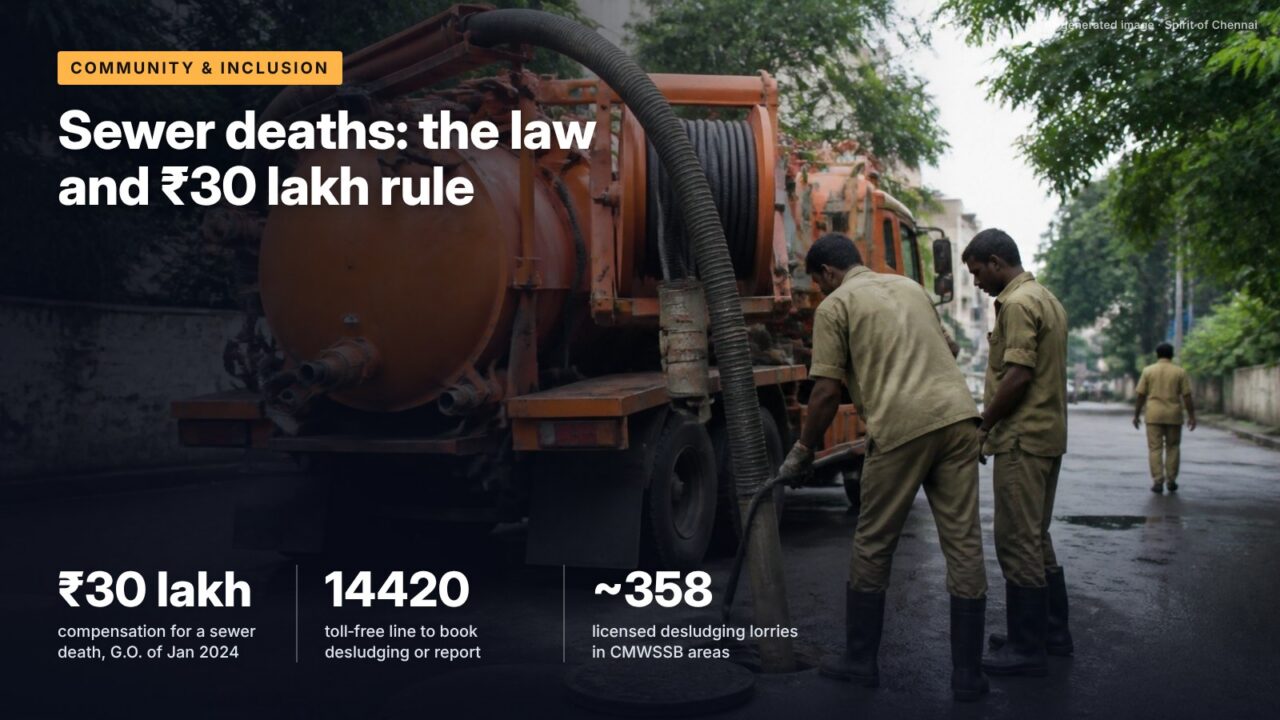
Since January 2024, the family of anyone who dies cleaning a sewer or septic tank in Tamil Nadu is owed ₹30 lakh. The law has banned the work outright for more than a decade. The gap between the two is where the deaths happen.
The numbers
Tamil Nadu’s Municipal Administration and Water Supply Department fixed compensation for a death during sewer or septic tank cleaning at ₹30 lakh in G.O.(Ms) No.5 of 23 January 2024, with at least ₹10 lakh for injury and at least ₹20 lakh for permanent disability that leaves a worker unable to earn. The figures follow the Supreme Court’s judgment of 20 October 2023 in Dr. Balram Singh v. Union of India, and are set out in the Chennai water board’s operating procedure for desludging.
Compensation is the end of the chain, paid after a death. The law’s real aim is that nobody enters a sewer or tank at all. That is why the same document lists Chennai’s licensed desludging lorries by area and tells householders, in plain terms, what they must refuse to allow.
What the 2013 Act prohibits
The Prohibition of Employment as Manual Scavengers and their Rehabilitation Act, 2013, works through two definitions. A “manual scavenger” handles human excreta by hand in insanitary latrines and similar places. “Hazardous cleaning” is manual cleaning of a sewer or septic tank by a worker whose employer has not provided the protective gear and devices the rules require. Section 7 bars any person, local body or agency from engaging anyone for hazardous cleaning, and section 9 punishes it. The CMWSSB procedure describes the penalty as imprisonment of up to two years or a fine, or both, for a first offence, rising to three years for a repeat. Where the worker is a Scheduled Caste or Scheduled Tribe member, the SC/ST (Prevention of Atrocities) Act also applies, and where a forced entry causes death, the relevant criminal law provisions apply.
What the Supreme Court ordered
The 2023 judgment did three things. It raised compensation for sewer deaths to ₹30 lakh, applicable to deaths since 1993 where families had not been paid. It set minimum disability compensation at ₹10 lakh, and ₹20 lakh where the disability leaves the victim economically helpless. And it told governments to phase out manual sewer cleaning altogether, to cancel contracts and impose liability where outsourced work causes a death, to build model contracts that require compliance with the Act, to conduct a proper national survey, and to set up a public portal on sewer deaths, compensation and rehabilitation.
Deaths from hazardous cleaning since 1993 reported by the Union ministry and cited by the Court, with compensation paid to 948 families (Balram Singh judgment).
The counting problem
| Measure | Figure | As cited |
|---|---|---|
| Deaths from hazardous cleaning since 1993 | 1,035 | Union ministry, in the 2023 judgment |
| Deaths after 2013 | 663 (compensation in 631, FIRs in 648) | Union, in the 2023 judgment |
| Sewer deaths in 2022-23 (to 31 March 2023) | 167 | NCSK, in the 2023 judgment |
| Manual scavengers identified, 2013 survey | 13,881 | Union, in the 2023 judgment |
| Manual scavengers identified, 2018 survey (194 districts) | 44,217 | Union, in the 2023 judgment |
| Sewer and septic tank workers profiled, Aug 2025 | 84,902 | NAMASTE, PIB |
Source: Supreme Court of India, Dr. Balram Singh v. Union of India, 20 October 2023; PIB, NAMASTE backgrounder, September 2025
The Court was sharply critical of these numbers. It found that both the 2013 and 2018 surveys failed to follow the Act and its rules, and pointed to state figures that jumped or vanished between rounds. The National Commission for Safai Karamcharis, the body that tracks these deaths, is not a statutory body, and the Court noted that it had four member posts vacant and was not functioning for part of 2022-23. No official state-wise series of sewer deaths for Tamil Nadu could be found on a government site during research for this article, which is itself a finding: the portal the Court ordered would fill exactly this gap.
It’s often said if no one is employed as a “manual scavenger”, a death in a septic tank is simply an accident.
The record shows The 2013 Act separately defines “hazardous cleaning” and makes engaging anyone for it an offence; employers who skip protective gear are liable, and the Court tied compensation to these deaths regardless of label (Balram Singh, para 96).
How Chennai is supposed to do it now
The CMWSSB procedure, issued under the state’s Septage Management Regulations and Operative Guidelines, 2023, puts the responsibility on everyone in the chain. Householders book a licensed lorry through the toll-free line 14420, which also takes complaints about unsafe cleaning. The document lists around 358 licensed lorries, grouped by area from Thiruvottiyur and Manali in the north to Perungudi and Sholinganallur in the south, each with its licence number and validity. The householder must show where the tank is, must not allow anyone to enter it, must not let the lorry draw power from the house, must see that workers wear a mask, gloves, helmet, coverall and gum boots, and must sign an undertaking form after the work.
The national scheme for sanitation workers
The national NAMASTE scheme supports this by identifying and equipping workers. By August 2025 it had profiled 84,902 sewer and septic tank workers, delivered 45,871 protective kits, covered 54,140 people under health insurance, paid ₹20.36 crore in capital subsidy to 707 workers and dependants, and helped constitute 642 emergency response sanitation units, according to PIB. Its outlay of ₹349.70 crore ran through 2025-26.
The state’s older public health law points the same way. The 1939 Public Health Act places drainage and cesspools under local authority control (sections 27 to 36), which is why the Corporation and the water board, not private households alone, answer for how sewage is handled. Where a worker who dies belongs to a Scheduled Caste, atrocity-law relief can also follow; the Adi Dravidar Welfare Department reported ₹71.45 crore in PoA Act relief across all case types in 2023-24.
What this means for you
- Never allow anyone to climb into your septic tank or a sewer manhole, even “just to loosen it”. Doing so can make you liable under the 2013 Act.
- Book desludging only through 14420 or a lorry with a valid CMWSSB licence, and keep the booking ID.
- Check that workers have masks, gloves, gum boots and helmets before work starts, and sign the undertaking form.
- If a worker is injured or dies, the family is owed at least ₹10 lakh or ₹30 lakh; report the incident to 14420 and the police the same day.
What to watch
Pending
The national survey and public portal on sewer deaths ordered by the Supreme Court in October 2023, which would give the first reliable state-wise count.
2026-27
Whether NAMASTE, sanctioned through 2025-26, is extended, and on what scale.
Checked against official sources on 23 October 2026. Figures and rules change; confirm on the linked official pages before relying on them.
Sources
- Dr. Balram Singh v. Union of India, W.P.(C) No. 324 of 2020, judgment of 20 October 2023 (Supreme Court of India)
- Standard Operating Procedures for Mechanised Desludging of Septic Tanks, Part II: Service Seeker, January 2024 (CMWSSB)
- National Action for Mechanised Sanitation Ecosystem (NAMASTE), September 2025 (PIB)
- Adi Dravidar and Tribal Welfare Department Policy Note 2024-25: PoA Act relief (Government of Tamil Nadu)
- The Tamil Nadu Public Health Act, 1939, text via FAOLEX (FAO)