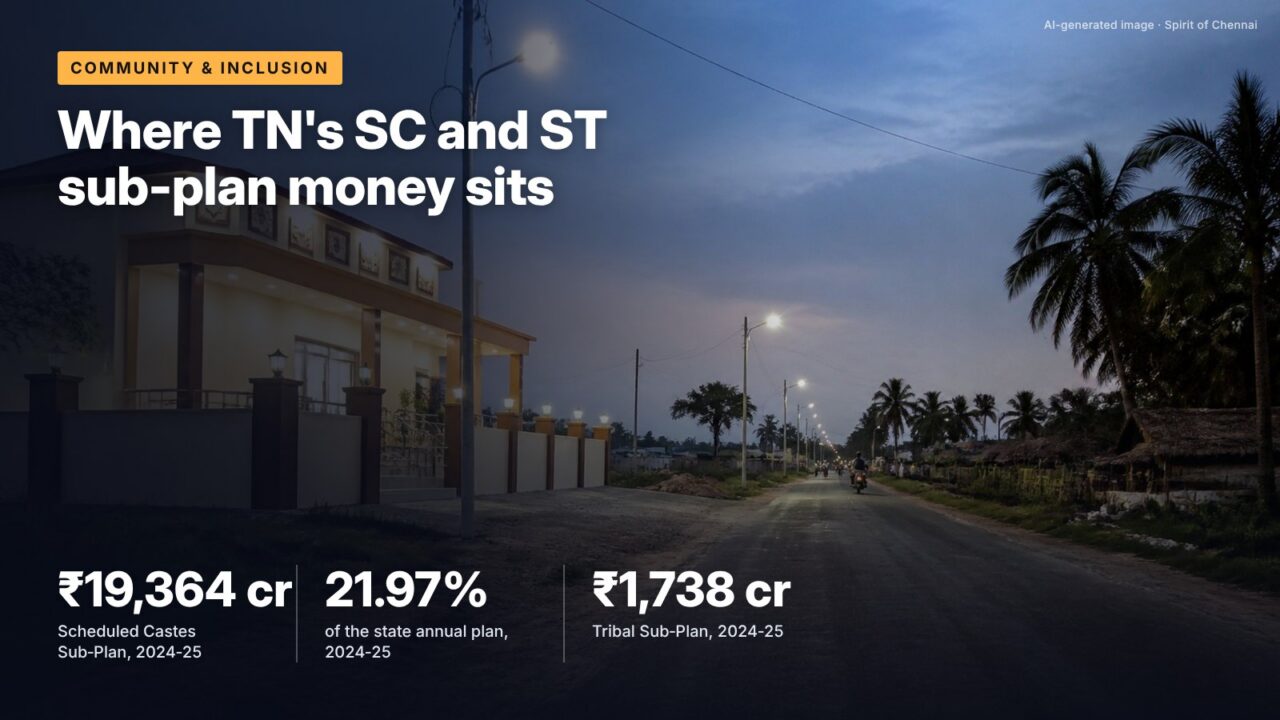
Tamil Nadu sets aside a fifth of its annual plan for Scheduled Castes and about 2% for Scheduled Tribes. Most of that money never passes through the department that carries their name, which is the first thing to understand about the sub-plans.
The numbers
For 2024-25, Tamil Nadu earmarked ₹19,363.56 crore under the Scheduled Castes Sub-Plan (SCSP) and ₹1,738.40 crore under the Tribal Sub-Plan (TSP), out of a state annual plan of ₹88,130.83 crore, according to the Adi Dravidar and Tribal Welfare Department’s policy note. That is 21.97% and 1.97% of the plan, against population shares of 20.01% and 1.17% in the 2011 Census.
The department’s own budget for the year was far smaller: ₹2,992.57 crore for Adi Dravidar welfare and ₹3,706.05 crore for the integrated Adi Dravidar and tribal welfare budget. The difference is the point of the sub-plan system. The SCSP is not a department budget; it is a share of every department’s plan spending that must be traced to schemes benefiting Scheduled Castes.
The gap the sub-plans are meant to close is visible in the department’s own figures: literacy among Adi Dravidars was 73.29% in the 2011 Census, against 80.09% for the state as a whole, which is why education takes most of the department’s budget.
How the sub-plan is meant to work
The idea is simple. If Scheduled Castes are a fifth of the population, at least a fifth of development spending should be shown to reach them, whether through roads to colonies, housing, scholarships, loans or electrification. Each department marks out the portion of its plan spending that qualifies, and the Adi Dravidar department acts as the nodal point that collects and reports it. Tamil Nadu allocates in proportion to population, 20.01% for Adi Dravidars and 1.17% for Scheduled Tribes, the policy note says, and in practice has earmarked slightly more than both shares.
Four years of allocations
| Year | State annual plan (₹ cr) | SCSP (₹ cr) | SCSP share | TSP (₹ cr) | TSP share |
|---|---|---|---|---|---|
| 2021-22 | 67,097.46 | 14,696.60 | 21.90% | 1,306.02 | 1.95% |
| 2023-24 | 77,930.30 | 17,075.70 | 21.91% | 1,595.89 | 2.05% |
| 2024-25 | 88,130.83 | 19,363.56 | 21.97% | 1,738.40 | 1.97% |
Source: Adi Dravidar and Tribal Welfare Department, Policy Notes 2021-22, 2023-24 and 2024-25 (allocations, not expenditure)
The SCSP grew by about 32% between 2021-22 and 2024-25 (₹19,363.56 crore against ₹14,696.60 crore), almost exactly in step with the plan itself, which grew about 31%. The share has stayed in a narrow band just under 22%. The TSP has grown a little faster than the plan, and its share has stayed above the 1.17% tribal population share every year in the series.
These are allocations. None of the four policy notes reports how much of each year’s SCSP or TSP was actually spent, which is the figure that would show whether the earmarking reached people. Without it, a reader can confirm that the promise was made in full, but not that it was kept.
The department’s 2022-23 budget estimate, with ₹1,798.71 crore for the central post-matric scholarship alone (Demand No. 4, 2022-23).
The department’s own budget, and why it fell
The department’s budget has moved in a way that looks alarming at first. It was ₹4,142.34 crore in the revised estimate for 2021-22, 84% of it for education, and ₹4,281.76 crore in the 2022-23 budget estimate. In 2023-24 it was ₹3,512.85 crore, with education down to 62.81%. The likely explanation lies in the post-matric scholarship, the department’s largest scheme. In 2022-23 the central post-matric scholarship was budgeted at ₹1,798.71 crore through the department. The 2024-25 note shows ₹472.50 crore for the scheme and explains that the state now releases its 40% share while the Union’s 60% goes directly to students. If that is the cause, the drop reflects a change in how money is routed rather than a cut in what students receive, though the notes do not set out the comparison themselves.
What the department runs directly
| Year | ADW hostels | Hostel inmates | ADW schools | Students in ADW schools |
|---|---|---|---|---|
| 2020-21 | 1,326 | 98,639 | 1,138 | 83,259 |
| 2021-22 | 1,324 | 98,509 | not stated | not stated |
| 2022-23 | 1,331 | 98,909 (sanctioned) | 1,138 | 87,729 |
| 2023-24 | 1,331 | 98,909 | 1,138 | 81,189 |
Source: Adi Dravidar and Tribal Welfare Department, Policy Notes 2021-22 to 2024-25
The hostel network has barely changed in four years: about 1,330 hostels holding about 99,000 students, most of them school hostels (1,141 in 2023-24, with 82,411 students) and 152 college hostels. The 2024-25 note’s inmate figure matches the previous year’s sanctioned strength exactly, which suggests it reports capacity rather than a fresh headcount. Enrolment in the department’s 1,138 schools fell from 87,729 to 81,189 in a year, a drop of about 7%, which the note does not explain. By comparison, the note counts 28,85,168 Adi Dravidar students in all government, aided and private schools, so the department’s own schools teach under 3% of them.
It’s often said the money for Scheduled Castes is the Adi Dravidar Welfare Department’s budget.
The record shows The 2024-25 SCSP of ₹19,363.56 crore is more than six times the department’s ₹2,992.57 crore; most of it sits in other departments’ schemes (Policy Note 2024-25).
Protection as well as development
The department also pays relief to victims under the Protection of Civil Rights Act and the SC/ST (Prevention of Atrocities) Act. Relief rose from ₹42.49 crore in 2020-21 to ₹71.45 crore in 2023-24, and the state has 23 exclusive special courts for these cases. Jobs were given to 104 next of kin of victims in 2022-23 and 153 in 2023-24. TAHDCO, the state’s housing and development corporation for Adi Dravidars, set up in 1974 with paid-up capital of ₹147.11 crore shared between the state and the Centre in a 51:49 ratio, gave ₹39.75 crore in subsidy to 2,058 entrepreneurs under the CM-ARISE scheme in 2023-24. Elsewhere in government, the Revenue Department administers the social security pensions that many Adi Dravidar households also draw, but those are not tagged by community in the policy notes.
What this means for you
- To find SCSP money in your area, look at the schemes of the departments that build roads, houses and water supply, not only at the Adi Dravidar department.
- Hostel seats are fixed at about 99,000; apply early for school and college hostels through the district Adi Dravidar welfare office.
- For post-matric scholarships, the Union share now goes straight to the student’s bank account, so a linked, active account matters.
What to watch
Pending
The 2026-27 policy note, the first under the new government, for the next SCSP and TSP allocations and any utilisation figures.
Pending
The next Census, whose population shares would reset the basis on which the sub-plans are earmarked.
Checked against official sources on 23 October 2026. Figures and rules change; confirm on the linked official pages before relying on them.
Sources
- Adi Dravidar and Tribal Welfare Department Policy Note 2024-25 (Government of Tamil Nadu)
- Adi Dravidar and Tribal Welfare Department Policy Note 2023-24 (Government of Tamil Nadu)
- Adi Dravidar and Tribal Welfare Department Policy Note 2022-23, Demand No. 4 (Government of Tamil Nadu)
- Adi Dravidar and Tribal Welfare Department Policy Note 2021-22 (Government of Tamil Nadu)
- Revenue and Disaster Management Department Policy Note 2024-25 (Government of Tamil Nadu)