Tamil Nadu’s holiday list is not a calendar convention but a legal order under a 1881 banking law. How the annual G.O. is made, changed at short notice, and who it binds.
The numbers
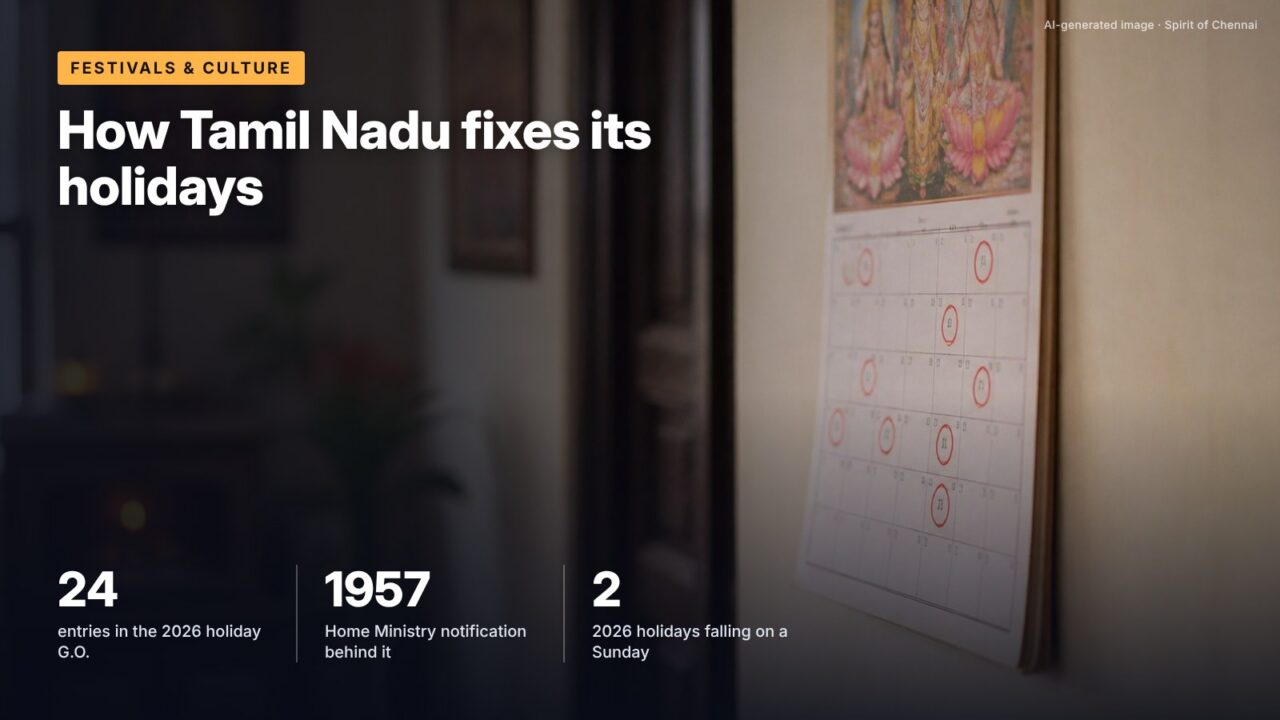
Tamil Nadu’s public holidays for 2026 were fixed by a single order: G.O. Ms. No. 708, Public (Miscellaneous) Department, dated 11 November 2025, published the same day in the Gazette Extraordinary and signed by Chief Secretary N. Muruganandam. It lists 24 days, in addition to Sundays, on which state government offices and all commercial and co-operative banks in the state close. One of them, 1 April, is for banks only.
The legal hook is unusual. The order does not rely on a state law. It uses the Explanation to section 25 of the Negotiable Instruments Act, 1881, a central law on cheques and bills, read with a Union Home Ministry notification of 8 June 1957 that lets state governments declare holidays under it. That is why the same list binds banks as well as state offices, and why changes come by a fresh gazette order rather than a circular.
How the annual list is made
The Public (Miscellaneous) Department issues the following year’s list late in the calendar year. The 2025 list came by G.O. Ms. No. 792 of 22 November 2024; the 2026 list by G.O. 708 eleven days earlier in the year. Each order names the festival, the date and the weekday. Dates for festivals that follow lunar calendars, including Ramzan, Bakrid, Muharram and Milad-un-Nabi, are fixed in advance on the expected date.
| 2025 list | 2026 list | |
|---|---|---|
| Order | G.O. 792, 22 Nov 2024 | G.O. 708, 11 Nov 2025 |
| Entries | 24 | 24 |
| Bank-only (annual closing, 1 April) | 1 | 1 |
| Holidays falling on a Sunday | Republic Day, Telugu New Year, Muharram | Thai Poosam, Deepavali |
| Two holidays on one date | Vijaya Dasami and Gandhi Jayanthi, 2 Oct | None |
| Deepavali | Monday 20 Oct | Sunday 8 Nov |
Source: Govt of Tamil Nadu, Public (Miscellaneous) Department, G.O. Ms. No. 792 (2024) and G.O. Ms. No. 708 (2025), Gazette Extraordinary
The fixed structure is visible in both years: three Pongal days, the national days, Tamil New Year combined with Dr. B.R. Ambedkar’s birthday on 14 April, May Day, and the main Hindu, Muslim, Christian and Jain festivals. Telugu New Year and Mahaveer Jayanthi are on the list too.
Holidays in the 2026 list that fall on a Sunday, Thai Poosam and Deepavali, according to G.O. 708. The order provides no substitute days.
When a date has to move
Because lunar festivals depend on the sighting of the moon, the list is sometimes corrected. In 2024 the government issued G.O. (Ms) No. 617 on 9 September moving the Milad-un-Nabi holiday from Monday 16 September to Tuesday 17 September. The order states that the change also applies to state undertakings, corporations and boards. The same section 25 power is used for emergencies: G.O. Ms. No. 752 of 4 December 2023 declared the very next day, 5 December 2023, a public holiday in Chennai, Tiruvallur, Kancheepuram and Chengalpattu districts as the region dealt with the cyclone and floods of that week. That order was issued and gazetted on the same day.
It’s often said when a festival holiday falls on a Sunday or Saturday, the government gives another day off.
The record shows The annual G.O. lists holidays “in addition to Sundays” and does not provide substitute days. In 2026 Thai Poosam and Deepavali fall on Sundays and Uzhavar Thirunal, Ramzan and Independence Day on Saturdays, with no compensating dates in the order.
Three calendars in one list
Comparing the 2025 and 2026 orders shows the list is built from three different calendars. Solar dates barely move: Pongal falls on 14 January 2025 and 15 January 2026, and Tamil New Year on 14 April in both years. Islamic festivals follow a lunar year about 354 days long, so each moved about ten days earlier: Ramzan from 31 March to 21 March, Bakrid from 7 June to 28 May, Muharram from 6 July to 26 June and Milad-un-Nabi from 5 September to 26 August. Hindu festivals follow a lunisolar calendar with periodic adjustments, so they can jump later: Deepavali moved from 20 October 2025 to 8 November 2026, and Vinayakar Chathurthi from 27 August to 14 September. That is why the lunar dates are the ones most often corrected by a later order.
Who is covered, and who is not
The state list applies to state government offices and banks. It does not by itself close central government offices, which follow a separate system run by the Department of Personnel and Training. Under the DoPT holiday policy, central offices outside Delhi observe 14 compulsory holidays and three more chosen from a list of 12 by the Central Government Employees Welfare Coordination Committee in each state capital. Employees can also take two restricted holidays from a longer list. The Chennai committee may shift the dates of Idul Fitr, Idul Zuha, Muharram and Milad-un-Nabi to match the state government’s decision, which is why central offices in Chennai usually close on the same day as state offices for those festivals.
Private employers are governed by other laws. Shops, establishments and factories follow national and festival holiday rules under labour legislation, which are separate from the Negotiable Instruments Act list. Schools follow the School Education Department’s calendar, and local holidays for temple festivals or weather are declared by district collectors.
What the list does to the banking week
For banks the stakes are practical. Section 25 of the 1881 Act decides when a promissory note or bill falling due on a holiday is treated as due, so a holiday declared under it settles, in law, which days count for payments. That is why emergency closures such as the December 2023 order are issued under the same Act, and why banks close even when the reason is weather rather than a festival.
For 2026 the effect is uneven. Three Pongal holidays run Thursday to Saturday in January. Ayutha Pooja and Vijaya Dasami fall on consecutive days, Monday 19 and Tuesday 20 October, and Krishna Jayanthi and Vinayakar Chathurthi fall ten days apart in September. Deepavali, on Sunday 8 November, adds no working-day holiday at all.
What this means for you
- Check the gazetted G.O., not a reposted list, when planning around lunar festivals; dates can be moved by a later order.
- Banks follow the same list, so cheques due on a declared holiday are payable the next working day.
- Central government offices in Chennai follow the coordination committee list; check their notice board for the three optional holidays.
- Private employers follow labour-law holiday rules, which can differ from the state list.
What to watch
Sunday 8 November 2026
Deepavali, as listed in G.O. 708. It falls on a Sunday, so it adds no extra closure.
Pending
The G.O. fixing the 2027 holiday list. The last two were issued on 22 November 2024 and 11 November 2025.
Checked against official sources on 23 October 2026. Figures and rules change; confirm on the linked official pages before relying on them.
Sources
- G.O. Ms. No. 708, Public (Misc.), 11 Nov 2025: public holidays 2026, Gazette Extraordinary No. 721 (Govt of Tamil Nadu)
- G.O. Ms. No. 792, Public (Misc.), 22 Nov 2024: public holidays 2025, Gazette Extraordinary No. 375 (Govt of Tamil Nadu)
- G.O. (Ms) No. 617, Public (Misc.), 9 Sep 2024: change of Milad-un-Nabi holiday (Govt of Tamil Nadu)
- G.O. Ms. No. 752, Public (Misc.), 4 Dec 2023: holiday on 5 Dec 2023 in four districts (Govt of Tamil Nadu)
- Holiday policy and hours of work (Department of Personnel and Training)