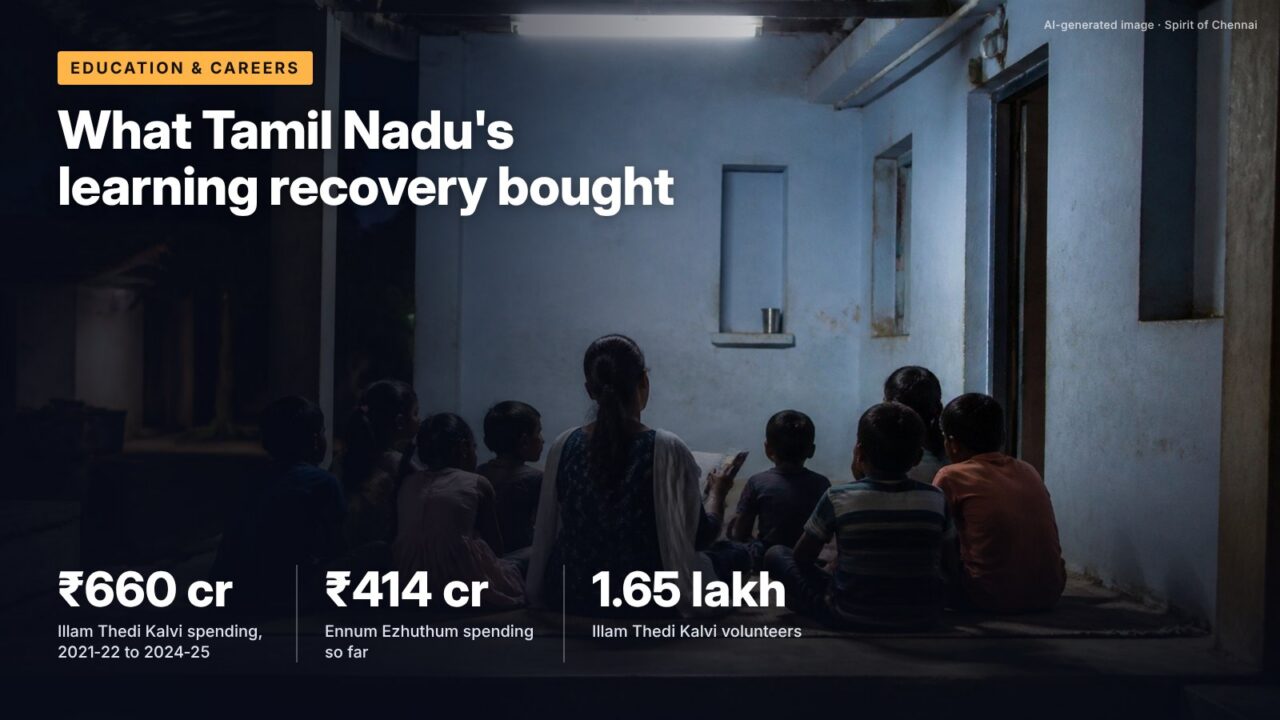
Tamil Nadu has spent about ₹1,075 crore since 2021 on two programmes to repair pandemic learning loss and build basic reading and arithmetic. The spending is well documented; independent evidence on results is thin, and one of the two is being scaled down.
The numbers
Illam Thedi Kalvi, the after-school volunteer programme launched on 27 October 2021, was allotted ₹660.35 crore over four academic years, according to the School Education Department’s policy note for 2025-26. Ennum Ezhuthum, the foundational literacy and numeracy mission for the early grades, has spent ₹414.41 crore. Together that is about ₹1,075 crore.
The most rigorous evidence on either comes from an outside study. Researchers tracking about 19,000 primary-age children in rural Tamil Nadu found that the government’s after-school remediation accounted for about 24% of the recovery in learning after schools reopened, in a National Bureau of Economic Research working paper published in October 2022. The policy note cites the same work as showing about a quarter of the loss recovered.
How Illam Thedi Kalvi worked
The idea was simple. Volunteers from the neighbourhood, many of them young women with a school or college education, ran short sessions for children of Classes 1 to 8 near their homes after school hours, using handbooks and teaching materials supplied by the department. The policy note records 1.65 lakh volunteers. It was built for a specific problem: children who had missed more than a year of classroom teaching during the Covid-19 closures.
| Academic year | Allotment (₹ crore) | Centres (lakh) | Beneficiaries (lakh) | ₹ per beneficiary |
|---|---|---|---|---|
| 2021-22 | 164.17 | 1.81 | 30 | 547 |
| 2022-23 | 226.27 | 2 | 34 | 666 |
| 2023-24 | 200.00 | 1.65 | 24 | 833 |
| 2024-25 | 69.91 | 0.5 | 7.97 | 877 |
| Total | 660.35 | 95.97 | 688 |
Source: School Education Department Policy Note 2025-26, Government of Tamil Nadu, p. 10. The last column is the allotment divided by beneficiaries, rounded. Beneficiaries are counted per year, so the total counts children more than once.
The table shows a programme at its peak in 2022-23 and sharply reduced by 2024-25, when the allotment fell by about two thirds and the number of centres to a quarter. In 2024-25 coverage was narrowed to primary classes (1 to 5), with a focus on educationally backward blocks, hill areas, urban slums and areas with large marginalised populations. Cost per child rose as numbers fell, which is typical when fixed costs such as materials and training are spread over fewer children.
What the evidence says
The working paper by Abhijeet Singh, Mauricio Romero and Karthik Muralidharan found that children tested in December 2021, after 18 months of closures, were about 0.7 standard deviations behind their 2019 counterparts in mathematics and 0.34 in language. In plain terms, a typical child had slipped well behind where the same grade would have been. About two thirds of that deficit was made up within six months of schools reopening, mostly through schooling itself, with the remediation programme contributing about 24% of the cohort-level recovery.
It’s often said Illam Thedi Kalvi repaired Tamil Nadu’s pandemic learning loss.
The record shows The independent study found most of the recovery came from children returning to school. The volunteer programme accounted for about a quarter of the recovery measured, a meaningful but partial contribution, and the study covered rural primary-age children only (NBER Working Paper 30552).
Ennum Ezhuthum: the foundational mission
Ennum Ezhuthum (roughly, numbers and letters) began in 2022-23 with a budget of ₹152 crore. Its stated goal was that by 2025 every eight-year-old in Classes 1 to 3 should be able to read, write and do basic mathematics. In 2023-24 it was extended to Classes 4 and 5, with ₹110 crore, and to government-aided schools. The policy note records 1.13 lakh primary teachers given special training and 25.08 lakh students reached in 37,767 schools at ₹152.41 crore, about ₹608 per student.
Unlike Illam Thedi Kalvi, Ennum Ezhuthum works inside the regular school day through teachers, simplified workbooks and handbooks. Practice notebooks for all three terms went to 36,481 children with intellectual disabilities. The 2025 target date has passed. The policy note does not report whether the goal was met, and no assessment results for the mission were found in the official documents read for this article.
Downloads of Manarkeni, the department’s learning app with 6,895 videos and 2,01,880 practice questions, according to the 2025-26 policy note.
The digital supports
Alongside the two programmes the department runs Manarkeni, launched in July 2023, and a reading campaign launched on 21 July 2023 in 914 schools across 11 districts, later expanded with 123 titles to about 44.5 lakh students. Digital tools depend on access. The share of Tamil Nadu schools with computers rose to 92.6% in 2024-25, while the share with internet fell to 84.9% from 99.0% the year before, according to figures the ministry gave the Lok Sabha in February 2026.
Reading the cost per child
The per-beneficiary column in the table above needs care. At ₹547 to ₹877 a child a year, Illam Thedi Kalvi was cheap by the standard of school spending, because its main input, volunteer time, was largely unpaid. Ennum Ezhuthum, at about ₹608 a student in 2023-24, is similar. Both figures cover only the programme’s own budget. They leave out the salaries of the teachers who deliver Ennum Ezhuthum during the school day, which come from the department’s regular budget. Measured against what the state already spends on each child in school, the two programmes are small additions whose value depends almost entirely on whether they change what children learn.
What is missing
The gap in the record is outcome data. The state’s policy note reports money, centres, volunteers and children reached, but not test results. The Union government’s national achievement surveys are the obvious external check on early-grade learning, and the 2026-27 budget, as summarised by PRS Legislative Research, does not mention Illam Thedi Kalvi. Meanwhile the school-age population is shrinking: total enrolment fell from 1.43 crore in 2014-15 to 1.30 crore in 2023-24 (Lok Sabha, February 2025), which should make per-child investment easier to sustain.
What this means for you
- If your child is in a government or aided primary school, Ennum Ezhuthum workbooks and teacher methods are part of the normal school day; ask the class teacher how your child’s level is assessed.
- Illam Thedi Kalvi now runs mainly in targeted areas for Classes 1 to 5. Check with your school whether a centre operates nearby.
- Manarkeni is free and maps to state syllabus concepts, useful for practice at home.
- Treat claims that any programme fully closed learning gaps with caution until state-level test results are published.
What to watch
Pending: Illam Thedi Kalvi’s future
The 2026-27 policy note will show whether the programme continues after its 2024-25 cut and in what form.
Pending: Ennum Ezhuthum outcome data
Results against the 2025 goal for eight-year-olds have not been published in the official documents reviewed.
Checked against official sources on 23 October 2026. Figures and rules change; confirm on the linked official pages before relying on them.
Sources
- School Education Department Policy Note 2025-26, Government of Tamil Nadu
- Covid-19 Learning Loss and Recovery: Panel Data Evidence from India, NBER Working Paper 30552, Singh, Romero and Muralidharan, October 2022
- Lok Sabha Unstarred Question 447, UDISE+ 2025-26 annexures, Ministry of Education, 2 February 2026
- Lok Sabha Unstarred Question 170, school enrolment annexures, Ministry of Education, 3 February 2025
- Tamil Nadu Budget Analysis 2026-27, PRS Legislative Research, 2026