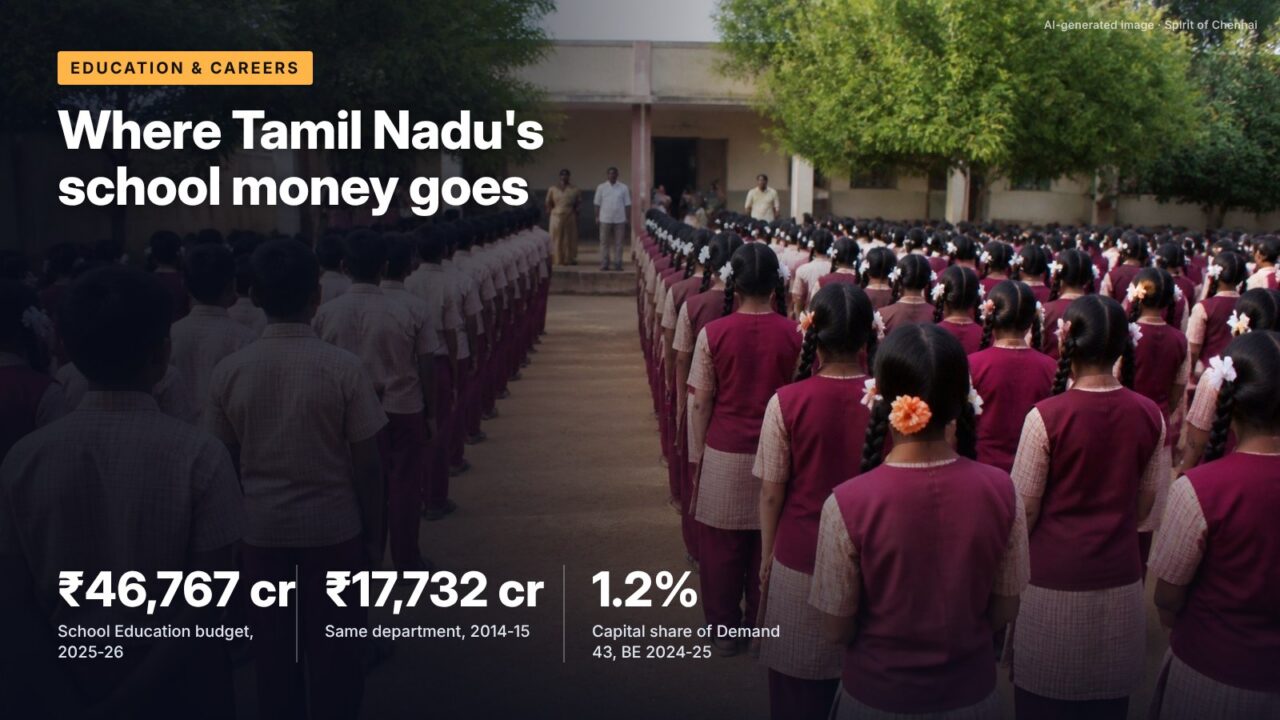
Tamil Nadu’s school education budget has grown from ₹17,732 crore to ₹46,767 crore in eleven years. The money mostly pays teachers, in government and aided schools alike, while capital spending is a sliver and the Union share sits in dispute.
The numbers
The School Education Department was granted ₹46,767 crore for 2025-26, the department’s policy note says. In 2014-15 its policy note gave a total of ₹17,731.71 crore. In nominal terms the budget is now about 2.6 times larger, while the number of children in Tamil Nadu’s schools has fallen.
Where the money goes has changed less than the total. Then and now, the bulk pays salaries in government schools and grants to aided schools, which use them for their teachers’ salaries. The schemes that draw public attention, from laptops to breakfast, are a modest share.
How the budget is built
School education is Demand No. 43 in the state’s budget. The demand book for 2024-25 shows a gross budget estimate of ₹44,042.08 crore, of which ₹43,524.82 crore is revenue spending and only ₹516.76 crore is capital outlay, about 1.2% of the total. Revenue spending covers recurring costs such as pay, grants and scheme payments; capital outlay covers new assets.
| Head (BE 2024-25) | ₹ crore |
|---|---|
| Elementary education (2202-01), incl. centrally shared | 21,138.88 |
| Secondary education (2202-02), incl. centrally shared | 21,226.42 |
| Of which: Panchayat Union school teachers’ pay | 6,138.40 |
| Of which: grants to non-government primary schools | 3,507.66 |
| Of which: grants to non-government secondary schools | 3,814.63 |
| Samagra Shiksha Abhiyan head | 3,556.92 |
| Capital outlay (4202) | 516.76 |
| Gross total, Demand 43 | 44,042.08 |
Source: Finance Department, Government of Tamil Nadu, Demand No. 43 School Education, Budget Estimate 2024-25. Sub-items are illustrative lines and do not sum to the totals.
Teacher pay in Panchayat Union schools alone (₹6,138.40 crore) is nearly twelve times the entire capital budget. Grants to aided schools, at about ₹7,322 crore across primary and secondary, are around a sixth of the department’s money. That reflects Tamil Nadu’s large aided sector, in which privately managed schools receive state grants for teacher salaries.
What a decade of growth bought
In 2014-15 the department counted 56,828 schools, 5,09,327 teachers and 1,33,65,140 students across all managements. It spent ₹1,080 crore on free laptops for 5.4 lakh students, ₹409.30 crore on uniforms, ₹323 crore on bus passes, ₹264.35 crore on textbooks and ₹216.04 crore on bicycles. Sarva Shiksha Abhiyan, the forerunner of Samagra Shiksha, had an outlay of ₹1,989.87 crore.
The rest of the 2014-15 kit list shows how the welfare model worked: notebooks (₹106.45 crore), footwear (₹120.07 crore), school bags (₹120.71 crore) and a special cash incentive for students (₹381 crore). Even added together with laptops, uniforms, bus passes, textbooks and bicycles, these lines came to roughly ₹3,020 crore, about 17% of that year’s budget. The Plan portion of the budget, the part then reserved for new schemes and capital works, was ₹3,290.66 crore, under a fifth of the total. The rest was the recurring cost of running schools.
The 2025-26 note lists a different set of priorities. Under the Perasiriyar Anbazhagan School Development Scheme, 8,370 classrooms, 52 laboratories and other facilities have been built at ₹3,527.50 crore, with 4,412 classrooms and 105 laboratories under construction and ₹1,000 crore budgeted this year. There are 22,931 smart classrooms in 21,984 government schools (₹455.32 crore) and 8,209 hi-tech laboratories (₹519.73 crore). The Chief Minister’s Breakfast Scheme reaches 17.53 lakh students in 34,987 schools.
It’s often said Free laptops and other giveaways eat up most of Tamil Nadu’s school budget.
The record shows In 2014-15, the peak years of the laptop scheme, its ₹1,080 crore was about 6% of the department’s ₹17,731.71 crore. The 2024-25 demand book shows salary and grant lines dominating, with capital outlay at about 1.2%.
Spending per child, roughly
UDISE+ counted 1,29,93,050 children in Tamil Nadu’s schools in 2023-24, from pre-primary to Class 12, the Ministry of Education told the Lok Sabha. Dividing the 2024-25 Demand 43 gross estimate of ₹44,042.08 crore by that number gives about ₹33,900 per child. In 2014-15, ₹17,731.71 crore over the 1,33,65,140 students in the policy note gives about ₹13,300. Both figures understate spending per government-school child, because the denominators include private-school children who receive little of this money.
The Samagra Shiksha question
Samagra Shiksha is the centrally sponsored scheme that funds teacher posts, school grants, inclusive education and infrastructure, with costs shared between the Union and the state. The Union’s allocation of its share for Tamil Nadu was ₹1,801.73 crore in 2019-20, ₹1,649.96 crore in both 2020-21 and 2021-22, ₹2,117.60 crore in 2022-23 and ₹2,090.77 crore in 2023-24, according to an answer in the Lok Sabha on 2 December 2024.
Allocation is not release. The same answer lists the conditions under which instalments are released, including the pace of spending, receipt of the matching state share, audited accounts and utilisation certificates. The Union government and the Tamil Nadu government have publicly disagreed over releases linked to the PM SHRI school scheme; the documents read for this article do not give an agreed figure for any amount withheld, so none is stated here.
Outlay in the 2026-27 budget to extend the breakfast scheme to Classes 6 to 8 in government and aided schools (PRS Legislative Research).
The 2026-27 budget
The budget presented on 5 August 2026 provides ₹15,387 crore for primary schools and ₹20,585 crore for secondary schools, covering government and non-government schools, PRS reports. Alongside the breakfast extension it announces ₹300 crore to modernise government schools. Central grants to the state are expected to rise 64% to ₹32,922 crore, which PRS attributes mainly to higher grants for centrally sponsored schemes including Sarva Shiksha Abhiyan. Whether that expectation is met depends on how the release conditions above are applied.
What this means for you
- Most school money pays teachers. Questions about teacher vacancies and posting matter more to quality than any single scheme.
- If your child is in an aided school, the state pays the teachers’ salaries; fee demands beyond approved amounts can be raised with the district education office.
- Breakfast now extends to Classes 6 to 8 under the 2026-27 budget; check with your school when it starts there.
- Per-child figures quoted in debates often divide by all children, including those in private schools. Ask which denominator is used.
What to watch
Pending: Samagra Shiksha releases for 2026-27
Whether the Union releases its share in line with the budget’s expectation of higher central grants will shape what the department can spend.
Pending: 2026-27 School Education policy note
The department’s note will give the new Demand 43 total and the breakfast scheme’s upper-primary rollout.
Checked against official sources on 23 October 2026. Figures and rules change; confirm on the linked official pages before relying on them.
Sources
- School Education Department Policy Note 2025-26, Government of Tamil Nadu
- School Education Department Policy Note 2014-15, Government of Tamil Nadu
- Demand No. 43, School Education Department, Budget Estimate 2024-25, Finance Department, Government of Tamil Nadu
- Lok Sabha Unstarred Question 982, Non-allocation of funds under Samagra Shiksha Abhiyan, 2 December 2024
- Lok Sabha Unstarred Question 170, school enrolment annexures, Ministry of Education, 3 February 2025
- Tamil Nadu Budget Analysis 2026-27, PRS Legislative Research, 2026