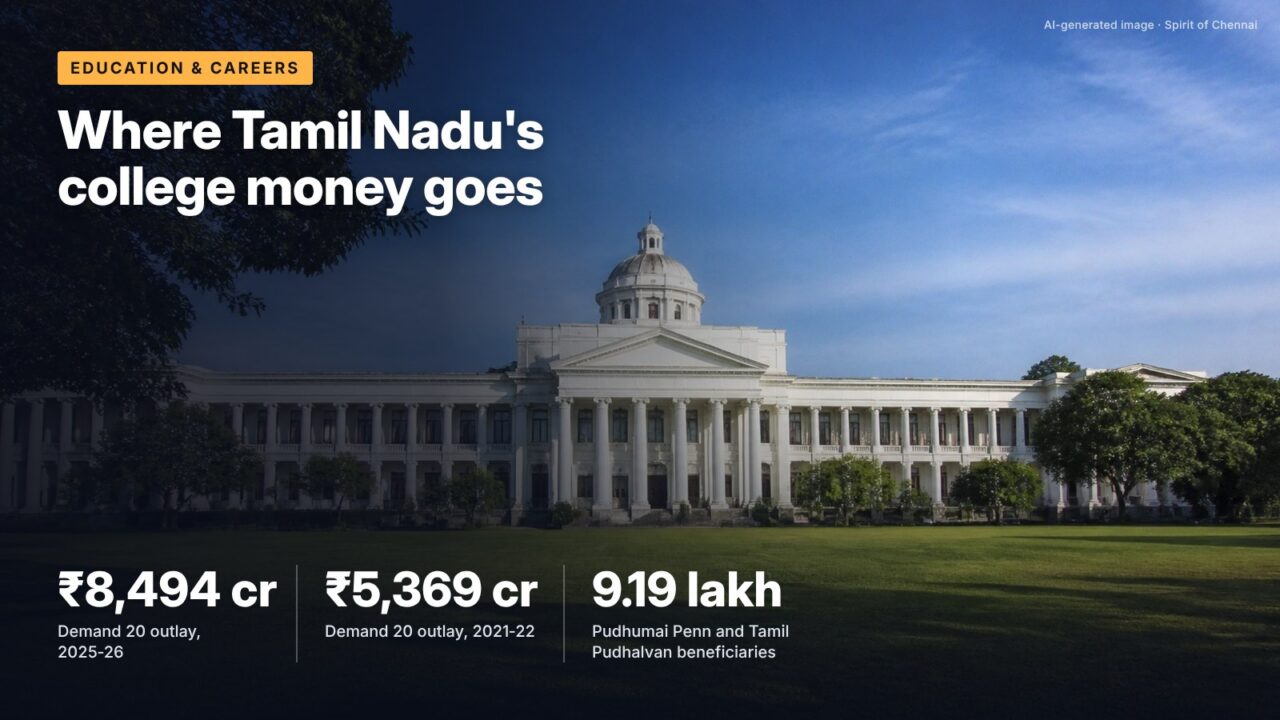
Tamil Nadu’s Higher Education Department now spends about ₹8,500 crore a year, 58% more than four years ago. Most of it still pays for colleges and teachers; the monthly cash schemes for students are large in reach but sit partly outside this budget line.
The numbers
The Higher Education Department’s budget, presented to the Assembly as Demand No. 20, was ₹8,494.10 crore for 2025-26, according to the department’s policy note. In 2021-22 the same document gave ₹5,369.09 crore. The increase of about 58% is far ahead of inflation over the period.
The growth has not been even. Technical education, which covers government engineering colleges and polytechnics, nearly doubled. Grants to universities rose by three quarters. The largest line, collegiate education, grew more slowly.
Where Demand 20 goes
| Head | 2021-22 (₹ crore) | 2025-26 (₹ crore) | Change |
|---|---|---|---|
| Directorate of Collegiate Education | 3,126.43 | 4,512.99 | +44% |
| Directorate of Technical Education | 1,317.54 | 2,465.99 | +87% |
| Universities | 767.98 | 1,353.08 | +76% |
| Total Demand 20 | 5,369.09 | 8,494.10 | +58% |
Source: Higher Education Department Policy Notes 2021-22 (p. 6) and 2025-26 (p. 16), Government of Tamil Nadu. Change is the 2025-26 figure divided by the 2021-22 figure, rounded. The three heads do not add to the total because smaller heads are omitted.
Collegiate education alone is 53% of the department’s money in 2025-26 (₹4,512.99 crore of ₹8,494.10 crore). It funds the 165 government arts and science colleges the policy note lists, out of 959 arts and science colleges in the state, and grants to aided colleges. In 2021-22 the directorate oversaw 887 arts and science colleges, so the sector has grown by 72 colleges in four years.
The number of state universities under the department has moved the other way, from 14 in 2021-22 to 13 in 2025-26, within a total of 61 universities in Tamil Nadu (2 central, 29 deemed, 8 private and 22 state).
The student cash schemes
Two schemes pay students ₹1,000 a month while they study. Pudhumai Penn, launched in 2022 for women who studied in government schools, has 4,93,689 beneficiaries according to the 2025-26 policy note: 3,21,559 in arts and science, 53,972 in engineering, 11,952 in polytechnics and 1,06,206 in other courses. Tamil Pudhalvan, launched in 2024 for men, has 4,25,346: 1,86,644 in arts and science, 79,730 in polytechnics, 71,010 in engineering and 87,962 in other courses.
The policy note does not give year-wise spending for either scheme. Simple arithmetic gives a ceiling. At ₹1,000 a month, every lakh of students paid for a full twelve months costs ₹120 crore a year. The combined 9.19 lakh beneficiaries would therefore cost up to about ₹1,100 crore a year, if all were paid every month. Actual spending depends on how many are enrolled at any time and how many months are paid.
It’s often said The monthly student payments now take up most of the higher education budget.
The record shows On the official figures, the largest single head in Demand 20 for 2025-26 is the Directorate of Collegiate Education at ₹4,512.99 crore, more than half the total. Even the arithmetic ceiling for the two cash schemes (about ₹1,100 crore a year) is well below that, and the policy note does not show the schemes’ cost as a separate line.
Skilling inside the colleges
The state’s in-college skilling programme, launched in 2022 as Naan Mudhalvan, trained 13.52 lakh students in 2022-23, 14.68 lakh across 2,085 institutions in 2023-24 and 13.17 lakh across 2,020 institutions in 2024-25, the policy note records, along with 40,218 faculty in 2024-25. It does not publish placement outcomes for those trained, so the programme’s reach is known but its results are not, from this document.
Students admitted to engineering colleges in Tamil Nadu in 2024-25, with 58,426 in polytechnics (Higher Education policy note 2025-26).
For a longer view of engineering demand, the 2021-22 note records that 1,41,827 candidates registered for online counselling in 2019-20 and 75,257 were admitted through it; in 2020-21, 1,77,409 registered and 68,397 were admitted. The 2024-25 admission figure covers all routes, so it is not directly comparable with the counselling-only numbers.
Teachers, the biggest cost
Behind the collegiate and technical education totals is a large teaching workforce. Tamil Nadu accounted for 13.1% of all teachers reported in AISHE 2021-22 and had a pupil-teacher ratio of 14 in regular courses against 24 nationally (AISHE 2021-22). A favourable ratio is expensive to keep: every vacancy filled in a government college adds to the salary bill that dominates Demand 20, while unfilled posts push the ratio up. The policy notes read for this article do not give the number of sanctioned and vacant teaching posts in government colleges, which is the figure that would show how much of the budget growth went to staffing.
What the 2026-27 budget changes
The 2026-27 budget, presented by Finance Minister N. Marie Wilson on 5 August 2026, allots ₹56,267 crore to education, sports, arts and culture combined, 4% more than the 2025-26 revised estimate, according to PRS Legislative Research. Education takes 12.2% of state spending, below the 14.5% average for states in 2025-26 budget estimates. For higher education, the headline item is a ₹2,000 crore Vetri Laptop Scheme for college students. The budget also announces an AI industry development programme aiming to skill five lakh young people by 2031.
PRS’s summary does not give a separate 2026-27 figure for Demand 20, and the 2026-27 Higher Education policy note was not available for this article. The pressure on any new spending is the state’s committed expenditure: salaries, pensions and interest together take 61% of revenue receipts in 2026-27, PRS notes, leaving limited room for new schemes without cuts elsewhere.
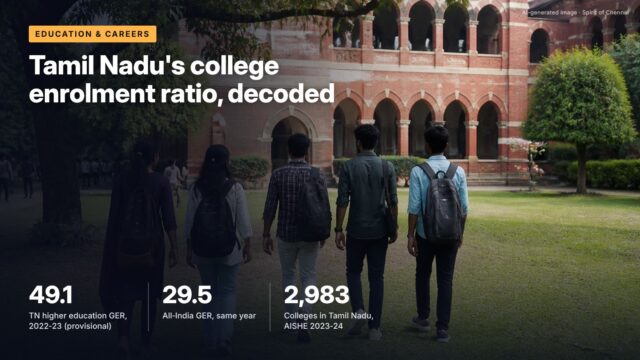
Spending per student is also worth keeping in view. AISHE recorded 34.0 lakh students in Tamil Nadu’s higher education institutions in 2022-23 (with a GER of 49.1). Most of them are in private colleges that receive no direct state funding, so the department’s budget is concentrated on a minority of institutions while the cash schemes reach students across sectors.
What this means for you
- If you are in a government or aided college, most of the department’s money is spent where you study; fee levels there are set by the government, not the market.
- Students from government schools should check whether they qualify for Pudhumai Penn or Tamil Pudhalvan; the counts above show these are mass schemes, not small grants.
- Watch for the guidelines of the ₹2,000 crore Vetri Laptop Scheme, which will decide who is eligible in 2026-27.
- Skilling numbers measure participation. Ask your college for placement data before relying on a course for jobs.
What to watch
Pending: 2026-27 Higher Education policy note
The department’s note for 2026-27 will show the new Demand 20 total and how the laptop scheme is booked.
Pending: laptop scheme guidelines
Eligibility, timing and the number of laptops for the Vetri scheme are yet to be set out in a government order seen for this article.
Checked against official sources on 23 October 2026. Figures and rules change; confirm on the linked official pages before relying on them.
Sources
- Higher Education Department Policy Note 2025-26, Demand No. 20, Government of Tamil Nadu
- Higher Education Department Policy Note 2021-22, Demand No. 20, Government of Tamil Nadu
- Tamil Nadu Budget Analysis 2026-27, PRS Legislative Research, 2026
- Lok Sabha Unstarred Question 4114, GER for Higher Education, Ministry of Education, 18 August 2025
- AISHE Final Report 2022-23, Ministry of Education, 2026
- All India Survey on Higher Education 2021-22, Ministry of Education