Tamil Nadu keeps almost nine in ten children in school to Class 10, far above the national rate. The leak that remains is concentrated in one place: boys in Classes 9 and 10, who drop out at more than twice the rate of girls.
The numbers
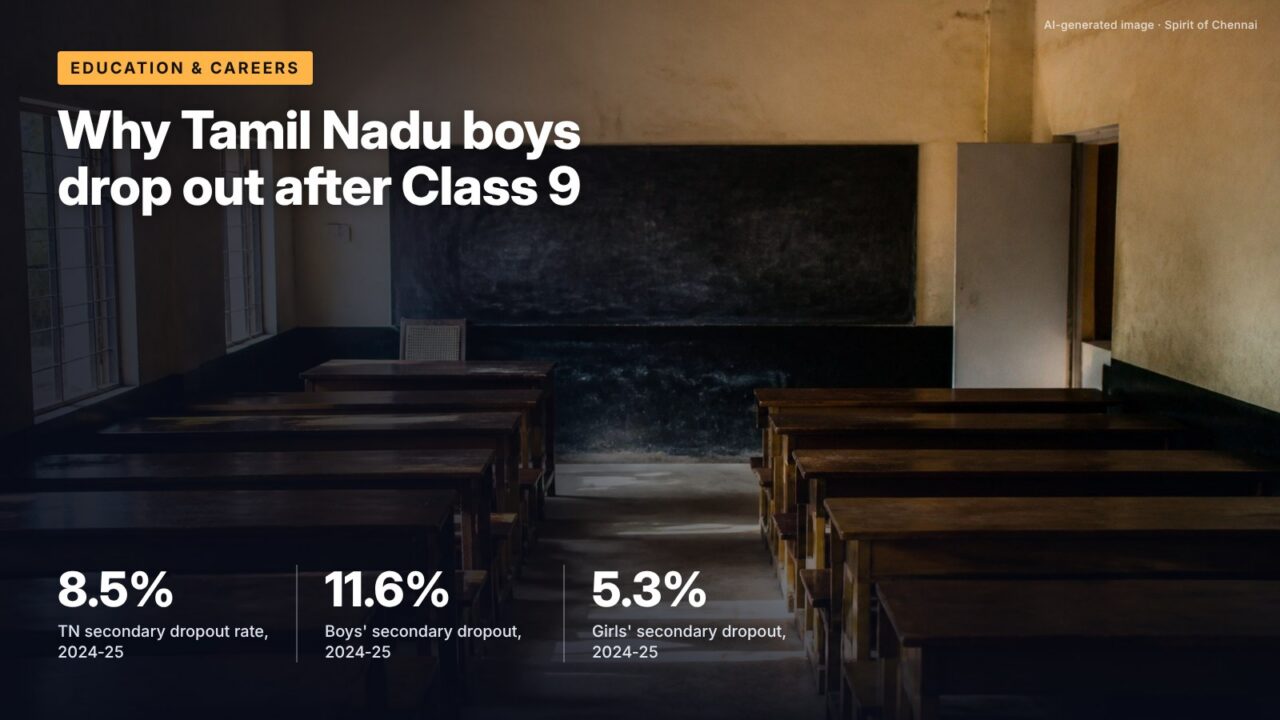
In 2024-25, 8.5% of Tamil Nadu’s students in Classes 9 and 10 dropped out, according to the UDISE+ 2024-25 state tables. The national rate was 11.5%, as the Ministry of Education told the Lok Sabha on 2 February 2026. The headline hides a sharp split. Boys dropped out at 11.6%; girls at 5.3%.
The same split appears in every year of the ten-year series the ministry tabled in February 2025. In 2014-15 the boys’ secondary dropout rate in Tamil Nadu was 16.1% against 8.0% for girls. A decade on, both are lower, but boys still leave at roughly double the rate.
How the dropout rate is calculated
UDISE+, the Unified District Information System for Education Plus, collects records from every recognised school. The dropout rate it publishes is not a head count of children who walked out. It is derived by following a grade from one year to the next: the share of students who were neither promoted to the next class nor kept back to repeat. That makes it sensitive to how well schools update enrolment records and to unusual years.
The pandemic years show this plainly. Tamil Nadu’s reported dropout at primary and upper primary level was zero in 2021-22, when promotion was effectively automatic, and secondary dropout fell to 4.5%. The next year secondary dropout was back at 10.3%. Neither number should be read alone; the trend is what matters.
| Year | Boys | Girls | Overall | All India overall |
|---|---|---|---|---|
| 2014-15 | 16.1 | 8.0 | 12.2 | 17.9 |
| 2016-17 | 13.7 | 6.3 | 10.0 | 22.1 |
| 2017-18 | 19.4 | 13.0 | 16.2 | 18.9 |
| 2018-19 | 17.7 | 8.1 | 13.0 | 17.9 |
| 2019-20 | 13.4 | 5.6 | 9.6 | 16.1 |
| 2020-21 | 8.6 | 4.1 | 6.4 | 14.0 |
| 2021-22 | 6.3 | 2.5 | 4.5 | 12.6 |
| 2022-23 | 13.9 | 6.4 | 10.3 | 16.4 |
| 2024-25 | 11.6 | 5.3 | 8.5 | 11.5 |
Source: Ministry of Education, Lok Sabha Unstarred Question 170 (3 February 2025), Annexure IV, for 2014-15 to 2022-23; UDISE+ 2024-25 Tables 6.13 to 6.15 and Lok Sabha Unstarred Question 447 (2 February 2026) for 2024-25. Secondary means Classes 9 and 10. The 2023-24 Tamil Nadu row was not in the text available.
Where Tamil Nadu stands among southern states
Kerala does better. Its secondary dropout rate in 2024-25 was 4.8%, and its retention to Class 10 was 99.5%. Karnataka does worse, at 18.3% secondary dropout. Tamil Nadu’s 89.3% retention to Class 10 compares with 62.9% nationally. Retention here means the share of a cohort that started Class 1 and is still enrolled by the end of the stage.
Share of Tamil Nadu’s Class 10 students who moved into Class 11 in 2024-25: 92.4% of girls but only 81.8% of boys, according to the UDISE+ 2024-25 tables.
The transition from Class 10 to Class 11 is where the gender gap is widest. Nearly one boy in five who finishes Class 10 does not appear in Class 11 the next year. Some move into Industrial Training Institutes or polytechnic diplomas, which are counted outside the school system; others go into work. UDISE+ cannot tell the two apart, which is one reason the numbers need careful reading.
The national trend is improving too
Tamil Nadu’s gains are not happening in isolation. Across India, secondary dropout fell from 14.1% in 2023-24 to 11.5% in 2024-25, and the share of Class 10 students moving into Class 11 rose from 71.5% to 75.1%, according to the ministry figures tabled in February 2026. National retention to Class 12 edged up from 45.6% to 47.2%. Tamil Nadu’s 74.7% retention to Class 12 is still more than half as high again as the national figure, but the gap with the rest of the country is narrowing at the secondary stage, where most states are starting from far worse positions.
The enrolment base is shrinking
Behind the rates sits a falling number of children. Total school enrolment in Tamil Nadu, from pre-primary to Class 12, was 1,42,86,328 in 2014-15 and 1,29,93,050 in 2023-24, the ministry annexure shows. That is about 12.9 lakh fewer, a fall of roughly 9%. Smaller cohorts mean that even a steady dropout rate represents fewer children each year, and that school capacity, not just attendance, becomes a planning question.
The state’s higher secondary Gender Parity Index, the ratio of girls’ GER to boys’, was 1.20 in 2014-15 and 1.15 in 2023-24. A figure above 1 means girls are enrolled at a higher rate relative to their population. Tamil Nadu has had more girls than boys, proportionately, in Classes 11 and 12 for at least a decade.
It’s often said Girls are the group most at risk of leaving school early in Tamil Nadu.
The record shows In every year of the ministry’s 2014-15 to 2024-25 series, Tamil Nadu boys in Classes 9 and 10 dropped out at a higher rate than girls, often twice as high. Girls are also more likely to continue into Class 11.
What the state is spending on keeping children in school
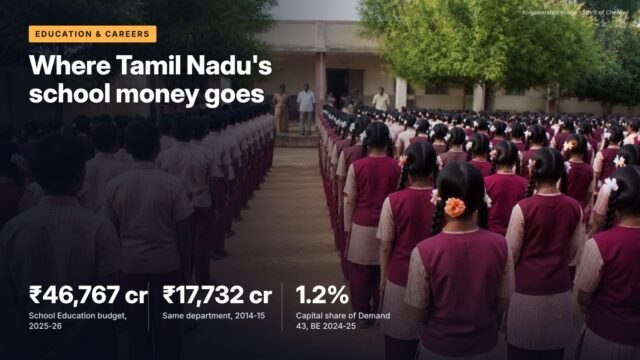
Most of Tamil Nadu’s retention measures are not labelled as anti-dropout schemes. The School Education Department’s policy note for 2025-26 lists the Chief Minister’s Breakfast Scheme, serving 17.53 lakh students in 34,987 government and aided schools, and a transport and escort allowance of ₹19.64 crore for 34,182 students in 2024-25 under Samagra Shiksha. The 2026-27 State Budget, presented on 5 August 2026, extends the breakfast scheme to Classes 6 to 8 with an outlay of ₹710 crore, according to PRS Legislative Research.
None of these is aimed specifically at boys in Classes 9 and 10. The policy note does not set a target for secondary dropout by gender, and no state evaluation tying any scheme to the dropout trend was found for this article.
What this means for you
- If your child is in Class 9 or 10 and attendance is slipping, the school’s headmaster and the Block Resource Centre are the first points of contact; UDISE+ records will flag a child who is not re-enrolled.
- A boy leaving after Class 10 for an ITI or polytechnic is not lost to education, but the school system will record him as not transitioning. Check the institute’s recognition before enrolling.
- For girls, the data show the bigger risk comes later, at the college stage, where state cash support schemes now apply.
- Treat single-year swings in dropout figures with caution, especially for 2020-21 to 2022-23.
What to watch
Pending: UDISE+ 2025-26 state tables
The ministry’s answer of February 2026 referred to the 2025-26 data round; state-wise dropout and transition rates for that year will show whether the 2024-25 improvement held.
2026-27 school year
The breakfast scheme’s extension to Classes 6 to 8 takes effect under the 2026-27 budget; its reach in upper primary is worth tracking.
Checked against official sources on 23 October 2026. Figures and rules change; confirm on the linked official pages before relying on them.
Sources
- Lok Sabha Unstarred Question 170, Drop in Enrolment Rate in Schools, annexures, Ministry of Education, 3 February 2025
- Lok Sabha Unstarred Question 447, UDISE+ 2025-26, annexures, Ministry of Education, 2 February 2026
- UDISE+ 2024-25, Tables 6.13 to 6.15, dropout, transition and retention rates (Ministry of Education tables; copy hosted by Education for All in India)
- School Education Department Policy Note 2025-26, Government of Tamil Nadu
- Tamil Nadu Budget Analysis 2026-27, PRS Legislative Research, 2026