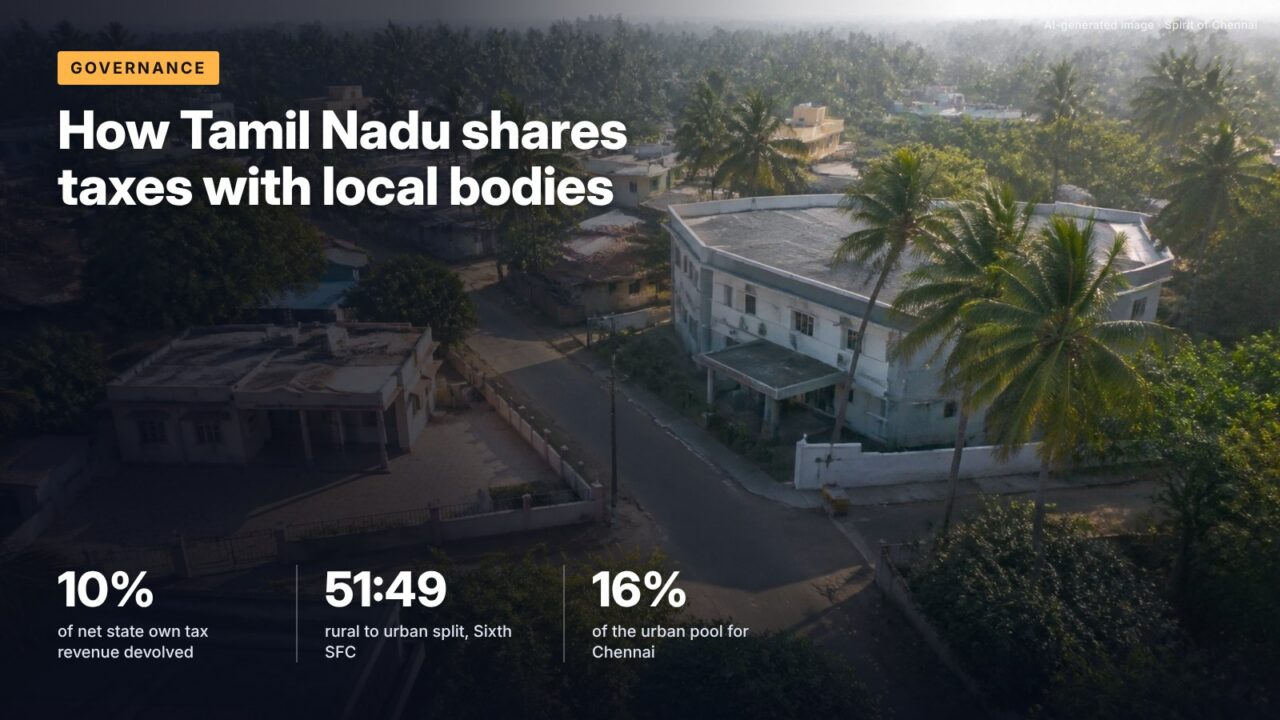
Every year Tamil Nadu hands a tenth of its net own tax revenue to panchayats, municipalities and corporations. How that money is split, and who decides, is set by the State Finance Commission. Here is the formula now in force and what the next commission is reviewing.
The numbers
Tamil Nadu’s formula for sharing state taxes with local bodies has barely moved in two decades: 10 per cent of the state’s net own tax revenue goes into a pool for village panchayats, panchayat unions, district panchayats, municipalities, town panchayats and corporations. What has changed with each State Finance Commission (SFC) is how that pool is cut. The current rules, set by G.O.(Ms) No. 60, Finance (SFC-MC) Department, dated 28 February 2023, cover the five years to 2026-27.
The Seventh SFC, constituted on 28 May 2025 under G.O.(Ms) No. 123 and chaired by K. Allaudin, a retired IAS officer, is now reviewing that formula, according to the Commission’s website. Its recommendations will decide how much Chennai and every other local body gets from the next award period.
Why a State Finance Commission exists
Articles 243-I and 243-Y of the Constitution, added by the 73rd and 74th Amendments, require each state to set up a finance commission every five years to review the finances of panchayats and municipalities. In Tamil Nadu it also draws its mandate from section 198 of the Tamil Nadu Panchayats Act, 1994, and the municipal laws. The Seventh SFC’s terms of reference ask it to recommend how the net proceeds of state taxes, duties, tolls and fees are divided between the state and local bodies and among local bodies, which taxes may be assigned to them, and what grants they should get.
The commission recommends; the government decides. Each report is followed by an action-taken report that accepts, modifies or rejects each recommendation, and then a G.O. that puts the accepted formula into effect.
How the share has moved since the first commission
| Commission | Share of state own tax revenue | Rural : urban split |
|---|---|---|
| First SFC | Recommended 8% rising to 12%; government kept 8% | 60 : 40 |
| Second SFC | Raised from 8% to 10% | 58 : 42 |
| Third SFC | Uniform 10% | 58 : 42 |
| Fourth SFC (report 29 September 2011) | Uniform 10% | Recommended 56 : 44; government kept 58 : 42 |
| Sixth SFC (report March 2022) | 10% of net state own tax revenue continued | Recommended 49 : 51; fixed at 51 : 49 |
Source: Report of the Fifth State Finance Commission, Tamil Nadu, chapter I (2017); Sixth SFC action-taken report and G.O.(Ms) No. 60 (2023)
The pattern is a slow tilt towards towns and cities, often resisted by the government. The Fourth SFC asked for 44 per cent for urban bodies and the government stayed at 42. The Sixth SFC recommended 51 per cent urban; the government’s action-taken report fixed the ratio at 51:49, which G.O. 60 applies as 51 per cent rural and 49 per cent urban.
The formula in force, step by step
G.O. 60 cuts the pool in stages. First, rural bodies get 51 per cent and urban bodies 49 per cent. Within the rural share, district panchayats get 6 per cent, panchayat unions 39 per cent and village panchayats 55 per cent (the commission had proposed 7:37:56). Within the urban share, Greater Chennai Corporation is carved out first with 16 per cent. Of Chennai’s portion, 82 per cent goes to the corporation and 18 per cent to the Chennai Metropolitan Water Supply and Sewerage Board. The remaining 84 per cent of the urban share is split 31 per cent to other municipal corporations, 36 per cent to municipalities and 33 per cent to town panchayats.
Inside each tier, money is distributed to individual bodies by weighted criteria.
| Tier | Population | Area | Third criterion |
|---|---|---|---|
| Village panchayats, panchayat unions, district panchayats | 65% | 15% | SC/ST population 20% |
| Municipal corporations | 65% | 15% | Slum population 20% |
| Municipalities | 60% | 20% | Slum population 20% |
| Town panchayats | 55% | 25% | Slum population 20% |
Source: G.O.(Ms) No. 60, Finance (SFC-MC) Department, Government of Tamil Nadu, 28 February 2023
Small bodies get floors: at least ₹7 lakh for a village panchayat and ₹40 lakh for a panchayat union or town panchayat. On top of the formula sit dedicated funds. For urban bodies, G.O. 60 provides an Urban Capital Grant Fund of ₹500 crore in the first year, rising by ₹50 crore a year to ₹3,000 crore over five years, plus an Urban Road Development Fund and an Urban O&M Grant of ₹1,200 crore each.
Cut in annual state-level special grants from 2024-25 if local bodies failed to carry out 14 listed reforms by June 2024, under G.O. 60; bodies that met them qualified for a one-time ₹300 crore incentive.
What the government declined
The action-taken report shows where the state drew lines. It rejected renaming village house tax as property tax, a slab system for house tax, a minimum water charge of ₹80 a month in villages and a ₹100 minimum for Chennai’s water board. It also rejected the commission’s call to stop using assigned revenue for state-level schemes, saying infrastructure for local bodies is delivered through those schemes. Betterment levies on land gaining value from public works were rejected because property tax already varies by zone. Proposals on penalties for unapproved layouts and a vacant land tax for peri-urban panchayats were deferred.
It’s often said local bodies receive whatever the State Finance Commission recommends.
The record shows The government decides. The CAG’s audit of the 74th Amendment in Tamil Nadu found fiscal transfers to urban bodies fell ₹1,306.89 crore short of SFC recommendations between 2015-16 and 2019-20, and that a monitoring cell the government had accepted was never set up.
What the money looks like on the ground
The Fifth SFC’s report traced devolution to rural bodies alone rising from ₹1,775 crore in 2010-11 to ₹3,774 crore in 2013-14, before an unexplained dip to ₹3,368 crore in 2014-15; over 2010-11 to 2015-16 the SFC transfer made up 59 per cent of rural bodies’ receipts. In Chennai, the corporation’s 2026-27 budget books ₹1,350 crore as “assignment from tax revenue”, up from an actual ₹1,067.51 crore in 2024-25. The pool grows with the state’s tax take: PRS Legislative Research puts Tamil Nadu’s own tax revenue at ₹2,26,740 crore in the 2026-27 budget. The devolution base is the net figure, so the pool is somewhat less than a tenth of that.
What this means for you
- Your panchayat’s or municipality’s untied money depends on this formula far more than on its own taxes, especially outside Chennai.
- Population carries the most weight, so the 2011 Census still drives shares; a new census count would reshuffle them.
- Chennai’s water board is funded partly from the city’s SFC share, so the 82:18 split matters for water and sewerage works.
- The Seventh SFC accepts views from local bodies and the public during its review; watch its website for consultations.
What to watch
Pending
The Seventh SFC’s report and the government’s action-taken report, which will set the formula for the next award period (see the Commission website).
2026-27
Final year of the Sixth SFC award period under G.O. 60.
Checked against official sources on 23 October 2026. Figures and rules change; confirm on the linked official pages before relying on them.
Sources
- G.O.(Ms) No. 60, Finance (SFC-MC), 28 February 2023: Sixth State Finance Commission recommendations, Government of Tamil Nadu
- Action Taken Report on the Sixth State Finance Commission, Finance Department, Government of Tamil Nadu
- Report of the Fifth State Finance Commission, Tamil Nadu, 2017
- Seventh State Finance Commission, Tamil Nadu (official website)
- Press brief: Performance Audit on Implementation of the 74th Constitutional Amendment Act, CAG of India (Tamil Nadu), 2022
- Budget 2026-27 at a glance, Greater Chennai Corporation, 2026
- Tamil Nadu Budget Analysis 2026-27, PRS Legislative Research, 2026