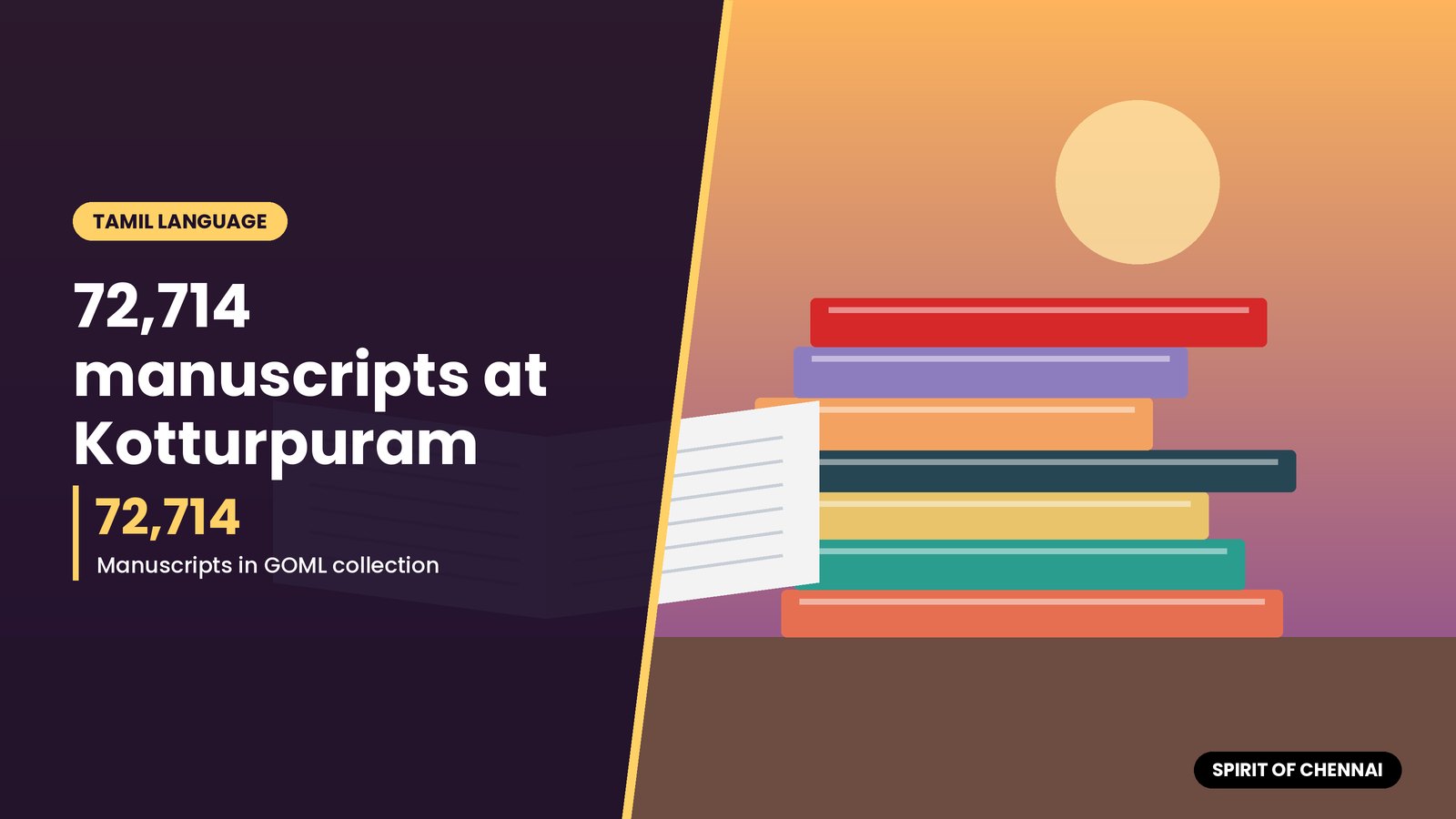
The palm-leaf manuscripts from which many of the Tamil classics were first printed are kept in a small library at No. 2, Arundale Beach Road, Besant Nagar, next to the Kalakshetra Foundation. The Dr. U.Ve. Swaminatha Iyer Library holds 939 manuscripts and 1,832 books collected by the scholar himself, his diaries, and more than 3,000 letters written to him, according to the Tamil Nadu public libraries listing, which gives the phone number as 044-24911697.
For anyone who has read the Silappatikaram or Purananuru in print, this is where that story begins. The library opened in 1943, a year after Swaminatha Iyer’s death, and marked its 75th year in 2018. This guide covers who he was, what the library holds, and how to plan a visit.
Who U.Ve. Swaminatha Iyer was
Swaminatha Iyer, often called Tamil Thatha (grandfather of Tamil), was born on 19 February 1855 at Uthamadhanapuram near Kumbakonam and died on 28 April 1942, DT Next recalled. He spent decades travelling to monasteries and homes in search of palm-leaf copies of old texts, comparing versions and printing corrected editions. His autobiography, En Charithiram, describes how often those searches ended in disappointment.
A speech by the Governor of Tamil Nadu at the library’s 2018 book release, published by Raj Bhavan, lists the milestones:
| Year | Milestone |
|---|---|
| 1880 | Appointed to the Tamil post at Government Arts College, Kumbakonam (16 February) |
| 1887 | Published Seevaga Sindhamani, his first major edition, followed by the Sangam anthology Pattuppattu |
| 1919 | Retired from teaching |
| 1924 to 1927 | Principal, Meenakshi Tamil College, Annamalai University |
| 1932 | Honorary doctorate from the University of Madras |
| 1943 | Library opened, with help from Rukmini Devi of Kalakshetra |
Over about five decades he published roughly 100 books, including editions of the Silappatikaram, Manimekalai and Purananuru, according to the same speech.
Why his editions mattered
Before Swaminatha Iyer, many Sangam poems and the twin epics existed only as scattered palm-leaf copies, often damaged, incomplete or full of copying errors. He gathered several copies of each text, compared them line by line, and printed an edition with notes on the different readings. That method is why later scholars could study classical Tamil from reliable printed books. It is also why his own manuscripts are valuable today: they are the evidence behind those first editions, and scholars still return to them to check a reading.
What the library holds
- Manuscripts: palm-leaf and paper manuscripts handed over by his son, Kalyanasundara Iyer, so that the collection would stay together. The public libraries page counts 939.
- Letters: more than 3,000 letters to Swaminatha Iyer from teachers, editors, students, patrons and foreign scholars, including G.U. Pope and Maraimalai Adigal. A volume of these letters, compiled by A.R. Venkatachalapathy, was released in July 2018.
- Diaries kept by Swaminatha Iyer.
- Books: 1,832 books he collected himself, plus a wider Tamil literature collection; the 2018 speech put the library’s holdings at more than 33,000 books.
- Rare printed books and letters dating from 1923 onwards.
The library received a grant of Rs 17.30 lakh in 2016-17, the public libraries listing says, and its valuable material is being digitised.
Digitisation of its palm leaves
The state’s Tamil Virtual Academy received Rs 105 lakh in 2017-18 to digitise and catalogue palm-leaf manuscripts at this library and two other Chennai institutions, the IT department’s scheme list shows. In 2019 the Tamil Development Department said more than 2.5 lakh pages from these collections had been digitised in a year, DT Next reported. Digitised material can be looked for on the Tamil Digital Library run by the Tamil Virtual Academy before you travel to Besant Nagar.
Planning a visit
- Call first on 044-24911697. Opening hours are not published online, and staff numbers are small.
- Say what you need. Researchers looking at a specific manuscript or letter should name it so staff can retrieve it.
- Combine with Kalakshetra. The library is beside the Kalakshetra campus on Arundale Beach Road, a short walk from Elliot’s Beach.
- Ask about publications. The library has issued its own books, including the 2018 letters volume with the University of Madras.
Photography of manuscripts generally needs permission. Ask before you take out a phone. Students from nearby colleges who want to see palm leaves for the first time should go in a small group with a teacher’s letter, which makes it easier for staff to plan the visit.
Quick answers
Where is the U.Ve. Swaminatha Iyer Library?
No. 2, Arundale Beach Road, Besant Nagar, Chennai 600090, near Kalakshetra.
When was it founded?
In 1943, a year after Swaminatha Iyer died in April 1942.
What can I see there?
His manuscripts, books, diaries and over 3,000 letters he received. Call ahead to arrange access.
Are its manuscripts online?
Part of the palm-leaf collection was digitised under a state scheme from 2017-18; check the Tamil Digital Library.
Information checked against official sources on 18 October 2026. Fees, dates and rules can change; confirm on the linked official pages before acting.
Sources
- Dr. U.Ve. Swaminatha Iyer Library, Chennai (Tamil Nadu Public Libraries)
- Governor’s address at book release, Dr. U.V. Swaminathaiyer Library and University of Madras, 12 July 2018 (Raj Bhavan, Tamil Nadu)
- TVA Schemes: palm-leaf manuscript digitisation (Information Technology Department, Government of Tamil Nadu)
- Those were the days: U Ve Swaminatha Iyer, scholar who re-ignited the Tamil renaissance (DT Next)
- Over 2.5 lakh pages of Tamil manuscripts digitised in a year (DT Next)