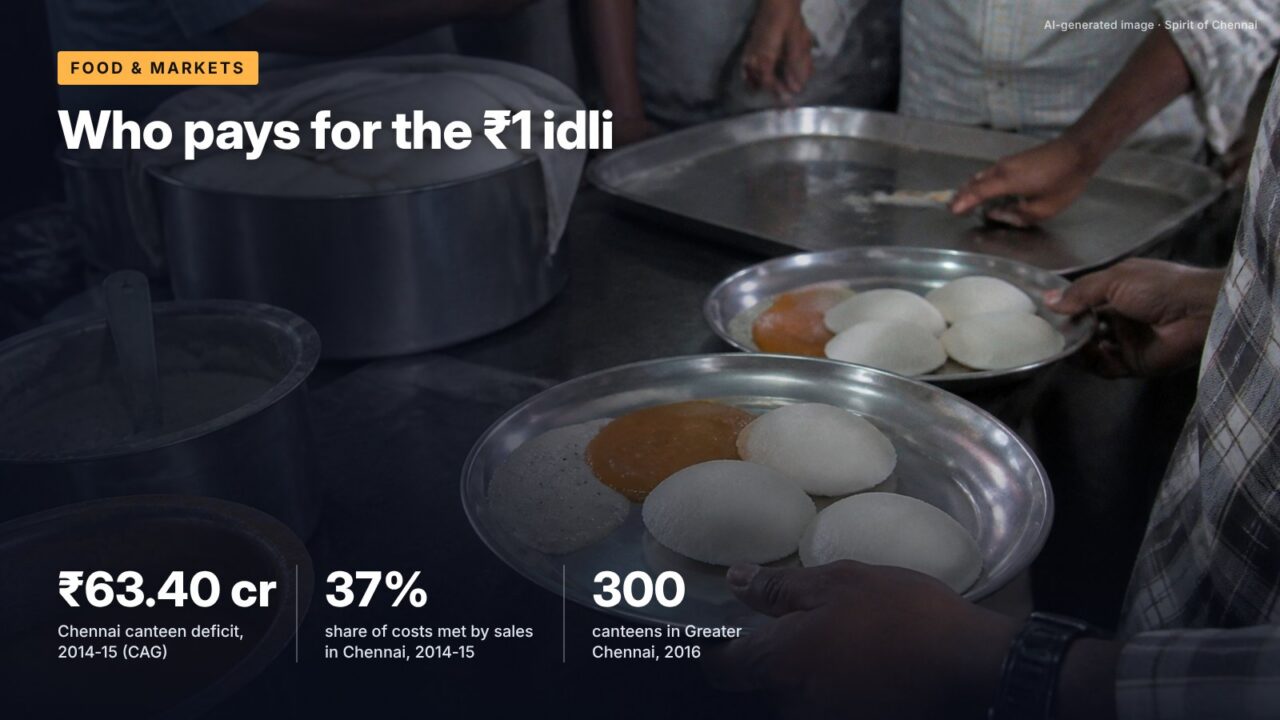
Amma Unavagam’s cheap idlis are paid for mostly by Chennai’s municipal budget, not by the state. The only full audit of the canteens’ books, by the Comptroller and Auditor General, shows how fast that gap grew and what the auditor found in the purchasing.
The numbers
In 2014-15, Amma Unavagam canteens run by the Corporation of Chennai took in ₹37.56 crore from customers and spent ₹100.96 crore, leaving a deficit of ₹63.40 crore, according to Chapter 6 of the CAG compliance audit report on local bodies for Tamil Nadu (Report 3 of 2016). Sales covered about 37% of costs that year (₹37.56 crore divided by ₹100.96 crore), down from about 55% in 2013-14, the canteens’ first year.
The auditor did not question the canteens’ purpose. Its report records that they helped people with little money and gave women’s self-help groups a living, and that all the canteens held FSSAI certification. Its concern was how the scheme was planned, budgeted and bought for, and who carried the cost.
How the canteens began
The Corporation proposed 200 tiffin centres in February 2012. The state government approved them in January 2013 and they were renamed Amma Canteens in March 2013. The Corporation opened 200 between February and April 2013, one per ward, without a survey to identify where demand was greatest, the auditor noted. The model spread to seven government hospitals in Chennai in November 2013, to nine other corporations in May 2013, and to 160 municipal-area centres in September 2014.
By 2016 the Municipal Administration and Water Supply Department policy note for 2016-17 counted 300 canteens in Greater Chennai (293 at various locations and seven in government hospitals) and 247 in other corporations and municipalities, 547 in all, with 107 more planned in the city. It listed idli at ₹1, pongal and variety rice at ₹5, curd rice at ₹3 and an evening meal of two chapathis with dal at ₹3, and estimated that about 3 lakh people ate at the city’s canteens every day.
The deficit in the books
| Corporation | Year | Receipts (₹ cr) | Expenditure (₹ cr) | Deficit (₹ cr) |
|---|---|---|---|---|
| Chennai | 2013-14 | 30.53 | 55.58 | 25.05 |
| Chennai | 2014-15 | 37.56 | 100.96 | 63.40 |
| Coimbatore | 2014-15 | 1.67 | 3.62 | 1.95 |
| Tiruchirappalli | 2014-15 | 1.17 | 2.72 | 1.55 |
| Tirunelveli | 2014-15 | 1.31 | 3.32 | 2.01 |
Source: Comptroller and Auditor General of India, Report 3 of 2016 (Local Bodies, Tamil Nadu), Chapter 6, Table 6.1
Chennai’s deficit more than doubled in a year while receipts rose by about a quarter. With around 207 canteens in the city at the time (200 ward canteens and seven in hospitals), the 2014-15 deficit works out to roughly ₹30 lakh per canteen. That is an approximation from the audit’s totals, since canteens opened at different dates.
The audit’s central financial point was that the state gave no budgetary support except rice supplied at ₹1 a kilo. The corporations bore the difference, the expenditure was unbudgeted, and the canteen deficits added to the corporations’ overall deficits. Each corporation also recorded the transactions differently, because there were no state or Commissionerate guidelines for the accounts.
It’s often said Amma canteens are funded from the state budget.
The record shows In the period audited, the state’s only support was rice at ₹1 a kilo; the CAG found that the corporations met the rest of the cost from their own funds. The government’s reply said each canteen had received ₹25 lakh from the Infrastructure Gap Filling Fund, but the auditor found no documents for this.
What the auditor found in the purchasing
Most of the money-specific findings concern how food and equipment were bought. Test checks covered four Chennai zones (V, VIII, IX and X) and three other corporations, for 2013-14 and 2014-15.
| Finding (CAG paragraph) | Amount |
|---|---|
| Dal and oil bought at open-market prices (6.1.8) | ₹2.78 crore avoidable |
| Chappati machines that failed trials, money not refunded (6.1.9.1) | ₹1.33 crore |
| Wheat flour bought at ₹38 a kilo, bypassing the grinding procedure (6.1.7) | ₹30.85 lakh excess |
| Wheat bought at ₹17.25 a kilo instead of ₹7.50 (6.1.6) | ₹17.69 lakh extra |
| 52 extra self-help group members in Zone X at ₹300 a day (6.1.9.3) | ₹56.94 lakh |
| Temporary advances not adjusted in test-checked Chennai zones (6.1.10) | ₹6.04 crore |
Source: CAG Report 3 of 2016 (Local Bodies, Tamil Nadu), Chapter 6, paragraphs as listed
The auditor also found that the Corporation’s 2013 proposal for a separate department of 111 staff had not been approved by May 2015, so the canteens ran on staff borrowed from the health, revenue and engineering wings. Of the temporary advances, ₹99.94 lakh had been pending for over two years against a three-month rule.
Self-help group members the government said were engaged per canteen, in arguing the provident fund law did not apply; the auditor rejected this because the corporations employed more than 20 people.
Who the subsidy reaches
The audit pointed out that subsidised food was sold to everyone, not only to daily-wage workers and the poor for whom the scheme was meant. The government replied that the scheme was social welfare rather than commercial, and that data on the urban poor already existed; the auditor said no documentary evidence of this was produced. The 2016-17 policy note describes the target group as slum residents, daily-wage workers, auto drivers and elders, but the canteens sell to anyone at the counter.
That design choice is the scheme’s main cost driver. Any rise in footfall, from whatever income group, adds to the deficit, because prices are fixed and below cost.
What has not been audited since
No later audit of the canteens’ accounts appears in the public record we examined. The Local Fund Audit consolidated report for 2021-22 on urban local bodies contains no paragraph on Amma Unavagam. Successive governments have since announced repair and upgrade drives for the canteens, but those announcements have not been matched by a published account of running costs.
The canteens remain a Corporation function: the Greater Chennai Corporation website links the scheme’s government order, and the Corporation’s location data for the canteens, as of May 2023, is republished on the OpenCity data portal.
What this means for you
- Every plate at an Amma Unavagam is subsidised from the Corporation’s general budget, which also pays for roads, drains and schools.
- Prices are fixed below cost, so the gap per plate widens whenever food or wage costs rise.
- Complaints about a canteen go to the Corporation, which runs them through its zones.
- The most detailed public account of the scheme’s costs is still the CAG’s 2016 report; ask your councillor for the canteen figures in the Corporation’s budget.
What to watch
Pending
Whether the Corporation’s budget documents show a separate line for canteen income and spending, which the CAG said was missing.
Pending
Any fresh CAG or Local Fund Audit paragraph on the canteens, the first since the 2013-15 audit.
Checked against official sources on 23 October 2026. Figures and rules change; confirm on the linked official pages before relying on them.
Sources
- CAG Report 3 of 2016, Local Bodies, Government of Tamil Nadu, Chapter 6: Compliance Audit (Amma Canteens)
- Policy Note 2016-17, Municipal Administration and Water Supply Department, Government of Tamil Nadu
- Consolidated Audit Report 2021-22, Part I (Urban Local Bodies), Local Fund Audit Department, Tamil Nadu
- Greater Chennai Corporation, official website
- Amma Unavagam locations, Greater Chennai Corporation data, May 2023 (OpenCity data portal)