Tamil Nadu tests far more food than most states and takes more cases to adjudication than almost any of them. Seven years of figures given to Parliament show how enforcement has grown, why one year looks odd, and where the cases go.
The numbers
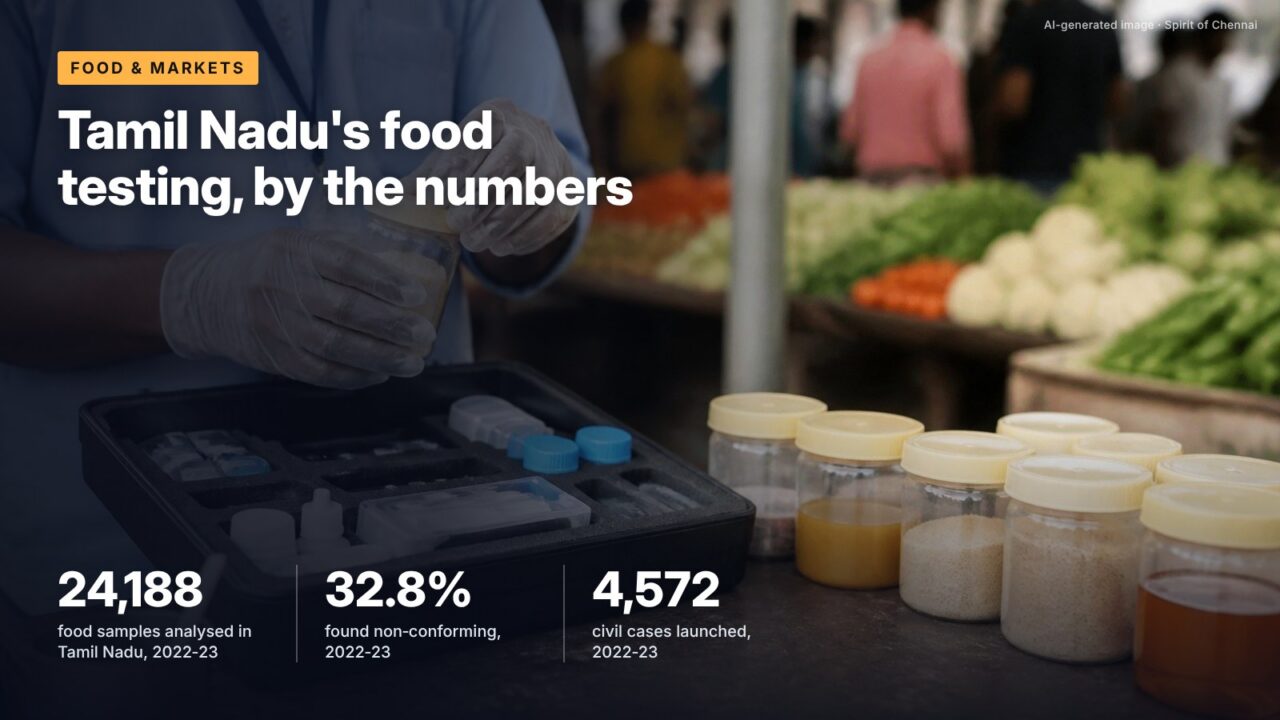
Tamil Nadu’s food safety officers had 24,188 samples analysed in 2022-23, and 7,924 of them, or 32.8%, failed to conform to standards, according to a Lok Sabha answer of 15 December 2023. The state launched 4,572 civil cases and 732 criminal cases that year. In 2016-17 the state analysed only 3,022 samples, so the volume has risen about eightfold in six years.
Among large states, only Uttar Pradesh analysed more samples in 2022-23. The share found non-conforming in Tamil Nadu has been strikingly stable, at around a third in most years, with one large exception that says more about record-keeping than about food.
How enforcement is organised
Enforcement under the Food Safety and Standards Act, 2006 lies primarily with the states. Tamil Nadu set up its machinery through four orders published in the Tamil Nadu Government Gazette Extraordinary No. 103 of 20 April 2012: G.O. Ms. No. 148 named the Commissioner of Food Safety, No. 149 made the District Revenue Officer of each of the then 32 districts the Adjudicating Officer, No. 150 appointed Food Analysts for government laboratories at Guindy, Thanjavur, Madurai, Palayamkottai, Salem and Coimbatore, and No. 151 appointed 544 Food Safety Officers with statewide jurisdiction.
A failed sample can go down two roads. Offences punishable only with a penalty go to the Adjudicating Officer under section 68 of the Act, which is the civil route. Offences that carry imprisonment go to special courts, or ordinary criminal courts where none exist, as a Lok Sabha answer of 6 August 2021 set out.
Seven years of Tamil Nadu figures
| Year | Samples analysed | Non-conforming | Share | Civil cases launched | Criminal cases launched |
|---|---|---|---|---|---|
| 2016-17 | 3,022 | 970 | 32.1% | 617 | 244 |
| 2017-18 | 7,383 | 2,461 | 33.3% | 825 | 496 |
| 2018-19 | 5,730 | 2,601 | 45.4% | 1,718 | 666 |
| 2019-20 | 10,528 | 3,155 | 30.0% | 1,779 | 857 |
| 2020-21 | 10,766 | 3,443 | 32.0% | 1,463 | 557 |
| 2021-22 | 16,363 | 1,033 | 6.3% | 2,745 | 837 |
| 2022-23 | 24,188 | 7,924 | 32.8% | 4,572 | 732 |
Source: Ministry of Health and Family Welfare, Lok Sabha Unstarred Questions 3357 (12 July 2019), 2901 (12 March 2021) and 2236 (15 December 2023), annexures; shares calculated
The share column is the non-conforming count divided by samples analysed. Two years stand out. In 2018-19 nearly half the samples failed, while the number tested fell. In 2021-22 the share collapsed to 6.3% even though the state launched more civil cases than ever, 2,745. Cases can be launched on samples taken in an earlier year, which the 2021-22 annexure acknowledges by splitting decided cases between previous-year and current-year samples. The same table shows Karnataka, Telangana and Punjab reporting zero non-conforming samples that year, which points to a reporting change rather than a sudden improvement in food.
How Tamil Nadu compares
| State | Samples analysed | Non-conforming | Share | Criminal cases decided |
|---|---|---|---|---|
| Uttar Pradesh | 30,140 | 18,108 | 60.1% | 251 |
| Tamil Nadu | 24,188 | 7,924 | 32.8% | 678 |
| Gujarat | 14,562 | 978 | 6.7% | 24 |
| Maharashtra | 11,077 | 1,340 | 12.1% | 5 |
| Kerala | 8,533 | 1,362 | 16.0% | 33 |
| Karnataka | 3,416 | 322 | 9.4% | 15 |
Source: Ministry of Health and Family Welfare, Lok Sabha Unstarred Question 2236, 15 December 2023, Annexure III (2022-23)
Tamil Nadu decided 678 criminal cases in 2022-23, against 732 launched, which is the clearest sign in these tables that cases are moving through courts. Maharashtra decided five. The comparison has limits: states choose what to sample, and a state that targets suspect products will report a higher failure rate than one that samples widely.
It’s often said Tamil Nadu’s food must be worse than other states’ because more of its samples fail.
The record shows The state tests far more than most: in 2022-23 it analysed more samples than Kerala, Maharashtra and Karnataka combined. Failure rates depend on how samples are chosen; the 2021 Lok Sabha answer distinguishes enforcement samples, lifted on suspicion, from surveillance samples. A high rate partly reflects targeting.
The national picture
Nationally, food testing has grown more slowly. The July 2019 answer counts 78,340 samples analysed across India in 2016-17, of which 23.4% did not conform, and 99,353 in 2017-18, with 24.4% failing. Tamil Nadu’s 7,383 samples in 2017-18 were about 7% of the national total; by 2019-20 its 10,528 samples were about 9% of the 1,18,775 analysed nationwide, according to the March 2021 answer.
The national failure rate has stayed in a band of about a quarter, while Tamil Nadu’s has run nearer a third. Uttar Pradesh reports the highest rates, above 60% in 2022-23, and the largest civil penalty totals: ₹33.55 crore of the national ₹57.77 crore in civil penalties raised in 2019-20, against Tamil Nadu’s ₹1.67 crore.
Penalties, convictions and the backlog
Earlier answers report convictions and penalty amounts. Tamil Nadu recorded 896 convictions in 2017-18 and penalties of ₹2.25 crore, according to the answer of 12 March 2021. For 2018-19 the same answer gives penalties of ₹50.12 lakh, while the July 2019 answer prints ₹5.01 crore for the same year and state. The digits match except for one place, so one of the two is likely a printing error; neither answer says which.
For 2019-20 the state reported civil penalties of ₹1.67 crore and criminal penalties of ₹73.78 lakh. Cases also pile up. As of 31 March 2021, 1,583 civil cases and 1,800 criminal cases were pending in Tamil Nadu, according to the 2021 answer, which drew on the state’s annual report for 2020-21.
Released by FSSAI to states and laboratories under its food-testing scheme between 2016-17 and 2022-23, nationally, according to the December 2023 answer; the scheme also funds mobile Food Safety on Wheels labs.
What this means for you
- A sample that fails does not automatically mean prosecution: most cases in Tamil Nadu take the civil route, ending in a penalty fixed by the District Revenue Officer.
- If you complain about a shop or eatery, the case your complaint starts may take years; over 3,300 were pending in March 2021.
- Year-to-year swings in these tables often reflect reporting changes, so look at several years before drawing conclusions.
- Six government food laboratories were named in the 2012 orders, including one at Guindy in Chennai.
What to watch
Pending
State-wise figures for 2023-24 and later, which have not yet appeared in a Parliament answer we could open.
Pending
A correction or clarification of the conflicting 2018-19 penalty figure for Tamil Nadu.
Checked against official sources on 23 October 2026. Figures and rules change; confirm on the linked official pages before relying on them.
Sources
- Lok Sabha Unstarred Question 2236, Substandard Food Samples, Ministry of Health and Family Welfare, 15 December 2023
- Lok Sabha Unstarred Question 2901, Food Adulteration Cases, Ministry of Health and Family Welfare, 12 March 2021
- Lok Sabha Unstarred Question 3357, Food Adulteration, Ministry of Health and Family Welfare, 12 July 2019
- Lok Sabha Starred Question 264, Fast Track Court for Food Adulteration Complaints, 6 August 2021
- Tamil Nadu Government Gazette Extraordinary No. 103, 20 April 2012 (G.O. Ms. Nos. 148-151, Health and Family Welfare), Food Safety and Drug Administration Department