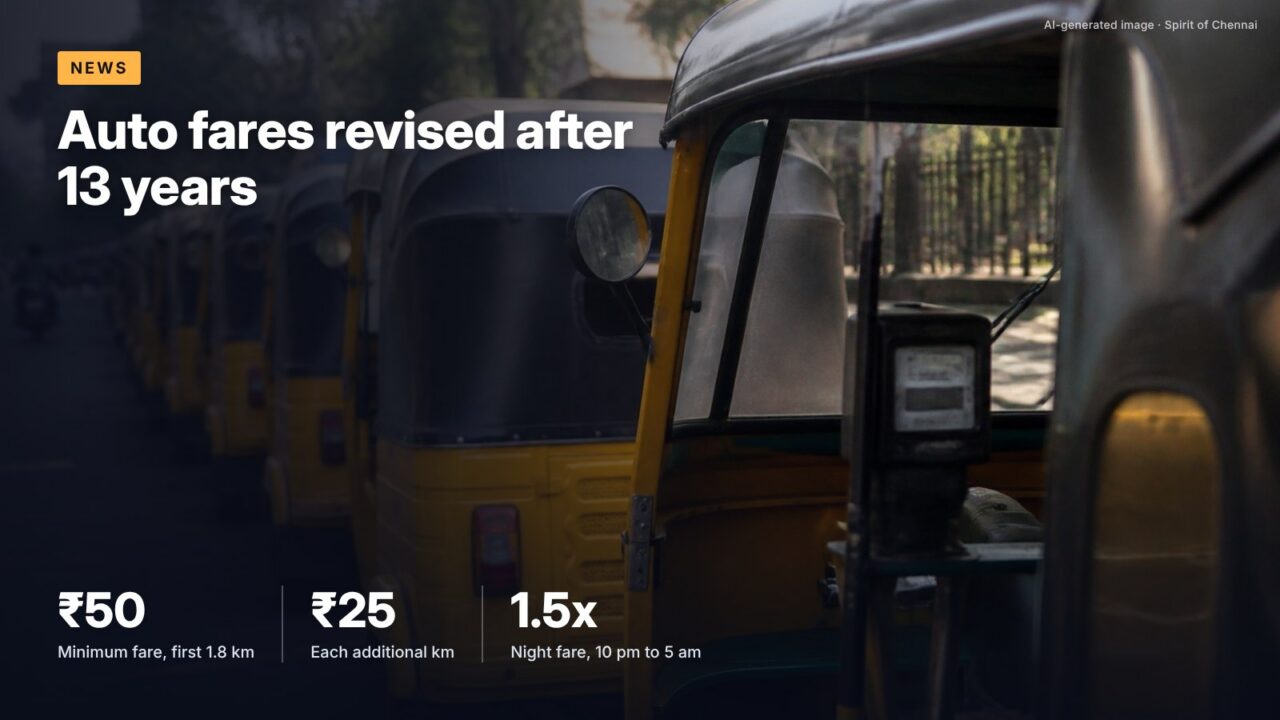
Tamil Nadu has notified new auto-rickshaw fares for the first time since 2013: ₹50 for the first 1.8 km and ₹25 for every kilometre after that, with night rides at one and a half times the day fare.
The numbers
The Home (Transport-I) Department published the revised rates in an extraordinary issue of the Tamil Nadu Government Gazette on Tuesday 27 October 2026, as reported by DT Next the same day. The notification directs the State Transport Authority and the regional transport authorities to enforce the rates under the Motor Vehicles Act, 1988. It doubles the minimum fare that had stood on paper in Chennai for 13 years.
Whether a trip is metered or negotiated, the new table gives passengers and drivers a current legal reference point. It is also the first step in a sequence the government has laid out: fares first, then meters, then rules for app-based aggregators.
The new fare table
The notification sets five components. The base fare covers the first 1.8 km. After that, the per-kilometre rate applies. Waiting time is charged by the minute. Night travel between 10 pm and 5 am is charged at 1.5 times the regular fare. Separate, higher rates apply on ghat (hill) roads, with a base fare of ₹60 and ₹30 for each additional kilometre, which DT Next described as 1.2 times the plains fare.
| Component | 2013 (Chennai Metropolitan Area) | October 2026 (Tamil Nadu) |
|---|---|---|
| Minimum fare | ₹25 for first 1.8 km | ₹50 for first 1.8 km |
| Each additional km | ₹12 | ₹25 |
| Waiting | ₹3.50 per 5 minutes | ₹1 per minute |
| Night | Extra 50%, 11 pm to 5 am | 1.5 times fare, 10 pm to 5 am |
| Ghat roads | Not specified | ₹60 base, ₹30 per km |
Sources: Tamil Nadu Government Gazette Extraordinary No. 240, 25 August 2013 (G.O. Ms. No. 611, Home (Transport-III)); DT Next report on the 27 October 2026 notification
How it compares with 2013
The 2013 fares were fixed by G.O. Ms. No. 611, Home (Transport-III), dated 25 August 2013, for contract-carriage autos in the Chennai Metropolitan Area. That order set ₹25 for the first 1.8 km, ₹12 for each kilometre after that, a detention charge of ₹3.50 for every five minutes of waiting and an extra 50% between 11 pm and 5 am. Other districts got their fares the following year. The State Transport Authority’s website still lists G.O. 611 as the auto-rickshaw fare order.
The new base fare and per-km rate are both roughly double the 2013 figures. The waiting charge works out to ₹1 a minute against the old 70 paise a minute (₹3.50 divided by five). The night window now starts an hour earlier, at 10 pm.
What a 5 km daytime ride costs on the new table: ₹50 for the first 1.8 km plus 3.2 km at ₹25. The same trip came to about ₹63 on the 2013 table.
A 10 km trip would be ₹50 plus 8.2 km at ₹25, or ₹255, before any waiting. At night the same ride would be about ₹383. These are meter fares; anything negotiated off the meter is a private bargain the notification does not cover.
It’s often said auto fares in Chennai were never officially fixed, so any price is fair.
The record shows fares have been notified in the gazette since at least 1981. The 2013 notification explicitly replaced earlier orders from 1981 and 2007, and the 2026 table replaces it in turn.
How the revision came about
Transport Minister A. Vijay Tamilan Parthiban told the Assembly during the demand for grants debate in September that a special committee had been formed on 5 August 2026 and had submitted its fare recommendation on 21 August, as reported by DT Next on 9 September. He said the revision reflected rising fuel and maintenance costs, a long-standing demand of owners and drivers.
The fare is fixed by direction under the Motor Vehicles Act, the same route the department used in February 2026 when it revised mini-bus fares through a gazette notification. That is why the rates take legal effect through publication, and why enforcement falls to the regional transport offices.
Meters and app aggregators
Two pieces are still pending. The minister said in September that fare meters would be installed in all autorickshaws once the fares were revised; no date or specification for the meters has been announced. He also said Tamil Nadu would roll out its proposed Motor Vehicles Aggregator Rules, drafted under Section 93 of the Motor Vehicles Act and based on the Union Road Transport Ministry’s 2025 guidelines, only after fares were fixed for different vehicle classes, including motor cabs and maxi cabs.
Until those rules are in force, the fares shown in ride-hailing apps for autos are set by the platforms, not by this notification. The new government table is the yardstick against which the state’s aggregator rules are expected to be written, so the gap between app prices and the meter fare is likely to be the next point of debate.
How to complain
The notification makes the regional transport authorities responsible for enforcement, so a complaint about overcharging or refusal goes to the regional transport office (RTO) for the area where the auto is registered, or to the traffic police on the spot. Note the auto’s registration number, the time, the pickup and drop points, and the fare demanded. A photograph of the number plate and the meter, if there is one, helps. Fare disputes are easier to pursue when the trip was agreed on the meter rather than on a quoted price.
What this means for you
- From 27 October, the official day fare is ₹50 for the first 1.8 km and ₹25 per km after that. Work out a rough fare before you get in.
- Night fares (10 pm to 5 am) are 1.5 times the day fare. Waiting is ₹1 a minute.
- App prices for autos are not yet bound by the state table, because the aggregator rules have not been notified.
- Keep the registration number and trip details if you plan to complain to the RTO or traffic police.
What to watch
Pending
A government order or notice on mandatory fare meters for all autos, with a deadline for fitting them.
Pending
Notification of the Tamil Nadu Motor Vehicles Aggregator Rules, which will govern app-based auto and cab fares.
Pending
Cab and maxi-cab fare tables, which the minister said would be fixed before the aggregator rules.
Checked against official sources on 29 October 2026. This is a developing story; confirm the latest on the linked official pages.
Sources
- Tamil Nadu Government Gazette Extraordinary No. 240, G.O. Ms. No. 611 Home (Transport-III), auto-rickshaw fares, 25 August 2013 (Government of Tamil Nadu)
- State Transport Authority, Tamil Nadu (Transport Department)
- Tamil Nadu Government Gazette Extraordinary No. 127, G.O. Ms. No. 102 Home (Transport-I), mini bus fare revision, 26 February 2026 (Government of Tamil Nadu)
- Tamil Nadu revises auto fares after 13 years; minimum charge fixed at Rs 50 (DT Next, 27 October 2026)
- Transport min: Tamil Nadu will roll out aggregator rules after fixing fares (DT Next, 9 September 2026)