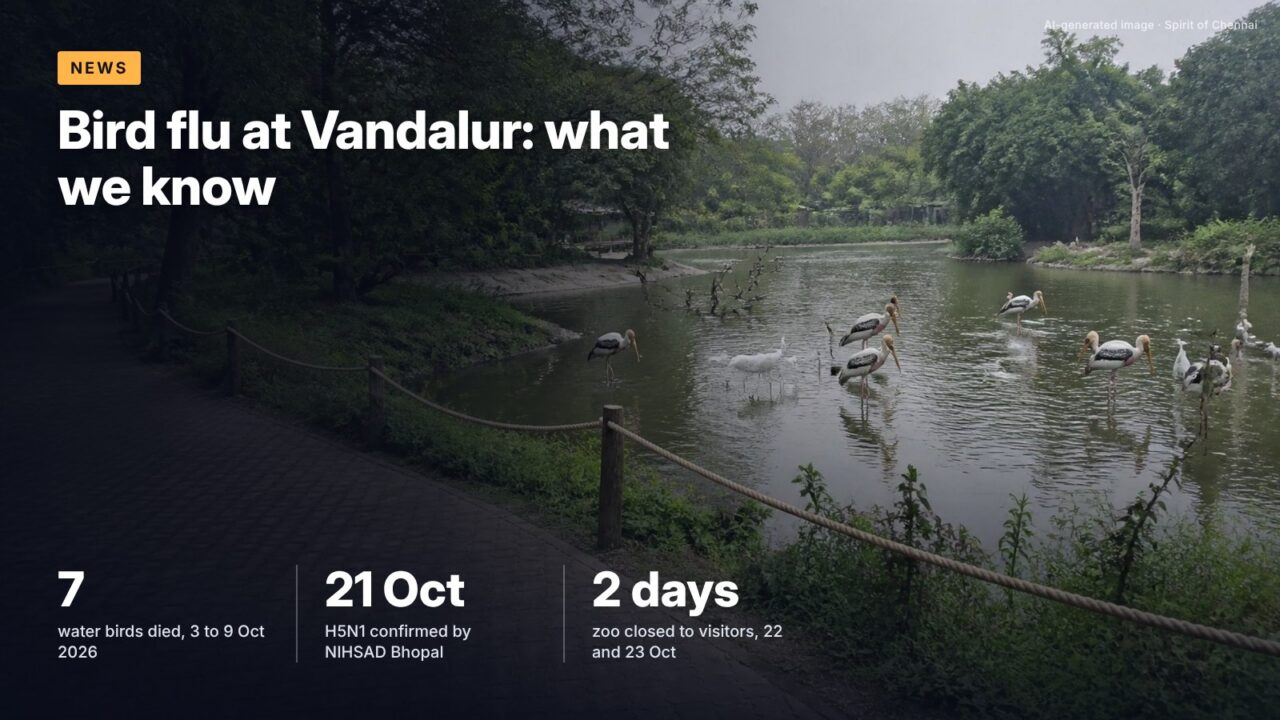
Arignar Anna Zoological Park at Vandalur shut its gates to visitors on 22 and 23 October 2026 after a national laboratory confirmed H5N1 avian influenza in water birds that died in the zoo’s Vedanthangal aviary earlier in the month. Here is what was found, what the national bird flu protocol requires, and what the risk is to people.
The numbers
Seven water birds died in the Vedanthangal birds enclosure, the largest aviary at the Vandalur zoo, between 3 and 9 October 2026. Samples were sent to the National Institute of High Security Animal Diseases (NIHSAD) in Bhopal, which confirmed H5N1 avian influenza on Wednesday 21 October. The zoo director said in a statement that day that the park would close to visitors on Thursday 22 and Friday 23 October, as reported by DT Next (PTI) on 22 October.
The director’s statement said no further bird deaths or sickness had been seen since 9 October, and that the enclosure had been cordoned off after the first death. The two-day closure was used for intensive sanitisation, tighter biosecurity and monitoring. Zoo officials told reporters they believed the outbreak inside the aviary may already have run its course.
What died and where
The birds were all wetland species housed together in the walk-through Vedanthangal aviary. The reported list:
| Species | Number that died |
|---|---|
| Painted stork | 4 |
| Grey pelican | 1 |
| Grey heron | 1 |
| Oriental darter | 1 |
| Total | 7 |
Source: Statement of the Director, Arignar Anna Zoological Park, 21 October 2026, as reported by DT Next (PTI), 22 October 2026
Wild water birds are the usual carriers of avian influenza viruses, which is why the national plan asks for wild birds to be kept away from poultry and water supplies. Captive birds in a large walk-through aviary share water and ground, so one infected bird can expose others through droppings.
What H5N1 is
H5N1 is a highly pathogenic strain of influenza A that circulates mainly in birds. In poultry it can kill most of a flock within days. Wild water birds can carry it over long distances. That is why a cluster of unexplained deaths among captive birds is sent for testing at once.
India’s control system rests on a single reference laboratory. Under the Union government’s Action Plan for Prevention, Control and Containment of Avian Influenza (revised 2015), NIHSAD Bhopal confirms each outbreak to the Department of Animal Husbandry, with a copy to the State Chief Secretary. A Rajya Sabha answer of 7 August 2024 says the plan was revised again in 2021 and that culled poultry owners are compensated under the Assistance to States for Control of Animal Diseases scheme, with costs split 50:50 between the Centre and the State.
What the national protocol requires
The action plan draws two rings around a confirmed case. The area within 1 km is the infected zone, which the State can widen in 1 km steps up to 3 km if infection is scattered. The ring from 1 km to 10 km is the surveillance zone, where samples are taken after control work ends. Inside a zoo, wildlife sanctuary or forest area, the plan puts the forest officer in charge of containment, with help from the Animal Husbandry Department.
For poultry outbreaks the plan orders culling of birds in the infected zone, closure of poultry and egg shops within 10 km until sanitisation is complete, and disinfection of premises with sodium hypochlorite or formalin. An area is declared free of the disease only if no new outbreak occurs and post-operation samples test negative for three months. No official notice of culling or a 10 km market closure around Vandalur had been published when this was checked.
Clean tests needed before an area is declared free of avian influenza under the national action plan.
Risk to people
Human infections with H5N1 are rare and almost always follow close, unprotected contact with sick or dead birds or their surroundings. The US Centers for Disease Control and Prevention, in its prevention guidance, says the virus enters through the eyes, nose or mouth, and that the best protection is to avoid touching sick or dead animals, their droppings and litter. It also says properly cooked poultry and eggs are safe, because cooking kills the virus.
India’s action plan protects those most exposed: keepers, cullers and cleaning crews must wear protective kit, including N-95 masks for direct handlers, and the Public Health Department supplies antiviral medicine to exposed staff free of cost. Health teams are to monitor people in the affected area, and anyone with fever after possible exposure should see a doctor and mention the bird contact. This is general public health information; consult a doctor about any symptoms.
It’s often said you can catch bird flu by eating chicken or eggs during an outbreak.
The record shows Cooking poultry and eggs to the proper temperature kills the virus, according to the CDC. The risk lies in handling sick or dead birds without protection, not in eating well-cooked food.
Reopening and the rest of the zoo
News Today reported on 24 October that the zoo was scheduled to resume normal visitor operations on Sunday 25 October, with the affected enclosure still cordoned off. Check the zoo’s official website for the current position before you travel, since sections of the park can stay shut after the main gates reopen.
What this means for you
- Check the zoo’s official website or call its office before a visit; enclosures linked to the outbreak may remain closed even when the park is open.
- Do not touch dead or sick birds anywhere, including crows and pigeons in your street. Report them to the Animal Husbandry Department or your local body instead of handling them.
- Wash hands after visiting aviaries or petting areas, and keep children from touching railings and droppings.
- Well-cooked chicken and eggs are safe. Avoid handling raw poultry with bare hands if you have cuts.
- If you develop fever or breathing trouble after contact with sick birds, see a doctor and mention the exposure.
What to watch
Next three months
Under the national plan, post-operation samples must test negative for three months before the area is declared free of avian influenza.
Pending
Any official report from NIHSAD or the Animal Husbandry Department on testing of other birds at the zoo and of wild birds in the surrounding wetlands.
Monsoon season
Wild bird surveillance under the national plan runs monthly from September to March, the period when migratory water birds arrive in Tamil Nadu.
Checked against official sources on 29 October 2026. This is a developing story; confirm the latest on the linked official pages.
Sources
- Action Plan for Prevention, Control and Containment of Avian Influenza (Revised 2015), Department of Animal Husbandry, Dairying and Fisheries, Government of India
- Rajya Sabha Unstarred Question No. 1823, Combatting Avian Influenza, Ministry of Fisheries, Animal Husbandry and Dairying, 7 August 2024
- Bird flu (H5N1) prevention, US Centers for Disease Control and Prevention
- Arignar Anna Zoological Park, Vandalur (official website)
- Vandalur Zoo closes due to bird flu spread threat, DT Next (PTI), 22 October 2026
- Vandalur zoo to reopen on Sunday after bird flu closure, News Today, 24 October 2026