Tamil Nadu’s electoral rolls go through a Special Summary Revision from 12 November 2026, with 1 January 2027 as the qualifying date. The Chief Electoral Officer’s meeting with parties on 23 October ended in a walkout by nine of them. Here is the official schedule, how to check or fix your entry, and what each side said.
The numbers
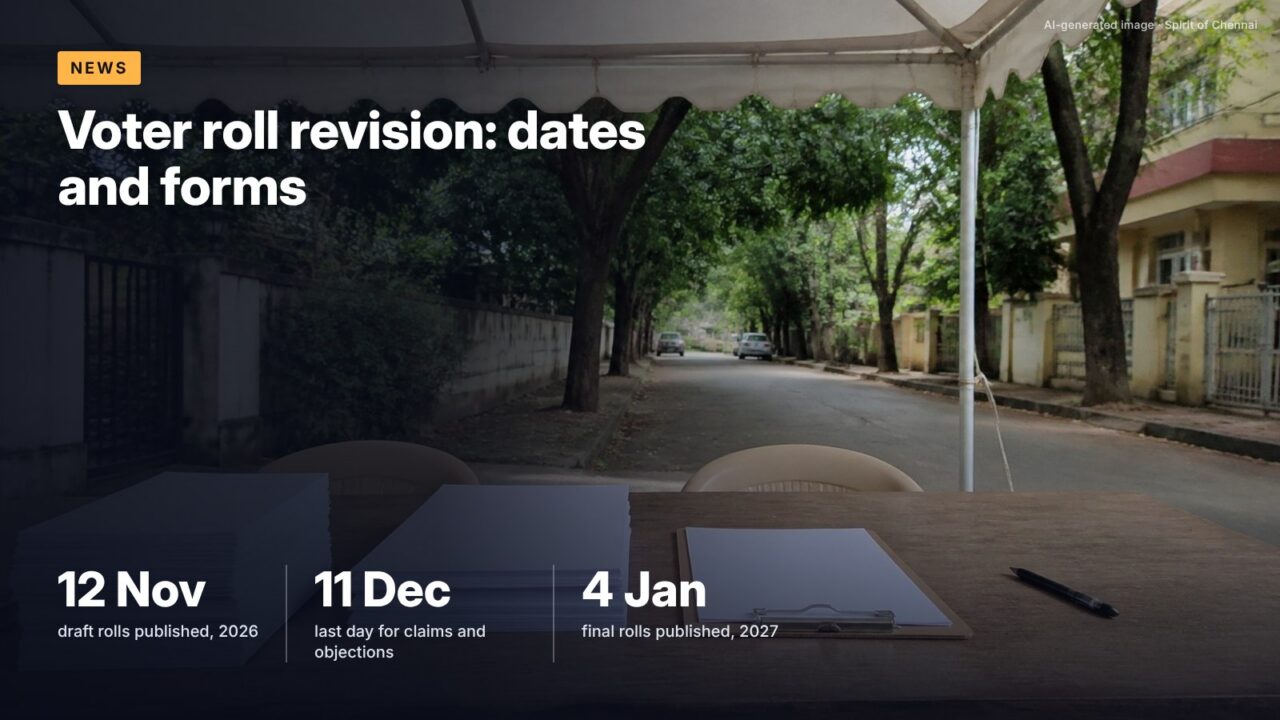
The Election Commission of India ordered a Special Summary Revision (SSR) of electoral rolls in 17 States and Union Territories, including Tamil Nadu, with 1 January 2027 as the qualifying date. According to All India Radio News on 17 October, draft rolls will be published on 12 November 2026, claims and objections will be accepted from 12 November to 11 December, and final rolls will be published on 4 January 2027.
On Friday 23 October, Tamil Nadu’s Chief Electoral Officer, Archana Patnaik, met recognised parties at the Secretariat in Chennai to brief them on the revision. Nine parties, among them the ruling TVK and the opposition DMK, walked out, The News Minute reported on 24 October. They demanded the resignation of Chief Election Commissioner Gyanesh Kumar and said errors from the earlier Special Intensive Revision (SIR) should be corrected first. The BJP, AIADMK and NPP stayed in the meeting.
What a summary revision is
A summary revision is the routine, annual update of the voters’ list. The existing roll is published as a draft, and the public then has a fixed window to file claims (to add a name) and objections (to remove one), along with corrections. Booth Level Officers and Electoral Registration Officers verify applications before the final roll is published. It differs from an intensive revision, such as the SIR that Tamil Nadu went through before the 2026 Assembly election, in which the roll is rebuilt through house-to-house enumeration.
Since amendments that took effect in 2022, explained in a note from the Chief Electoral Officer of Odisha, the law has four qualifying dates a year: 1 January, 1 April, 1 July and 1 October. The annual revision still uses 1 January, but young people who turn 18 on any of the later dates in 2027 can apply in advance during this window and will be enrolled once they qualify.
The schedule
| Stage | Date |
|---|---|
| Qualifying date | 1 January 2027 |
| Draft roll published | 12 November 2026 |
| Claims and objections window | 12 November to 11 December 2026 |
| Final roll published | 4 January 2027 |
Source: Election Commission of India schedule as reported by All India Radio News, 17 October 2026
Which form to use
The forms were rewritten in 2022, so older advice about “Form 8A” or using Form 6 for a change of address is out of date. The current uses, from the Odisha CEO’s note:
| Form | Use it to |
|---|---|
| Form 6 | Enrol as a new voter, including advance applications by those turning 18 |
| Form 6A | Enrol as an overseas Indian elector |
| Form 6B | Link your Aadhaar number to your entry (voluntary) |
| Form 7 | Object to a name, or seek deletion of your own or another entry on grounds such as death or shifting |
| Form 8 | Correct details, shift residence within or across constituencies, replace your EPIC card, or mark a disability |
Source: Chief Electoral Officer, Odisha, press points on amendments to the Registration of Electors Rules
Forms can be filed online at the voters’ service portal (voters.eci.gov.in) or the Commission’s mobile app, or on paper with your Booth Level Officer during the window. Form 7 carries a warning that a false statement is punishable under Section 31 of the Representation of the People Act, 1950. Aadhaar is voluntary: the Odisha note states that not giving it is no ground to refuse enrolment or delete an entry.
Qualifying dates a year since the 2022 amendments: 1 January, 1 April, 1 July and 1 October (CEO Odisha).
The objections, in the parties’ words
The dispute is about the SIR, not the mechanics of the SSR. As reported by The News Minute, TVK’s C.T.R. Nirmal Kumar said the Commission should first rectify the mistakes made in the SIR. The DMK’s I. Paranthaman cited about 74 lakh deletions in Tamil Nadu and asked how eligible voters would be re-enrolled. Former VCK MLA S.S. Balaji said the Commission had not disclosed how many ineligible names the SIR found or how.
The AIADMK’s D. Jayakumar, who stayed, said about 97 lakh entries had been affected and called for a review of deletions, while describing walkouts as a democratic right. The DMK said it would submit a memorandum to the President. No response from the Chief Electoral Officer to the walkout was reported. These figures are the parties’ claims and have not been set against an official count in this article.
It’s often said if your name was removed in the SIR, you have to wait for the next election cycle.
The record shows The summary revision is the normal route back: anyone who is eligible and not on the roll can file Form 6 during the 12 November to 11 December window, or later in the year against the next qualifying date.
What this means for you
- From 12 November, search the draft roll for your name and check your polling station, spelling and age.
- If you are missing, file Form 6. If details are wrong or you have moved, file Form 8. Keep the acknowledgement number to track your application.
- If you turn 18 on 1 April, 1 July or 1 October 2027, you can apply in advance in this window.
- Use Form 7 only for genuine deletions such as a death in the family. False objections are an offence.
- Applications are free. Your Booth Level Officer can accept paper forms.
What to watch
12 November 2026
Draft rolls published across Tamil Nadu; claims and objections open the same day.
11 December 2026
Last date to file claims, objections and corrections for this revision.
4 January 2027
Final electoral rolls published.
Checked against official sources on 29 October 2026. This is a developing story; confirm the latest on the linked official pages.
Sources
- Amendments to electoral roll law and forms: press points (four qualifying dates, revised Forms 6, 6B, 7 and 8), Chief Electoral Officer, Odisha
- Form 7: Application for objection to inclusion or deletion of name in electoral roll, Chief Electoral Officer, Delhi
- ECI orders Special Summary Revision of electoral rolls in 14 States and three UTs, All India Radio News, 17 October 2026
- TVK, DMK walk out of meeting over SIR deletions, The News Minute, 24 October 2026