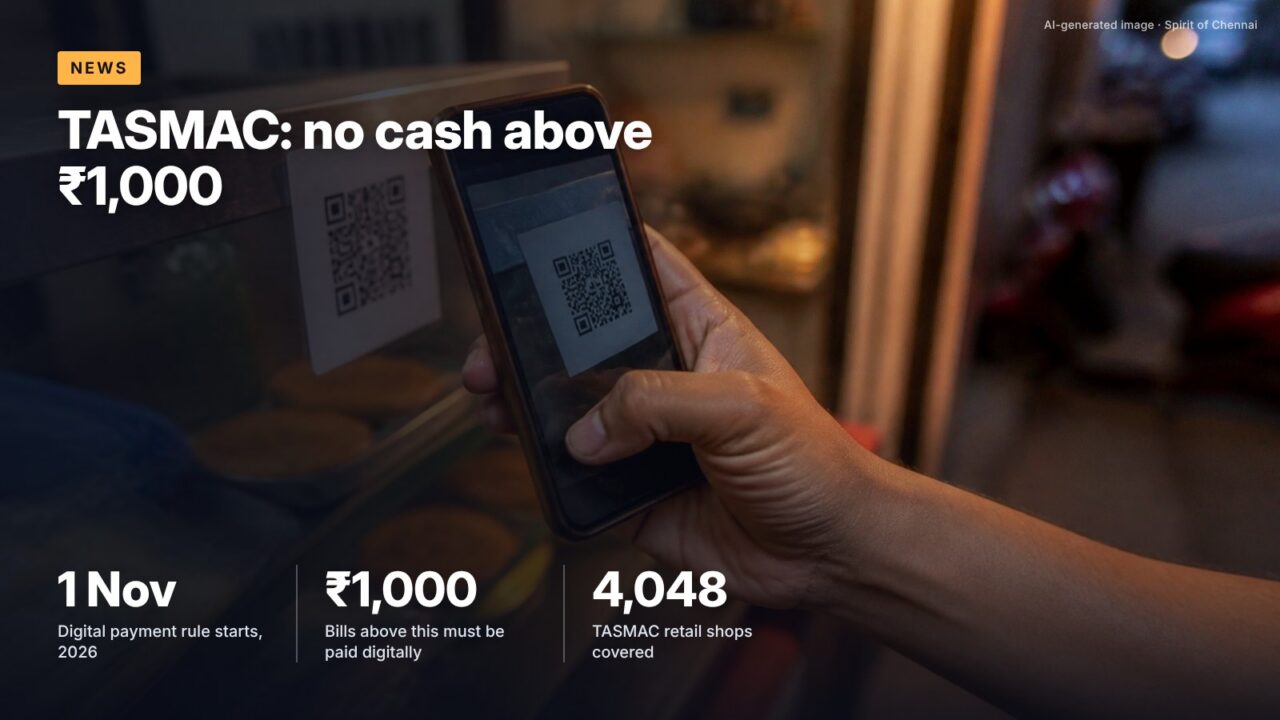
From Sunday 1 November 2026, any purchase above ₹1,000 at a TASMAC liquor shop in Tamil Nadu must be paid by UPI, debit card or credit card. Cash stays allowed for smaller bills, but the cash limit is set to fall to ₹500 from 1 January 2027.
The numbers
The Tamil Nadu State Marketing Corporation (TASMAC), the state-owned company that runs every retail liquor shop in Tamil Nadu, issued the instruction in a circular to its district managers on Monday 26 October 2026. DT Next reported the circular the same day, naming the managing director, K. Nanthakumar, as its author. The rule applies to all 4,048 TASMAC retail outlets.
A senior official told the Press Trust of India, in a report carried by ThePrint on 27 October, that UPI and cards were already accepted at the shops but that most transactions were still in cash. The circular is designed to change that for larger bills and, according to officials, to deal with complaints of bottles being sold above the printed price.
What the circular says
From 1 November, a single purchase worth more than ₹1,000 can be paid only by UPI, debit card or credit card. Purchases of ₹1,000 or less may still be paid in cash or digitally. All digital payments must go through point-of-sale (POS) machines linked to TASMAC’s designated bank account.
Staff are barred from collecting money through personal UPI IDs, personal QR codes or their own bank accounts. A bill must be issued for every sale, and the amount charged must match the maximum retail price (MRP). Bottles are to be handed over only after the payment has been confirmed on the shop’s POS machine. PTI reported that violations will attract severe disciplinary action, without giving details.
The toll-free number TASMAC has given for customers to report overcharging, according to DT Next’s report of the circular.
Why TASMAC says it is doing this
The reasons given in the circular, as reported, fall into two groups. The first is cash handling. Officials cited the risk of carrying large sums from shops to banks, accounting mismatches, counterfeit notes and the workload on shop staff. The second is pricing: the state has received repeated complaints of liquor being sold above MRP. A digital payment leaves a timestamped record of the amount paid, which can be matched against the bill and the stock sold, and the money goes straight into the corporation’s account.
This builds on systems already in place. The Prohibition and Excise Department’s policy note for 2023-24 said POS machines had been installed in all retail shops so that customers could pay electronically. The 2024-25 policy note repeated this and described a track-and-trace project with RailTel to follow each bottle from distillery to shop sale, with real-time stock and sales data visible at the corporate office. It also reported IP CCTV cameras in 3,000 shops.
It’s often said TASMAC shops only take cash.
The record shows card machines have been in every shop for years. The 2023-24 policy note recorded POS machines in all retail vending shops. What changes on 1 November is that digital payment becomes compulsory above ₹1,000.
The shops and the money
The number of shops has fallen steadily. The policy notes give 5,329 retail vending shops as on 31 March 2023 and 4,829 as on 31 March 2024; the circular now covers 4,048. Liquor is one of the state’s biggest revenue sources, through excise duty and value added tax (VAT) collected on TASMAC sales.
| Year | Excise revenue | VAT (sales tax) | Total |
|---|---|---|---|
| 2021-22 | ₹8,236.60 cr | ₹27,814.05 cr | ₹36,050.65 cr |
| 2022-23 | ₹10,422.47 cr | ₹33,698.66 cr | ₹44,121.13 cr |
| 2023-24 | ₹10,774.28 cr | ₹35,081.39 cr | ₹45,855.67 cr |
Source: Home, Prohibition and Excise Department, Policy Note 2024-25 (2023-24 figures subject to reconciliation)
At that scale, even a small share of sales made outside official billing matters, which is why the corporation is pairing the payment rule with audits and inspections rather than relying on the counter alone.
How it will work at the counter
District managers have been told to make sure POS machines and network connections are working before 1 November, and to train staff in digital transactions and in reconciling the day’s takings. Each shop must display a notice board, 2 feet by 3 feet, explaining the rules. Shop supervisors are to report complaints and violations, including overcharging, without delay. District managers and head-office officials will inspect shops, PTI reported weekly reviews of the transition, and DT Next reported monthly monitoring reports on implementation.
For a customer the sequence will be simple: the bill is raised first, the amount is paid on the shop’s POS machine, and the bottles are handed over once the payment shows as received. The circular does not say what happens if a machine or the network fails; that is why district managers have been told to check connectivity in advance. Because every sale needs a bill, the records inspectors check will show how purchases are being paid.
The step to ₹500
The circular also sets a second stage. From 1 January 2027, the threshold for compulsory digital payment is to drop to ₹500, which will bring a much larger share of everyday purchases under the rule. TASMAC has not said whether the date could move if the first phase runs into problems with connectivity or machines.
What this means for you
- From 1 November, carry a UPI app or a card if your bill will cross ₹1,000. Cash will not be accepted above that.
- Pay only through the shop’s POS machine, never a staff member’s personal QR code, UPI ID or account.
- Ask for a bill for every purchase and check the price against the MRP printed on the bottle.
- Report overcharging to TASMAC’s toll-free number, 1800 889 2015, with the shop details and your payment record.
- Expect the same rule to apply to bills above ₹500 from 1 January 2027.
What to watch
1 November 2026
Digital payment becomes compulsory for bills above ₹1,000 at all 4,048 shops.
November and December 2026
Weekly and monthly reviews by district managers and the head office on how the change is working.
1 January 2027
The threshold for compulsory digital payment is scheduled to fall to ₹500.
Checked against official sources on 29 October 2026. This is a developing story; confirm the latest on the linked official pages.
Sources
- Policy Note 2024-25, Prohibition and Excise, Home, Prohibition and Excise Department (Government of Tamil Nadu)
- Policy Note 2023-24, Demand No. 37 Prohibition and Excise (Government of Tamil Nadu)
- Tasmac to make digital payment mandatory for bills above Rs 1,000 from November 1 (DT Next, 26 October 2026)
- TASMAC mandates digital payments for liquor purchases above Rs 1,000 from Nov 1 (PTI via ThePrint, 27 October 2026)